


Scotland. Part 10
Description
This section is from the book "Scotland - John L. Stoddard's Lectures", by John L. Stoddard. Also available from Amazon: John L. Stoddard's Lectures 13 Volume Set.
Scotland. Part 10

Abbotsford, South Front.
One winter's morning, in 1826, a friend arrived at Abbots-ford and found the novelist in great mental agitation. As he approached, Sir Walter said to him: "My friend, give me your hand, mine is that of a beggar"; for, in truth, the publishing house with which the author had been long connected had, through no fault of his, failed with enormous liabilities. From that time on, Scott's life became heroic and his character sublime. If he had chosen to act as many insolvent merchants do, the matter could have been quickly settled, but Scott regarded his pecuniary troubles from the standpoint of honor. He thought that by devoting the rest of his life to his creditors, he could, finally, pay them every farthing that he owed, and he succeeded. But at what a cost! There are few sadder things on earth than the poverty of old age; few more pathetic sights than that of an old man who has lost the fortune, acquired la-boriously through his earlier years, to shelter him in the decline of life and to provide for those most dear to him. For, when the shadows of life's fleeting day are falling eastward, and the hush of evening steals upon the world, it ought to be an old man's privilege to rest; and it is pitiful to see him, then, wearily groping in the twilight for treasures which he should have harvested and garnered in the heat of day. This, however, was exactly what Scott was obliged to do. At the time of the failure he was fifty-five years old, and his obligations amounted to six hundred thousand dollars; yet this enormous sum he earned and paid off in six years, by the unceasing labor of his brain.

The Hall.

The Drawing-Room.
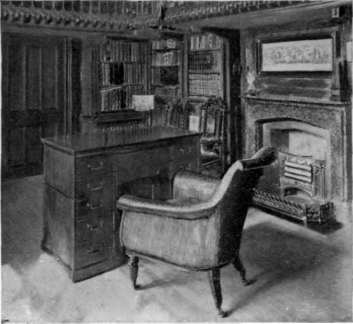
Scott's Study.
But, alas! he gave his life to save his honor. Twelve, fourteen, sixteen hours a day he toiled through those six years of failing strength and premature old age. What had once been a joyous occupation, became at last a struggle similar to that of General Grant, when he kept Death at bay till he had finished dictating his memoirs. At last, in 1832, shortly before his death, he wrote: "I think I shall never walk again; but I must not complain, for my plan of settling my debts has been, thank God, completely successful, and I have paid one hundred and twenty thousand pounds, without owing any one a ha'penny".
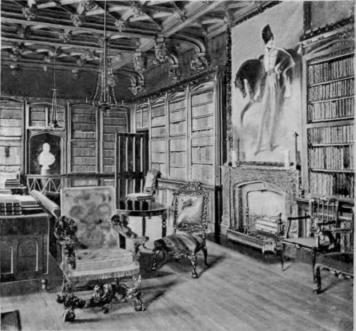
Scott's Library.

Scott's "Own Romantic Town".
Nothing in Scott's career is more touching than his last attempt to work. Though very ill, he begged his daughters to bring him ink and paper, and to put the pen into his trembling hand. They did so, and he smiled and thanked them; but when he tried to write, his fingers could not hold the pen. It dropped upon the page. The old hero sank back in his chair. He did not speak and tears rolled down his cheeks. At length he murmured, "Don't let me expose my weakness here. Get me - get me to bed. That's the only place now".
In the long library at Abbots-ford Sir Walter's marble bust looks out upon the visitor from the dark background of his favorite books. It is a kindly, noble face. No wonder Scotland venerates the memory of this man. Humanity admires him as well. Here certainly was one whom Nature framed to bear " the grand old name of gentleman." To me, as I beheld the symmetry and beauty of this work of art, it seemed a symbol of the fact that as the sculptor's strokes had caused it to emerge from a rough block of marble, so by adversity's relentless blows the poet's soul had been developed, from an untried and formless character, into one made perfect through suffering.

Bust Of Scott.

Room Where Sir Walter Died.
It was in the dining-room at Ab-botsforcl that Sir Walter died. He had requested that his bed be made up here, because from this room he could most plainly hear the murmur of the river. "It was a beautiful day," writes his biographer, "so warm, that every window was wide open, and so perfectly still, that the sound of all others most delicious to his ear, the gentle ripple of the Tweed over its pebbles, was distinctly audible".
Continue to:


My Books

