


Scotland. Part 9
Description
This section is from the book "Scotland - John L. Stoddard's Lectures", by John L. Stoddard. Also available from Amazon: John L. Stoddard's Lectures 13 Volume Set.
Scotland. Part 9

Sir Walter's Statue.
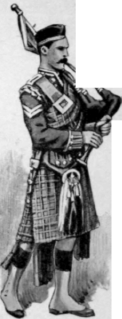
A Scotch Piper.
Now the windows are as bare and desolate as eyeless sockets, and only a few poor traces of their ornamentation still exist, where through exhaustion or caprice the vandals stayed their wearied hands; while the stained-glass figures of saints and prophets, which formerly peopled all these elegantly bordered spaces, in robes of ruby, orange, violet, green, and gold, have, like the thousands who once knelt beneath them, disappeared forever.

Melrose Abbey.

The Great Window.
Originally, too, this abbey had a roof of stone, as exquisitely carved as were the columns which upheld it; but that has, also, long since vanished, and now its only covering is the dome of heaven.
Through these abandoned aisles the winds of many centuries have blown; where flags of brave crusaders proudly waved, masses of weeds and ivy flutter in the breeze; the only footsteps here, today, are those of travelers; the only incense on its ruined altar is the breath of the wild rose.
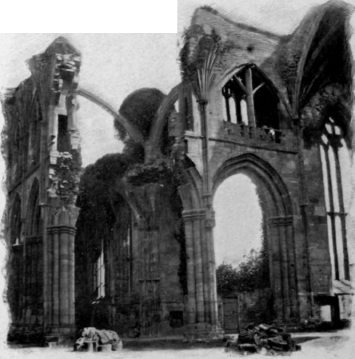
A Corner Of The Abbey.
One object, however, has escaped destruction. It is a beautifully sculptured window, carved in the likeness of the crown of thorns which Roman soldiers placed derisively upon the head of Christ. It is an admirable work of art. Even in stone, the cruel points turn down as if to sink profoundly into the bleeding flesh. The pious hands which wrought this masterpiece have crumbled into dust. The eyes which gazed upon it, doubt-less, often dimmed with tears, have long ago been closed in death; yet where all else has perished, this survives. Before this symbol of majestic suffering, even the hands of desecrators faltered powerless. Itself the crown of this imposing ruin, its thorns are still, as they have been for centuries, the souvenir of a divine self-sacrifice, its perfect circle the emblem of eternity. The interest of Melrose Abbey is not confined, however, to its architecture; for in one part of the building lies buried the heart of the valiant Robert Bruce, and it also contains the grave of the warlike Douglas, and that of the reputed wizard, Michael Scott. Every reader of the "Lay of the Last Minstrel" will remember that this is the spot alluded to by Sir Walter when he describes the visit to Melrose Abbey of William of Delo-raine, who had come to wrest from the dead necromancer's withered hand his book of magic; and it was through these windows, once so glorious with color, that "The silver light so pale and faint Showed many a prophet and many a saint," as the awe-stricken chieftain watched till a moonbeam fell directly on the wizard's grave, and thus gave warning that the fearful hour had come when he could safely take from the dead man's grasp the secret of his power.

Grave Of The Wizard, Michael Scott.
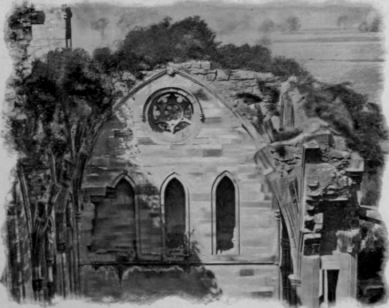
The Crown Of Thorns Window.

Sir Walter Scott.

Melrose Abbey, From The Churchyard.
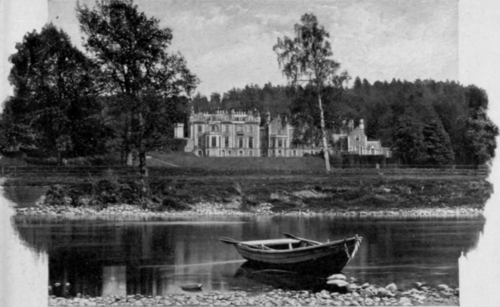
Abbotsford, From The River.
Leaving this charming ruin, a drive of three miles through a pretty, undulating country brought us to Abbotsford, the home of Scott. It is delightfully situated on a terrace, just above the Tweed; in fact, so near it, that the murmur of the river in its rocky bed can be distinctly heard through the open windows. This tract of country possessed for Scott a peculiar fascination. It had belonged in former times to the old Abbots of Melrose, and near it were the ruins of the Abbey which he loved so well. When he first bought the property, he lived upon it in a modest cottage; but, as his wealth increased, he built a veritable castle of red sandstone trimmed with granite, where he, subsequently, resided and which became his joy and pride. It was his own creation, and every part of it was intended to recall to him some tower or romantic ruin which he had admired and described. He likened it, therefore, to one of his romances carved in stone. Not long, however, was he destined to remain here in undisturbed enjoyment. The very year in which it was completed beheld the terrible financial crisis which, with the sudden fury of a cyclone, wrecked his fortune and in a single day transformed him into a pauper.
Continue to:


My Books

