


Scotland. Part 8
Description
This section is from the book "Scotland - John L. Stoddard's Lectures", by John L. Stoddard. Also available from Amazon: John L. Stoddard's Lectures 13 Volume Set.
Scotland. Part 8

The Mountains Of Glencoe.

Princes Street, Edinburgh.

Edinburgh.

Edinburgh Castle And Scotch Guards.
What memories are hidden in the massive battlements of this abode of Scottish kings, like jewels in an iron casket! Along the steep path leading to the Castle gate, fair Mary, Queen of Scots, and many other royal visitors often passed. In one of its apartments poor Mary's only child was born, and from a window in these walls the little one was lowered several hundred feet in a basket, and thence conveyed in furious haste to Stirling Castle. What a strange introduction into the world, for one who finally became the King, not only of Scotland, but of England also, and thus at last consolidated the rival crowns!
In an apartment called the "Crown Room," and guarded by a metal cage reaching from floor to ceiling are the old, discarded souvenirs of Scottish sovereignty, including the crown once worn by Robert Bruce, the sword of State, the sceptre, and some splendid jewels. There was something profoundly sad to me in the sight of these abandoned relics of Scottish royalty. If this was to be the ending of all the centuries of warfare between the Scotch and English, of what avail was the loss of thousands of lives along the Border, the valiant deeds of Wallace, the heroism of Bruce, and the victories of Bannockburn and Flodden Field? But Time works marvels; and what would have been treason, or cowardice, in one century, may become good State policy in the next. Community of interests and mutual protection are often more potent than national prejudices, and sometimes bring about a change in public sentiment amounting almost to a revolution. Such prejudices, when removed by the broader, gentler spirit of humanity, resemble mighty icebergs which have been drifting southward from the Arctic Circle, threatening commerce with annihilation, and seeming to be indestructible from their enormous size and mountainous solidity; but which, yielding little by little to the warmer waters of the Gulf Stream, and the milder breezes from the tropics, finally, without a struggle, dissolve and disappear forever in the boundless sea.

The Old Town, Edinburgh.
A few years previous to Mary's execution, the idea of a union between Scotland and England would have been scouted by her former subjects, to whom the English seemed their bitterest foes. In fact, the claim of Mary to the throne of England the poor people, and the dogs." On his return, also, his meeting with his old favorites was quite touching; and when the last sad days arrived, as his dogs came around his chair and mutely licked his hands, their dying master said farewell to them with mingled smiles and tears. It is pleasing to remember, as one looks upon it, that subscriptions for this memorial to Scott's genius came from all classes of society, and if upon the list appears the contribution of one hundred pounds from Her Majesty, the Queen, one can read there, also, the donation of three pounds seven shillings "from the poor people of the Cowgate".
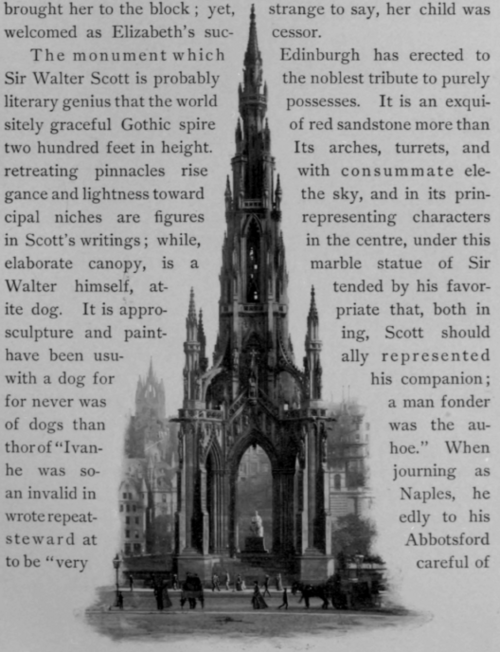
Scott's Monument, Edinburgh.
Some years before Scott's death, on a hot summer day, the future architect of this magnificent structure, Mr. John M. Kemp, then a poor apprentice, was trudging along a dusty road carrying a heavy basket of tools. A carriage passed him going in the same direction. Within it was an elderly gentleman who, noticing his weary face, offered the lad a seat. The poor boy gratefully accepted; and while thus taking his first drive in a gentleman's carriage, the subsequent designer of this monument met for the only time in his life the celebrated author, with whose illustrious name his own was destined to acquire a lasting fame.
A journey of a few hours from Edinburgh brought us to the ruined edifice of which Sir Walter was so fond, - Melrose Abbey. The first impression made upon me as I walked through its deserted corridors was that of overwhelming sadness at the vandalism which had destroyed it; for it is true of this, as of so many others of the world's great monuments, that man, not Nature, caused the ruin. Although constructed more than seven hundred years ago, it might be standing now in its entirety, had not the ravages of war, and of a still more pitiless religious fury, dealt here their cruel and destructive blows. No less than four English armies of invasion vented their fury on its walls; Cromwell actually bombarded it; and, finally, the followers of John Knox, in their mistaken zeal, defaced it with malicious joy. How much of its former beauty is, therefore, lost to us! The spacious windows, for example, were once encased in beautifully sculptured frames, whose exquisite stone carving seemed a reproduction, in elaborate garlands, of Nature's lovely handiwork in the adjoining fields.
Continue to:


My Books

