


Scotland. Part 7
Description
This section is from the book "Scotland - John L. Stoddard's Lectures", by John L. Stoddard. Also available from Amazon: John L. Stoddard's Lectures 13 Volume Set.
Scotland. Part 7
"As a perfume doth remain In the folds where it hath lain, So the thought of you remaining Deeply folded in my brain, Will not leave me; all else leaves me, You remain".
On leaving Loch Katrine and riding on among the wild and picturesque mountains that environ it, Sir Walter's memory still follows us at every step. One of the bristling peaks, for example, recalls the scene where the brave Knight Fitz James informed the stranger he had met, that he had sworn to some day face the rebel chieftain, Roderick Dhu, and all his miscreant band. Standing before the hillock, still called "Roderick's Watch-tower," we recollect that chieftain's answer:
" ' Have, then, thy wish !' He whistled shrill, And he was answer'd from the hill; Wild as the scream of the curlew, From crag to crag the signal flew.
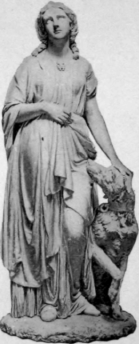
The Lady Of The Lake.

The Landing.

Ellen's Isle.
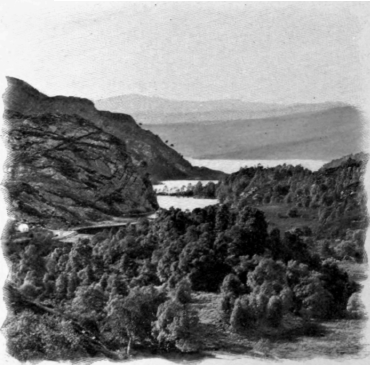
Leaving Loch Katrine.

Trossachs Church, Loch Achray.
On right, on left, above, below, Sprung up at once the lurking foe;
And every tuft of broom gives life
To plaided warrior arm'd for strife.
That whistle garrison'd the glen
At once with full five hundred men.
The Mountaineer cast glance of pride
Along Ben Ledi's bristling side,
Then fix'd his eye and sable brow
Full on Fitz James: ' How say'st thou now ?
These are Clan-Alpine's warriors true;
And, Saxon, I am Roderick Dhu!' "
Sometimes, however, in traveling among these lakes and mountain streams, we are diverted from the past to the present, and from poetry to a very practical pursuit. Hunting has largely disappeared from the Scottish Highlands, yet fishermen still have a chance to exercise their skill. But at what a cost! Can there be any pleasure in wading into the water, and soaking there for hours, merely to catch a cold, - sometimes a fish? I must confess that when I hear enthusiastic followers of Izaak Walton declare that such an experience is delightful, I feel inclined to reply, as a polite Frenchman did, on hearing an incredible story, "No doubt you aire right, but God knows it ees imposseeble!"
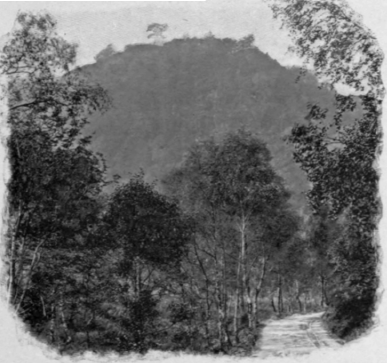
Near Roderick's Watchtower.

A Salmon Pool In The Trossachs.
The traveler, accustomed to the Alps, is apt to say, as he surveys the Trossachs, "There is no grandeur in the scenery of Scotland." Yet his opinion will inevitably change, when he beholds the mountains of Glencoe. The secret of their undeniable sublimity is not, however, their great height, since they rarely attain an elevation of four thousand feet above the sea. It is not even the impressive way in which they heave their monstrous masses westward, like gigantic waves. The grand effect which they produce is principally due to the forever changing clouds, which magnify their altitude by heaping up around and upon them, noiselessly and swiftly, enormous shapes which are themselves almost as large as the huge peaks they half conceal. Scotch mists are usually cold and unattractive; but, grouped in billowy immensity, around the mountains of Glencoe they are sublime; and, when illumined by the glow of sunset, these northern vapors become radiantly beautiful; for the departing sun transforms them into fields of splendor, gilds all their gloomy heights with glory, and places upon Scotland's brow a crown of gold.
Edinburgh in the early part of this century was called the "Athens of the North." It was, indeed, the brain of Scotland, and on this northern firmament had suddenly appeared a galaxy of literary stars: Sir Walter Scott, Burns, Jeffrey, Hume, and Chambers, who gave the city an immortal fame. Still another reason for that title was furnished by the topographical resemblance between the capitals of Greece and Scotland. Both overlook the sea, and both have neighboring mountains which bear a striking similarity to one another in the relative positions they hold toward their respective cities. This is particularly noticeable in Edinburgh's Castle Rock, which rises from the town as boldly and abruptly as the Acropolis from the city of Pericles. It is a pleasing, and certainly not an unprofitable, occupation for the tourist to sit at his hotel window, on Princes Street, and watch the lingering twilight of the North climb slowly up that perpendicular rock, and, finally, leave it in the care of Night, as it has done, day after day, so many million times since a caprice of Nature placed it there. As for the period of its history since man has had to do with it, it is of course the oldest portion of the city, - the starting-point of its development, and it was no doubt a fortress even before the conquest of the country by the Romans. It is another proof of what we find all over Europe, among the Alps and Apennines, through the Black Forest and along the Rhine, that every isolated crag or mountain peak was always utilized as a stronghold of defense, in the days when every man's hand seemed to be raised against his neighbor, and when life was based upon "the plan"That he shall take who has the power, And he shall keep who can".
Continue to:


My Books

