


Scotland. Part 6
Description
This section is from the book "Scotland - John L. Stoddard's Lectures", by John L. Stoddard. Also available from Amazon: John L. Stoddard's Lectures 13 Volume Set.
Scotland. Part 6

Grave Of Highland Mary.

Robert Burns.

House Where Burns Died, Dumfries.
From the birthplace of Burns, a journey of only a few hours brings the tourist into the very heart of Scotland, the region of the Scottish Lakes, - the country of the Trossachs. The special charm of this enchanted land is not alone its mountain scenery: its greatest fascination lies in the fact that both its history and legends have been en-deared to the whole English-speaking race by the transcendent genius of one man. This is not only Scotland: it is Scott's land; and guide-books are not needed here, so much as a previous reading of the "Waverley Novels," and the soul-stirring cantos of "Marmion," and the "Lady of the Lake." It is impossible to overestimate our indebtedness to Sir Walter for making Scotland's history and beauties so well known. In traveling here, we reap what he has sown, and we absorb with speed and comfort what cost him years of labor to accomplish. It is a great mistake to suppose that all of Scott's charming descriptions came without effort from his pen. They are as absolutely accurate as if he had been writing a guide-book. Did he make one of his characters gallop a certain distance in a single day? He had first galloped it himself to see if it could be done. Moreover he always carefully noted even the names of the flowers and trees about the scenes which he was to describe. When a friend once remarked that he should think the author's imagination would supply such trifles, Scott replied, "No imagination can long retain its freshness, which is not nourished by a constant and minute study of Nature." In this connection, too, we may recall Byron's observation, that easy writing makes hard reading.

The Country Of The Trossachs.

Loch Katrine The Tourist's Steamer, Loch Lomond.
There is, perhaps, no better instance of a place in which poetical associations are more charmingly and inseparably blended with natural beauty than Loch Katrine. It is, indeed, diminutive, but through the genius of the "Great Magician" its fame has filled the world. It is a proof that Nature always needs the human element, even though it be fictitious, to permanently hold our interest. Without Scott's magic touch of poetry, this lake would be what scores of others in the world still are to us, - merely a placid mirror to reflect the blue of Heaven, but with no background of romantic history. Along the shore still curves the smooth white beach which, from its fair expanse of snow-white pebbles, bears the name that Scott bestowed upon it, - "The Silver Strand." This, as every reader of the poem knows, was the meeting-place of Fitz James, who had lost his way, and Ellen, "Lady of the Lake"; for, as the former blew a bugle blast to call, if possible, his scattered followers to his side, "When lo! forth starting at the sound, From underneath an aged oak That slanted from the islet rock, A damsel guider of its way, . . . A little skiff shot to the bay. The boat had touch'd the silver strand, Just as the hunter left his stand And stood concealed amid the brake To view this Lady of the Lake".
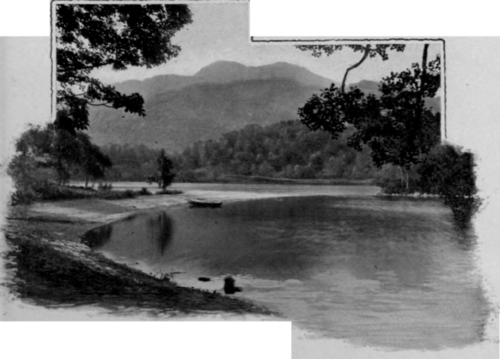
The Silver Strand, Loch Katrine.
It was a lovely summer morning, many-years ago, that I first approached this heroine's wave-encircled home, still known as Ellen's Isle. On that occasion, my boat was rowed, not by a Highland lassie, to remind me of Scott's fair creation, but by a boatman rough, yet kind-hearted as a Scotch collie. In a peculiar dialect, half English and half Gaelic, he spoke of the places mentioned in the poem, as if they were historic sites. Nor is this strange. Immediately after the first edition of the "Lady of the Lake" appeared, crowds came to view the scenery of Loch Katrine, which, until then, had been comparatively unknown; and the subsequent summer (that of 1810) the public and private houses of the neighborhood were filled to overflowing with tourists. The stage-coach business, also, gained at once extraordinary activity and has been steadily increasing ever since. Truly, Napoleon was right when he exclaimed, "Imagination rules the world." Never shall I forget that bright June morning on Loch Katrine. Save for the boatman, I was quite alone - the only denizen of the sylvan paradise where "Ellen" had once reigned supreme. The mountain breeze which broke into a thousand dimples the smiling surface of the lake, the songs of the awakened birds, charming sense of the absolute possession of a tiny realm of poetry and romance, all these combined to give such life and beauty to Scott's stanzas that I could say of this fair lake what a poet had written of the lady of his love:
Continue to:


My Books

