


Scotland. Part 5
Description
This section is from the book "Scotland - John L. Stoddard's Lectures", by John L. Stoddard. Also available from Amazon: John L. Stoddard's Lectures 13 Volume Set.
Scotland. Part 5
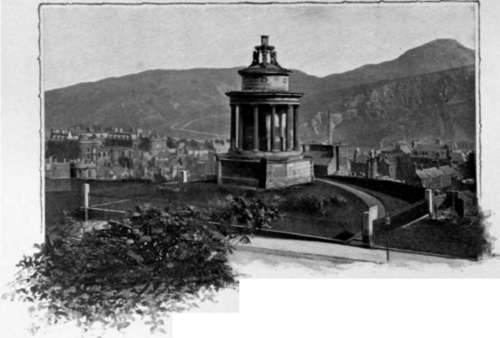
The Burns Monument, Edinburgh.
What wonder, then, that animated thus by poverty and pride the sympathy of Burns, in both the French and American Revolutions, was with the cause of freedom ? Once, at a dinner party, he refused to drink the health of the Prime Minister of England - William Pitt - but proposed, instead, that of George Washington. Everywhere he was the same uncompromising democrat. Thus, though he gained for a time the attention of the fashionable world at Edinburgh, he never lost his head in all the flattery that was offered him. He understood it perfectly. He saw the lords and ladies stare at him as if he were a curious animal, and knew that, though they liked his poetry, they looked upon him with disdain and, had it not been for his indisputable genius, would not have come in contact with him Yet, now the only reason that those lords and ladies live in history is that they entertained the plowman Burns. Who does not recollect his splendid outburst against class distinctions, when he cries:
"What though on hamely fare we dine, Wear hoddin gray an' a' that; Gie fools their silks and knaves their wine, A Man's a Man for a' that!
You see yon birkie ca'ed 'a lord,' Wha struts an' stares an a' that ?
Tho' hundreds worship at his word, He's but a coof for a' that.
His ribband, star an' a' that,
The man o' independent mind, He looks an' laughs at a' that!
The rank is but the guinea's stamp, The Man's the gowd for a' that !"

The Burns Memorial, Ayr.
Upon a lovely hillside, near the town of Ayr, stands the Burns Monument, cutting its graceful Grecian silhouette against the sky. Within it are some interesting relics of the poet, together with his bust and portrait. The face of Burns is, above all else, lovable; and Burns was loved, and loved in turn, not wisely always, but too well. His sorrows, also, caused him often to seek oblivion in drink; yet now that he lies cold in death, his glorious black eyes no longer scintillant with mirth or passion, those blemishes are far more readily forgiven than would have been the qualities of meanness, treachery, and hypocrisy. The former faults sometimes exist together with a noble soul; the latter, never.
Filled with these thoughts I stood beside the little brook where Burns and his Highland Mary said farewell to each other, before she returned home to prepare for their wedding. According to the solemn custom of the country, the lovers, when exchanging their vows of everlasting faithfulness, stood beside a stream of running water, emblem of eternity, and, holding a Bible between them, pledged their love and loyalty forever. They never met again, however, for Mary died soon after at her home. The Bible which they held is now preserved in the Burns Monument, at Ayr, and on a faded page we see his autograph and, beneath it, a tress of Mary's hair.

Interior Of The Burns Memorial, Ayr.

Beside The Brook.
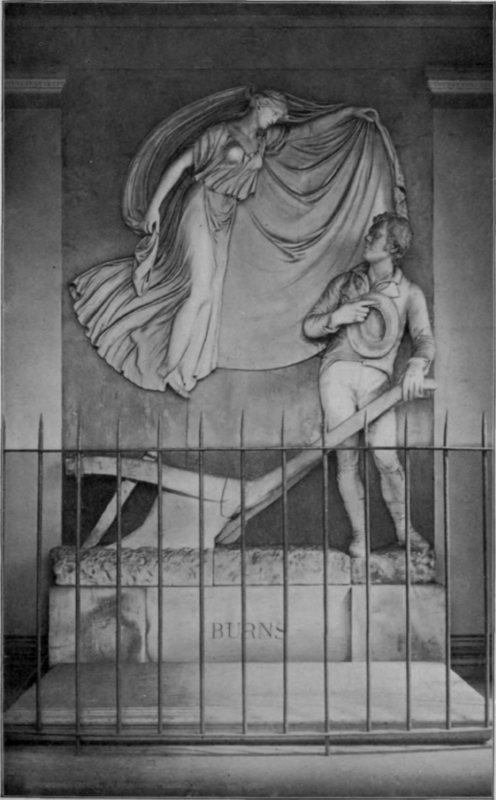
Interior Of The Burns Mausoleum, Dumfries.
A tender melancholy is awakened by the sight of the grave of this fair girl whom Burns loved as he loved no other woman in his life. In the centre of the monument, delicately sculptured in relief, are the figures of the lovers, clasping hands in that pathetic leave-taking, which was so quickly followed by another, wherein the poet's fingers were replaced by the cold hand of Death. Below them are the simple words: "Erected over the grave of Highland Mary." No other name is there inscribed; but none is needed, for "Highland Mary" is the title she will now bear to the end of time.
A pilgrimage to the haunts of Burns would be incomplete without a visit to the miserable house, at Dumfries, where he died at the age of thirty-seven. He had been for a long time ill, and it was while he lay upon his deathbed that he composed, to please the servant-maid who had been kind to him, one of the sweetest of his poems, "Oh, wert thou in the cauld blast," which has been rendered still more beautiful by the music composed for it by Mendelssohn. At this time, also, Burns was miserably poor. The volume of poems, which Scotland now regards as the most precious of her treasures, had brought him only forty-five dollars. A day or two before his death a merchant, for a bill of five pounds, had threatened to put him in jail and to turn his wife and children into the street. Burns was extremely sensitive. The horror of the situation killed him. His last words were a malediction on the man who had written him that threatening letter. Oh, the pathos of it! Now, now that he is dead, he is admired and almost worshiped by his countrymen. Statues and monuments have been erected to his memory in every part of Scotland; but, alas! how much in this world seems to come too late! The greatest of Scotch poets died, owing a trifling debt; and now the world owes him a debt that it can never pay.
Continue to:


My Books

