


Scotland. Part 15
Description
This section is from the book "Scotland - John L. Stoddard's Lectures", by John L. Stoddard. Also available from Amazon: John L. Stoddard's Lectures 13 Volume Set.
Scotland. Part 15

Mary's Bedroom.
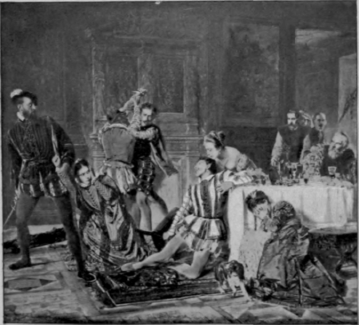
Murder Of Rizzio.
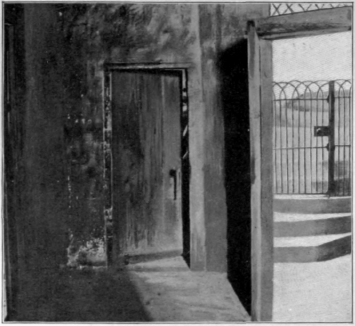
The Spot Where Rizzio Was Slain.
As for Mary, when all the uproar had subsided, and she had partially regained her senses, her lawless nobles told her that she was their prisoner, and, setting a guard at her door, they left her to spend the night in horror, anxiety, and fear. Is it any wonder if, after such an experience as this, Mary's character was somewhat changed? There are some natures which resemble water, - tractable enough when they flow in their appointed channels; but, when congealed by coldness, they freeze and cannot be bent. They may indeed be broken, but that ruins them.
Upon a little island in one of the most beautiful of Scottish lakes - Lochleven - stands the prison of Queen Mary. For, at last, her enemies dethroned her. Two of her nobles, in the dead of night, took her from Edinburgh Castle, placed her upon a horse, and made her ride with them for several hours at full gallop, until at dawn she found herself upon the borders of this lake. Without delay she was conveyed across the water to the castle, where two of the murderers of Rizzio (well calculated, therefore, to inspire her with fear) threatened to drown her in the lake if she did not immediately sign her abdication in favor of her son, and name one of their number, the Earl of Murray, Regent, till the boy became of age. This, in her desperate condition, Mary was obliged to do. Having played, therefore, their last and most successful card, the game was won and Mary's foes withdrew in triumph, leaving her here a broken-hearted captive.

Lochleven.
The thrilling episode of her escape from Lochleven is as exciting as a romance. Some months had passed since Mary had been forced to abdicate. Day after day had dragged monotonously on, like shadows on the castle walls. At last, however, there came a change. One Sunday night the Queen stood at her window watching the lake intently. Her eager scrutiny was at length rewarded. She saw a small boat approaching the island noiselessly. Within it was a young man named George Douglas. He was the son of her jailer; but both he and his younger brother, enamoured of the lovely captive, had sworn to risk their lives in her behalf. It is another proof that the explanation of half the history of the world is love. While this was going on, the other members of the Douglas family were at supper. Among them was William, the accomplice of his brother George. The castle keys were lying on the table. William contrived to drop a napkin over them, lifted them noiselessly, and left the room. Five minutes later the family had been locked in, as captives; Mary's door had been opened; the keys had been thrown into the lake; the two young men were rowing to the land with all their might; and with them sat the fairest woman in all Scotland, -Mary, Queen of Scots, leaving this hated prison forever.

Lochleven Castle.
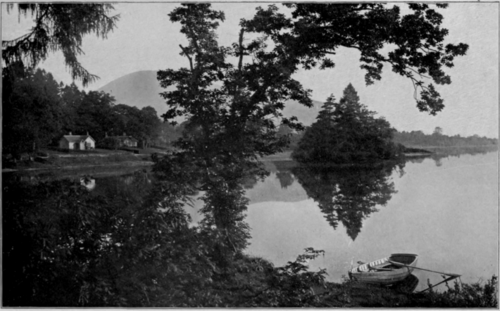
Swan Island, Loch Lomond.
Poor, beautiful, Queen Mary! the fascinating story of her tragic life imparts an interest and pathos to everything connected with her memory. Thus, of the crumbling castle of Lochleven, a poet has well sung:
"No warden's fire shall e'er again
Illume Lochleven's bosom fair; No clarion shrill of armed men
The breeze across the lake shall bear; But while remains a stone of thine,
It shall be linked to royal fame,- For here the Rose of Stuart's line
Hath left the fragrance of her name".

Lochleven By Moonlight.
Not long, however, did the Queen enjoy her freedom. A few weeks later her faithful followers were defeated by the army of the Regent, and Mary was again a fugitive. For two days she remained in old Dundrennan Abbey, in anxious consultation with her few attendants. What should be done ? Mary herself desired to go to England and appeal to Elizabeth for help. Her friends, however, fearing that Queen's duplicity and jealousy, advised her to escape to France. This, doubtless, would have proved the wiser plan; but Mary trusted to the friendly words which had been sent by Elizabeth during her captivity at Lochleven. Accordingly she crossed the English frontier and rashly confided herself to the royal cousin who had, from first to last, invariably been her foe. It is hard to realize that Mary's captivity in England lasted almost three times as long as her whole Scottish reign; but it is true that, having been Queen of Scotland only seven years, she was Elizabeth's prisoner nineteen. Yet what a mistake, as well as crime, was this unjust imprisonment! Her lovely form seen through her prison bars made her at once a heroine and martyr, and touched ten thousand hearts with sympathy. Her old claim to the English throne, thus constantly suggested, gave rise to scores of plots whereby the Catholic party tried to regain supremacy. Of many of them Mary undoubtedly knew nothing; but since her name was always used, and her release was an essential feature of each scheme, the Protestant reformers hated her relentlessly, and urged Elizabeth to take her life. At last, a new conspiracy was discovered, in which the unhappy prisoner seemed implicated, so far at least as trying to regain her liberty. She was, however, accused of treason and of a wish to assassinate Elizabeth. Mary protested against the right of any English court to judge her (since she was not a subject of Elizabeth, but an independent sovereign), but the English earls and barons who composed her judges pronounced her guilty, and Parliament sentenced her to death. It only remained for Elizabeth to decide whether or not the sentence should be carried into effect.
Continue to:


My Books

