


Scotland. Part 2
Description
This section is from the book "Scotland - John L. Stoddard's Lectures", by John L. Stoddard. Also available from Amazon: John L. Stoddard's Lectures 13 Volume Set.
Scotland. Part 2

Shipbuilding On The Ciyde, Shipping On The Clyde.

Dumbarton Castle.
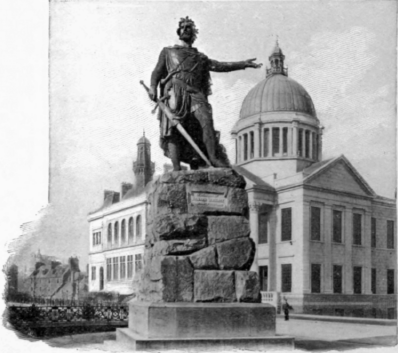
Wallace Statue, Aberdeen.
Despite the centuries which have since elapsed, the world has not forgotten Wallace. Even this almost impregnable rock was not considered secure enough to hold him. Accordingly he was conveyed to London. Crowds gathered there to see him pass, and gazed with awe on the renowned and dreaded prisoner. Meantime the King of England thirsted for his blood. The thirst was quickly slaked; for, after a mock trial in London, the gallant Wallace was condemned to die. What a death was that reserved for him! He was first hanged, but cut down while alive; then, portions of his body were torn out and burned before his face; and, finally, after atrocious sufferings, his head was struck off by the executioner and placed upon a pole on London Bridge. Even then his body was dismembered. His right arm was displayed at Newcastle; his left at Berwick; one leg was sent to Perth; the other to the town of Aberdeen: yet England's triumph was of short duration.

Wallace Statue, On The Wallace Monument.
Above a densely wooded hill near Stirling, where Wallace had, some years before, defeated England's army of invasion, rises a massive monument of stone two hundred and twenty feet in height. It is the National Memorial to Wallace. It stands as he stood, solitary, unshaken, and majestic, towering above the country he so gallantly defended. It is a striking illustration of the fact that to destroy a man like Wallace is impossible. Burn, cut, or crucify the body if you will, if he who dies thus stands for some immortal truth, his soul emerges from the mutilated casket indestructible, and travels triumphant down the path of history.

A Distant View Of The Wallace Monument.
"Speak, History! Who are life's victors? Unroll thy long annals and say: Are they those whom the world called victors, who won the success of a day? The martyrs, or Nero? The Spartans who fell at Thermopylae's tryst, Or the Persians and Xerxes? His judges, or Socrates? Pilate, or Christ?"
Rivaling, in point of interest and numbers, the statues of Wallace in Scotland are those of his successor, - Robert Bruce. Only a brief interval occurred between these heroes; for, goaded into fury by the cruel murder of her champion, within six months after the death of Wallace, Scotland had risen again and had proclaimed the gallant Bruce her king. A complete record of his exploits would fill many pages. A hundred episodes in his career could give material for an epic poem. The story of his struggles for Scotland's freedom forms a northern Iliad, and Homer would have been proud to sing of him as of Achilles. Homeless and penniless, hunted by England, excommunicated by the Pope, he, nevertheless, fought desperately on, until the object of his life was reached and not a particle of Scottish heather was crushed beneath an English foot. To those who love the memory of Bruce, no spot in Scotland is more interesting than the scene of his most glorious victory, - Bannockburn. Nearly six hundredyears have come and gone since that eventful day, yet one may still see here the very stone in which the Scottish standard was then placed, just as a modern flagstaff rises close beside it now. Bannockburn is the Marathon of Scotland. The English army numbered one hundred thousand men; the Scots had less than forty thousand; but they were fighting for their fatherland, and they were led by Robert Bruce. Before the battle Bruce had caused innumerable holes and trenches to be dug here, which afterward were carefully concealed with turf. Accordingly the field, which looked to the enemy firm and undisturbed, was, in reality, a death-trap for the English cavalry. As the invading host advanced, the Scots knelt down and solemnly invoked the aid of God. "What are they doing," cried the English king, "kneeling already for our mercy?" He was soon undeceived; for, rising from their knees, the Scots attacked their foes, not, as in modern times, from a distance with artillery, but hand to hand with sword son truly; but, after all, the Scots do well to keep such monuments as these. Who has not seen a Scotchman's blue eyes kindle when his native land was mentioned? It is not strange, for Scotchmen lead their children to these landmarks of their country's history, and under the same sky that Robert Bruce beheld, and in the shadow of the Wallace monument, repeat to them those deeds which are their nation's proudest heritage.
Continue to:


My Books

