


Scotland. Part 3
Description
This section is from the book "Scotland - John L. Stoddard's Lectures", by John L. Stoddard. Also available from Amazon: John L. Stoddard's Lectures 13 Volume Set.
Scotland. Part 3

The Wallace Monument.

The Statue Of Robert Bruce.
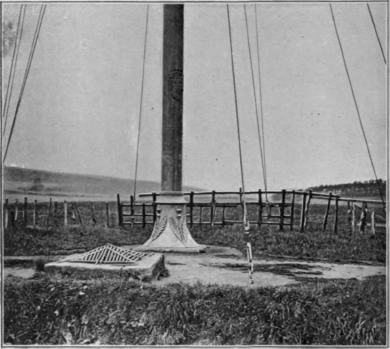
Flagstaff Stone, Bannockburn.

The Field Of Bannockburn.

Ben Nevis And Ruins Of Inverlochy Castle.

Scotland is so diminutive that it is easy to turn in a few hours from these scenes of warlike memories to a more peaceful section of old Scotland, the quiet, little town of Ayr, rich in its souvenirs of Robert Burns. "More hero-worship," does one say ? Ah! but believe me, the time is never wasted which we spend in honoring departed greatness. The trouble with this age is, not too much respect and reverence, but too little. Great men are like great mountains : they lift our thoughts above the ordinary level of humanity; they give us hope and inspiration. In studying the heroes of the past we, too, are stimulated to heroic deeds; and when we read the biographies of men of genius, - from Plutarch's Lives to those of Washington and Lincoln, - we draw instinctively a deeper breath, as when upon a sultry day there suddenly is brought to us the cool, exhilarating freshness of the sea. Before investigating the subject, I had no idea how many people go to Ayr to render homage to the poet's memory. They number, on an average, more than thirty thousand, annually. I know of nothing like this in the world. Even the pilgrims to the home of Shakespeare do not exceed fourteen thousand, yearly. It shows how deeply and imperishably Burns is enshrined in the affections of the English-speaking race, in spite of the difficulty to many readers of understanding his Scotch dialect. The town abounds in quaint reminders of the poet who has given it such fame. Thus, the Old Bridge of Ayr is very little changed since the time of Burns, and casts its shadow in the stream below just as it did when the inspired plowman used to lean upon its time-worn parapet. In his day, however, a New Bridge had been erected a little farther down the stream, and Burns describes the fancied rivalry between them. Standing upon the "Auld Brig," as it is called, one recollects how the New Bridge is made to say to it, disdainfully, "Will your poor, narrow foot-path of a street, Where twa wheelbarrows tremble when they meet, Your ruin'd, formless bulk o' stane and lime, Compare wi' bonie brigs o' modern time?" to which the ancient structure answers proudly, "I'll be a brig, when ye're a shapeless cairn".
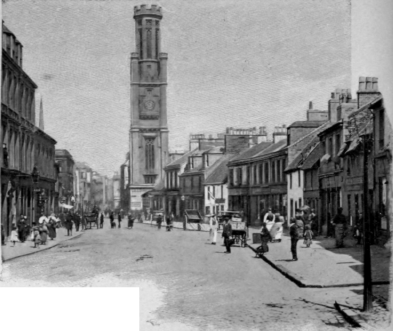
High Street, Ayr.

The "Twa Brigs".

A Highland Cottage.

"The Auld Brig O' Doon," Ayr.
Strangely enough, the poet's prophecy proved true. The venerable arches, built six hundred years ago, are still in use, while the New Bridge, constructed only a century since, has been superseded already by a newer one.

Alloway Kirk, Ayr.
A short walk from the hotel in Ayr brought us to Alloway's witch-haunted kirk. It is a picturesque old ruin, in the tower of which still hangs the ancient bell which is regarded by the peasants with superstitious reverence. But even when standing in the graveyard of this church, beside the tombstone of William Burns, the poet's father, I could not feel in the least degree serious; for Burns has made this place forever humorous as the scene of Tarn O'shanter's ludicrous adventure on the night when "a child might understand The deil had business on his hand".
One must be heavy-hearted, indeed, not to be amused as he recalls the mirth-provoking stanzas of that poem, while he beholds the very window through which the unearthly light streamed forth that lured the ill-fated Tam to peep at the uncanny sight of witches dancing in mad glee, while the Devil furnished the music on a bagpipe, and, sitting upright in their coffins, each corpse held a lighted candle in its hand. Tam O'shanter was not an altogether fictitious character; for the original of Burns' hero was a certain Douglas Graham, of Shanter Farm not far away, and on his tombstone in the village churchyard he is designated, not only by his real, but also by his poetic title. Moreover one sees in Ayr, today, the "Tam O'shanter Inn," - the identical tavern where Tarn caroused so long with his boon companion, Souter Johnny, and above the doorway is a rude painting portraying Tam and Johnny drinking bumpers to each other's health, and reminding one of the lines :
Continue to:


My Books

