


Spain. Part 12
Description
This section is from the book "Spain - John L. Stoddard's Lectures", by John L. Stoddard. Also available from Amazon: John L. Stoddard's Lectures 13 Volume Set.
Spain. Part 12
The murmur of thousands of voices, the cries of the venders of oranges and fresh water, and the cheers of eager spectators, as different movements were made preparatory to the combat, all formed a confused roar, comparable to nothing I had ever heard. At length, the shrill blast of a trumpet fell upon our ears. It was the signal for the arena to be cleared of all its lingering occupants. In a few moments the last man had left the enclosure. The arena was empty. Another flourish of trumpets, and in through one of the principal entrances marched the actors in the coming tragedy. At the head rode two picadors, lance in hand, and dressed in brilliant colors. Next came the chulos, bearing on their arms the scarlet cloaks with which it would be their duty to infuriate the bull. These were followed by four or five banderilleros, who were to act in a way which will be presently described. Last of all appeared, in the place of honor, the matadors, who give the bull his deathblow. The costumes of these men were peculiar. All except the picadors wore short breeches, silk stockings, and vests and jackets embroidered with silver and gold. Their hair, which was very long, was arranged in a tight twist behind the head. After the procession had crossed the arena, it halted after the manner of the Roman gladiators, before the royal box and made a salutation. Then it completed the circuit of the ring, the matadors retiring from the arena, while the others took various positions about the barrier. Two officers, dressed in black, and with long nodding plumes in their hats, now rode in, and asked permission of the governor of the spectacle to admit the bull. The governor threw to them the key of the den where the bull was confined, and riding rapidly across the arena, the officers handed this to the keeper of the gate. While this was taking place I heard two persons directly behind me speaking English. "Harry," said a pleasant voice, "you know I have come here merely to please you. I think it is all horrid. I am not going to look at a thing in that arena. Moreover, remember, you promised to take me out if I feel faint."
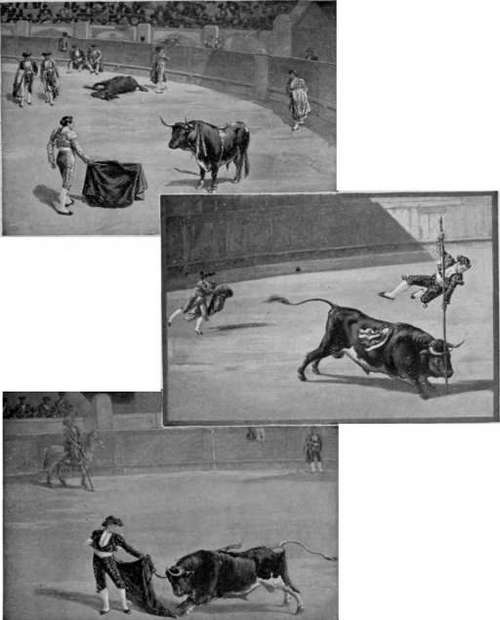
The Matador's Cunning.
The Chulo's Cloak.
A Leap For Life.
"Faint!" was the reply; "nonsense! Just exercise your will-power, and you won't feel faint. If anything disagreeable happens, cover your face with your fan. Ah! there he comes!"
I heard a little scream, but had no time to look behind me; for the gate had suddenly swung open and a huge iron-gray bull had darted from a perfectly dark den into the arena. For a moment, dazzled by the sudden glare of light, astonished by the sight of the vast curving wall of human faces, and startled by the yells of thousands, he halted, his nostrils quivering. Then catching sight of the chulos, who at a safe distance were waving their red cloaks at him, he lowered his head and dashed furiously at them. Nimble as squirrels, these men leaped lightly over the railing of the arena into a circular space beyond, and the bull stopped with a violent shock within a foot of their retreating heels. With a snort that denoted mischief the bull glared around him. Twenty feet away was a picador on horseback. Straight at him the bull now went. The horse, whose eyes were blinded by a cloth, obedient to his rider's spur, wheeled to one side, and the picador pressed his lance into the bull's shoulder as he passed, inflicting only a slight wound, however, for the iron on the lance is purposely made very short. The bull turned savagely about and, irritated by the pain, charged once more upon the horse. This time the picador could do nothing, and both horns plunged deep into the horse's side. Ten thousand voices greeted this with yells of approval. "Bravo, Toro! Bravo, Toro!" resounded in deafening shouts from all parts of the arena. This was bad enough, but I felt almost faint when I saw the bull, by a tremendous effort, lift both horse and rider from the ground and roll them over in the dust. All was at once a frenzy of excitement. The bull drew out his dripping horns and prepared for a new charge. If he made it, it would be all over with the picador. But now the chulos came to the rescue. Three or four flaunted their cloaks in his face and drew his attention to themselves. As he advanced, however, these agile men slipped aside, and the bull struck only the cloaks which passed lightly over his head. While this was being done, other men assisted the fallen picador to get upon his feet. He could not have risen without aid, for besides being bruised by his fall, his legs were encased in iron plates of great weight, made to resist the bull's horns. As for the poor horse, he was left to die in agony, writhing upon the sand, while his life-blood poured out in streams, as he struggled impotently to rise. By this time the bull had charged furiously upon the other picador. Almost the same scene was now repeated, save that the bull succeeded in plunging only one horn into the horse's side. Therefore, for the next five or ten minutes, this wretched animal actually galloped about the arena, urged hither and thither by his rider, while his entrails were dragging around his heels, and the blood was gushing forth in copious jets. I need hardly say that the ladies of our party shielded their eyes from this horrible sight. A German lady near me wept. But the fair Spaniards seemed to think of nothing but the men and the bull.
Continue to:


My Books

