


Spain. Part 13
Description
This section is from the book "Spain - John L. Stoddard's Lectures", by John L. Stoddard. Also available from Amazon: John L. Stoddard's Lectures 13 Volume Set.
Spain. Part 13

The Picador's Attack.
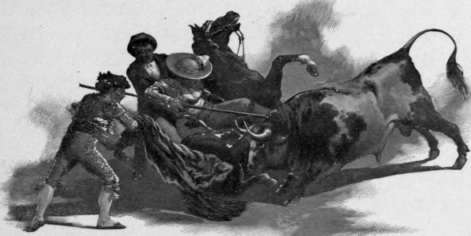
The Picador's Overthrow.
The second horse also soon dropped in the agonies of death, and, as new picadors came in, the bull, within fifteen minutes, had killed three horses outright and horribly wounded a fourth.
Presently he stopped as if exhausted. The practiced eye of the governor detected the moment for a change of tactics. He gave a signal, which was followed by a blast from the trumpet, and the picadors withdrew from the arena, much to our relief, although the weltering corpses of three horses still lay upon the sand. The chulos now came prominently forward to take a more decided part in the contest than they had previously assumed, and to perform some of their daring feats. One of them ran boldly out to meet the bull, as if he were to encounter a pet dog. My heart stood still a moment at the man's audacity. On came the bull, his blood-stained horns pointed directly at his daring foe.
"He is lost!" I said to myself, as the bull's head was lowered to receive him. But no; for planting his foot between the horns, the chulo took a flying leap, and landed safely on his feet, amid a tempest of applause, while the astonished bull looked perfectly dumbfounded at his disappearance. But this was nothing to what followed; for by the time the bull had turned and caught a glimpse of him, the chulo had obtained a pole, with which he coolly waited for the charge. He had not long to wait. Of all the lively ani-. mals I ever saw, that bull would take the palm. Apparently he did not pause to draw a breath, but darted forward with the air of certain victory. It was indeed a hazardous act that this bold chulo now performed, for he was forced to calculate, at some distance, just when to jump, since if he leaped too soon, the bull would have a chance to halt and receive him on his uplifted horns. In any case the pole is liable to be knocked from under him, and he must see to it that he alights on his feet, or he will be speedily despatched. Of course, no chulo would have dared to do this when the bull was fresh; but now fatigue had rendered his charges shorter and more easily avoided. What wonder that he was wearied? Up to this time his exertions had been tremendous. The perspiration glistened on his panting sides, and blood coated both shoulders with a crimson mantle, proving that the lances of the picadors had done their work.

A Leap Over The Horns.

Dead In The Arena.
After this sport had gone on for some time, the trumpets sounded a new signal, and the banderilleros made their appearance, to exhibit feats of even greater daring and adroitness. One after another placed himself before the bull and goaded him to madness by shaking in his face two colored wands, on the extremities of which were twisted barbs. When the angry animal made a dash at his tormentor, the critical moment came. The banderillero waited until the head of the charging beast was within his grasp, and then, reaching between the advancing horns, thrust the colored shafts into the shoulders of the bull! There was a horrible fascination in this, for it was done just as the bull lowered his head to toss his enemy to the sky. At one moment the man seemed doomed to instant death. The next we saw him leap lightly aside, while the baffled bull fairly bounded up and down under the stab of the two darts, which remained fixed in his bleeding neck. Another banderillero now took his position before the bull, and the same exciting scene again ensued, until, by a succession of such performances, the wearied and tormented animal bore many of these pointed shafts, which he in vain attempted to shake out of his flesh.
But one may ask, "What can induce men to adopt such a foolhardy business as this?" Partly, no doubt, the fame they thus acquire. Their names are household words in Spain, and they themselves are looked upon as demigods. Then, too, aside from their magnificent toilettes of silk and satin, glittering with gems, their salaries are enormous. The chief matador, whose duty it is on a Sunday afternoon to kill only two bulls, sometimes receives for this task about three thousand dollars. Frascuelo, "the first swordsman in Spain," demanded and received four thousand dollars for every appearance. The men below him were also paid in proportion to the risk they run; and as these toreadors are engaged for months ahead in the various amphitheatres, it is easy to see that in Spain it is more profitable to kill bulls on Sunday than in America to preach sermons.
Continue to:


My Books

