


Spain. Part 14
Description
This section is from the book "Spain - John L. Stoddard's Lectures", by John L. Stoddard. Also available from Amazon: John L. Stoddard's Lectures 13 Volume Set.
Spain. Part 14
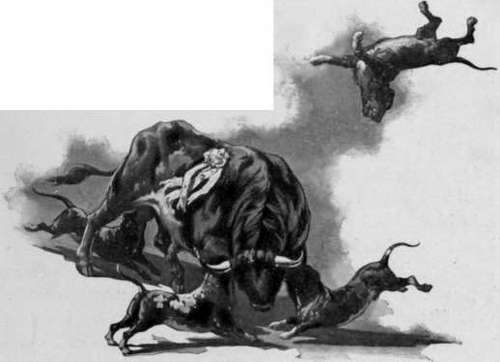
The Bull Harassed By Dogs.
But this was not all. When the banderilleros were exhausted, fierce dogs were let loose in the ring to rouse the wearied bull to a new pitch of fury. Just at the moment when one of these dogs had been tossed into the air, and I was all aquiver with excitement, I felt a gentle pressure on my shoulder. Turning my head, I saw a small, white hand, -a lady's hand - clutching unconsciously the lapel of my coat to steady herself as she leaned forward to obtain a better view of the arena.
"Oh, Harry," cried the owner of that little hand, "isn't it just splendid! Three dogs have got him now. He cannot shake them off!"
"Don't you feel faint?" inquired her companion; "had n't you better go out now?"
"Oh, dear," was the reply; "I know it's dreadful, but I 'm not a particle faint. On the contrary, I 'm so excited I could scream this minute."
"Well, you had better let go that gentleman's coat," he whispered with a laugh.
At last another flourish of trumpets gave the signal for the closing scene.
The matador entered the arena, and, being a special favorite with the public, was received with exultant cheers. With slow and dignified step this admired hero and pet of the ladies advanced to the royal box, and asked permission to kill the bull in a way that should do honor to all Spain. This being granted, he turned about and faced the bull. In one hand he carried a small red cloak, in the other a straight Toledo blade. All eyes were fixed upon him. Thousands of hearts were beating with excitement. The silence was impressive. The combat had reduced itself to a duel, with no hope of mercy even for the matador, for in that amphitheatre were fifteen thousand eager critics, from whom the slightest nervousness on his part would bring down jeers and cries, until the wretched man might lose his self-control and possibly his life.
Advancing to within a few feet of the bull, he irritated him a little with the cloak, and made a few passes in order to study his wiles. If it be a bold bull which he thus tries, there is little danger, for such a one usually shuts his eyes and madly rushes ahead; but the sly bulls, those which advance and then retreat, and seek to outwit their antagonists, require close attention. A skillful matador, however, can usually choose the place where he will lure the bull and finally kill him; and if the matador's ladylove be in the amphitheatre, depend upon it, it is at the point nearest her that the bull will die.
Frascuelo used to say that the matador's trade was a safe one, when well learned, provided the bull had never "performed" before, since experience renders them almost as wily as the bull-fighter; and it is a significant fact that the bull which recently killed Frascuelo had appeared in the arena at least once before. It is evident, therefore, that the most experienced matador sometimes fails. Accordingly, what courage, coolness, hope, and perhaps fear are concentrated in that moment! For in this deadly game he knows that one must die, and both may, since, though the chulos may leap the barrier, it would be dishonorable for the matador to try to escape. No matter what happens, he must stand his ground.
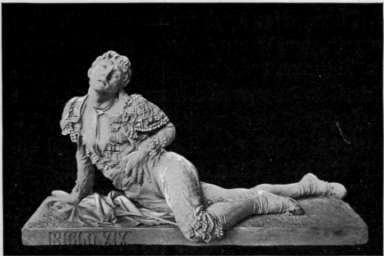
A Dying Matador.
Nor can this trying moment be prolonged - the feelings of the populace will not bear suspense. At length the bull made a grand rush forward. This was what the matador desired. Instead of leaping aside, he planted his feet firmly, the mantle dropped as if by magic, and the Toledo blade, like a flash of lightning, entered between the shoulder and neck of the bull, and pierced the heart; and while the victor whirled to one side and bowed to the audience, the bull halted, staggered a few steps, and then, struck as it were with instantaneous paralysis, fell at his conqueror's feet, - his recent fury, life, and passion gone forever.
Thunders of applause greeted this denouement of the tragedy, and the gorgeously dressed matador quitted the amphitheatre, bowing to right and left, and evidently feeling himself to be upon the pinnacle of glory. In three minutes the bodies of the dead bull and horses had been removed by a train of mules with tinkling bells, and all was ready for a new combat. For a bull-fight in Spain usually comprises six distinct tournaments such as I have described; and if the day be a particularly sacred one, seven bulls are slain to gratify the populace. The sport is not, however, so monotonous as might be imagined, for the animals differ from each other in courage and ability. We had the somewhat exceptional fortune to see, during the afternoon, one cowardly bull. It was the second one that entered the arena. Instead of charging directly on the chulos and picadors, this timid animal ran around the ring, seeking some way of escape. Observing this, the picadors rode directly up to him and pricked him with their lances. Even then the bull would not actually fight, but merely pretended to charge upon the horses, turning away at the last moment without giving the fatal thrust. Then rose a perfect storm of yells, screams, and derisive shouts. So great was the noise that it was impossible to make ourselves heard by each other save by shouting. Scores of oranges were hurled by the audience at the unlucky bull. "Put him out!" "Out with him!" was the verdict of the fifteen thousand spectators. This was soon seen to be a necessity, for neither chulos nor banderilleros could exasperate him to a charge. Accordingly, he was ignominiously rejected. A gate was opened, and six or eight tame steers were allowed to enter the arena. The coward immediately joined them, and they were all driven out together.
Continue to:


My Books

