


Spain. Part 15
Description
This section is from the book "Spain - John L. Stoddard's Lectures", by John L. Stoddard. Also available from Amazon: John L. Stoddard's Lectures 13 Volume Set.
Spain. Part 15
It is well known that, notwithstanding the skill of the participants, fatal accidents sometimes occur in these encounters, and frequently there are hair-breadth escapes. The famous matador Frascuelo was once about to give a bull the coup de grace, when the cunning animal, by a peculiar jerk of the head, twisted the sword from the matador's hand. Disdaining to run, the matador stood his ground. On came the bull, and catching the man upon one horn, held him there for five minutes, and ran with him around and around the ring despite all the efforts of the chulos to release him. At last he flung him into the air. The horrified spectators expected, of course, to see him fall a mangled corpse. Instead of that, the matador arose and assured the audience that the bull had not harmed him in the least. The horn had slipped between his girdle and his shirt!
"Did he afterwards kill the bull?" I asked.
"Oh, senor," was the reply, "I never saw a bull killed so beautifully. You see, Frascuelo was so angry that he thrust his sword in to the very hilt, and held it there till hand and arm were crimsoned."
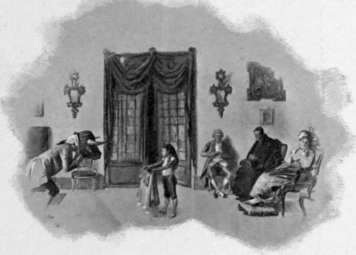
Playing At "Toro."
Another marvelous escape from death was told me by Patricio. A banderillero, in running from a bull, was just about to leap the barrier, when he fell. He rose and tried to leap again, but the infuriated bull was close upon him. Instinctively the man drew himself up into the smallest possible space and pressed his body tightly against the barrier. A second more, and the bull's horns had passed, one on each side of him, and stuck fast in the wooden fence, leaving about an inch of space between the man's waist and the monster's head.

Cordova.
"Did that man ever have nerve enough to fight again?" I asked.
"Of course," was the reply; "it was he who thrust the darts so splendidly to-day."
Perhaps the most remarkable fact connected with Spanish bull-fighting is the fascination that it has for children. Their favorite sport is to imitate its horrors. The boys all play at "Toro," as they call it, indoors in winter, out of doors in summer, enacting every scene of the arena, and carefully observing every rule which there prevails. Thus, trained to it from infancy, we cannot wonder that, as men, they see no harm in such amusements, and even arrange special bullfights to assist the church, or help some charity, or even t;o raise funds for the Society for the Prevention of Cruelty to Animals.
From Madrid, a railway journey of a few hours brought us to Cordova, - a place so thronged with interesting memorials that it is difficult to know which one to study first. Every part of Cordova, to him who hears aright, is eloquent of ancient grandeur. More than two thousand years ago it was a famous city. The river that still glides by its walls had then been darkened by the shadows of Rome's legions, and even the bridge that echoes to our horse's feet to-day rests on foundations laid by order of a Roman emperor when Christ was still a child in Galilee.
But the especial glory of Cordova dates from its conquest by the Moors. With their advent so brilliant an era of prosperity was ushered in that it received the name of the "Athens of the West." Indeed, the description of the wealth, luxury, and refinement of Cordova under the Moors reads like an Eastern tale. In the tenth century, when most of Christian Europe was sunk in the depths of ignorance, witchcraft, and semi-barbarism, Cordova possessed nearly a million inhabitants. Within its walls then were six hundred mosques, fifty hospitals, nine hundred baths, six hundred inns, eight hundred schools, and a library of six hundred thousand volumes, although, four centuries later, the royal library of France consisted of only nine hundred volumes.
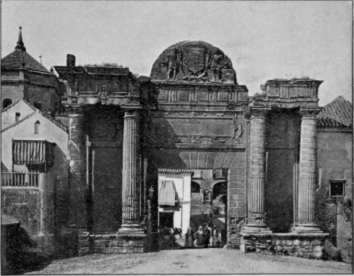
An Ancient Gate, Cordova.
"The Arabs," says the great scientist and philosopher, Humboldt, "deserve to be regarded as the veritable founders of physical science, even taking those words in the extended sense which they bear to-day. They may almost be said to have created botany. Chemistry is no less indebted to them. They cultivated geography and geometry with success. Astronomy especially owes to them an extensive development, and they determined the duration of the earth's annual revolution with an exactness which differs but one or two minutes from the most recent calculations."
Continue to:


My Books

