


Spain. Part 21
Description
This section is from the book "Spain - John L. Stoddard's Lectures", by John L. Stoddard. Also available from Amazon: John L. Stoddard's Lectures 13 Volume Set.
Spain. Part 21
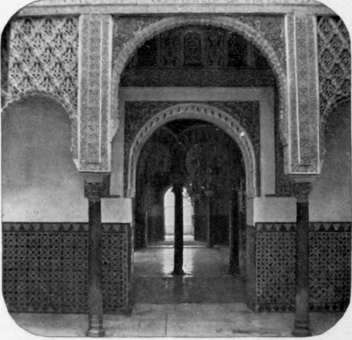
In The Alcazar, Seville.
This charming palace possesses for every visitor from the New World a special interest; for it was here that Queen Isabella gave her private jewels to Columbus, that he might have the means requisite for his voyage of discovery. In imagination, therefore, we can almost see the brave-hearted discoverer, his face kindled with the glow of hope regained after years of sad delay, kneeling before that gracious sovereign, whose wise courage and judicious patronage will ever remain a glorious honor to her memory. A casket of jewels does not seem much in itself, yet it sufficed in this case to change the destinies of two worlds.

Courtyard Of The Alcazar, Seville.
But all the souvenirs of this Alcazar are by no means so attractive. Around it cluster also gloomy memories which seem to have no fitness for so fair a spot; for these mosaic pavements have been reddened by the blood of murdered relatives and guests, and the atrocious deeds of Don Pedro, whom history has branded with the title of "The Cruel," have cast a lurid light upon these richly decorated halls. It was, for example, through these apartments that, sword in hand, this Nero of Seville, pursued his brother, whom he hated with jealous fury; and here the unhappy victim was at last struck down by the blows of the courtiers; while Don Pedro, coming up to where his brother lay quivering on the pavement, looked at him attentively, and then drawing his dagger, handed it to an African slave to give the wounded man his death-blow. This done, he calmly re-entered the palace and sat down with invited guests to dinner.
The most delightful portion of a tour in Spain is that devoted to Granada and the Alhambra. In the southeastern part of the Spanish peninsula lies an enchanting plain some thirty miles in length, green as the richest moss, partly-enclosed by picturesque hills and dominated by the snow-crowned Sierra Nevada. This beautiful expanse of verdure is dotted with innumerable white-walled villages and towers, as a rare Oriental rug might be adorned with pearls. At one extremity of this valley, which has often been the scene of desperate conflicts between Moors and Christians, two famous objects glitter in the sun, - one on the plain itself, the other seated like a queen upon a lofty throne: the first is the city of Granada, the second the palatial fortress of the Moors, - the world-renowned Alham-bra. Granada, - which by the way is the birthplace of Eugenie, the ex-Empress of France, - is said to have derived its name from the granates or pomegranates, which flourished here seven centuries ago as they do to-day. It is still one of the largest cities of Spain, although its population is but seventy-five thousand, as contrasted with four hundred thousand in the time of the Moors.
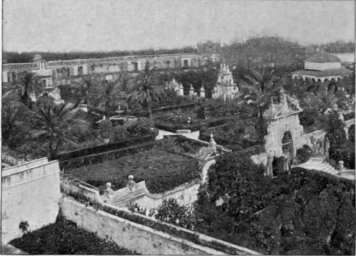
Gardens Of The Alcazar, Seville.
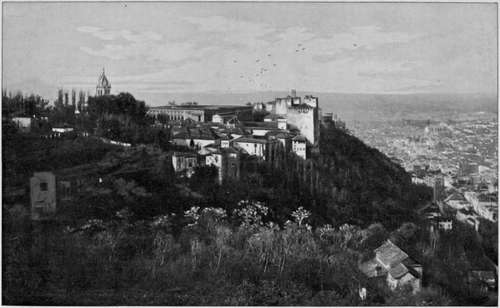
The Alhambra And Granada.
Above the town itself rises a steep hill, not unlike the Acropolis of Athens, crowned with the favorite home of the Moorish caliphs. The name Alhambra appropriately signifies "Red Castle;" for its walls and towers, emerging from an ocean of green foliage at their base, glow with a beautiful vermilion tint, in striking contrast to the blackness with which the hand of Time too frequently enshrouds the ancient edifices of the North.
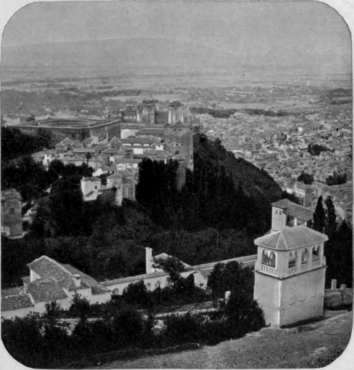
The Alhambra And Plain Of Granada.
The ascent to the Alhambra is easy. Broad avenues, often completely embowered in the shade of giant elms, one hundred feet in height, lead the way upward in gradual curves over finely graded terraces. There are certain glorious sensations in the life of every enthusiastic traveler, which in a moment repay him for weeks of absence, privation, and fatigue. No amount of travel can take anything from the thrill of emotion with which one first beholds certain historic sites. Such a spot is the Al-hambra, - a gem dimmed and flawed by the rude grasp of many conquerors, but still so mar-velously beautiful as to draw to itself admirers from every quarter of the globe. As I rode up this steep ascent and rapidly approached its storied courts, I felt as I did when gliding into Venice, or entering imperial Rome, or when my gaze first rested on the gilded domes of Moscow, or my feet trod the rough pavement of Jerusalem. Nor is the charm here purely one of history; for over these terraces stream numerous cascades, in channels framed with ivy leaves and verdant moss. In fact, the music of fountains or cascades, loosed from the mountain fastnesses above, greets one at every turn. We found the air here in the month of May as soft as in Greece or Egypt. Nightingales were singing in the abundant foliage, while the delicious perfume of orange-flowers and roses, which lined the walls at frequent intervals, made breathing a luxury and mere existence a delight.
Continue to:


My Books

