


Spain. Part 23
Description
This section is from the book "Spain - John L. Stoddard's Lectures", by John L. Stoddard. Also available from Amazon: John L. Stoddard's Lectures 13 Volume Set.
Spain. Part 23

Interior Of The Palace Of Charles V.
In the centre is still a marble basin of water, one hundred and thirty feet in length, now tenanted by goldfish and surrounded by hedges of myrtle and orange-trees, bright with their glistening leaves and golden fruit.
At each end of this enclosure we saw a row of slender marble columns supporting walls which looked like chiseled ivory. Above us was a characteristic Alhambra roof, composed of countless bits of cedar-wood inlaid with mother-of-pearl, and looking like the cells of a honeycomb or a grotto of stalactites. The whole place seemed so delicate and dainty, that I at first had scruples about walking freely on its marble pavement. In the walls are little openings surmounted by exquisitely sculptured arches, resembling the convolutions of a shell. It is supposed by some that these tiny mural alcoves held the slippers of the sultanas while they went to bathe. Others maintain that they contained some of the rare Alhambra vases; while others still believe that here were placed at night elegant porcelain lamps to shed a softened light upon the matchless decorations of the walls. However this may be, it is impossible to linger in this lovely court without imagining scenes which must have once occurred beneath these delicate arcades, when a sultana made her toilette attended by her female slaves. It seems incredible that this fair palace has not been tenanted for centuries. Everything here seems merely awaiting the return of some princess of the Arabian Nights.

Mural Alcove, Alhambra.
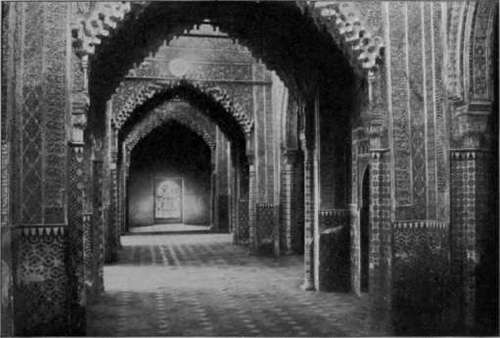
A Court In The Alhambra.
"Do you hear that song of the nightingale outside the walls?" asked my guide, Mariano, as I stood here. "In those notes, we fancy we hear the voices of the lost sultanas, who return thus in spirit to haunt their earthly paradise."
From the Court of Myrtles it is but a step to the Hall of Ambassadors, - the grand reception-room of the Moorish sovereigns. How is it possible to describe this apartment, in which, nevertheless, we lingered hour after hour during those bright May days? Piercing the thick Alhambra walls are nine elaborate windows, whose exquisitely chiseled arches seem as unsubstantial as frost-work; while so glorious is the view which they command, that at one of them Charles V is said to have exclaimed, sighing in pity for the exiled Moor, "Unhappy the man who lost all this!" Between these windows, and around the walls to the height of three or four feet, is a continuous expanse of the unrivaled Moorish tiles; and above these the mural decorations are so beautiful, that as I beheld them outlined against the azure of the Spanish sky, seen through the casements, I could think of nothing but a gorgeous mantle of finely woven, cream-colored lace, suspended near a robe of light blue silk; for, indeed, all the designs of the celebrated Spanish lace sold at Granada are copied from the walls of the Alhambra. It was here especially that Washington Irving loved to read and write; and the swallows which he described as twittering about the historic hall still dart in and out through the marble arches, and rest upon the cedar-wood lattices in the high wall, through which, doubtless, many a fair sultana has often gazed, unobserved, on the festivities below.
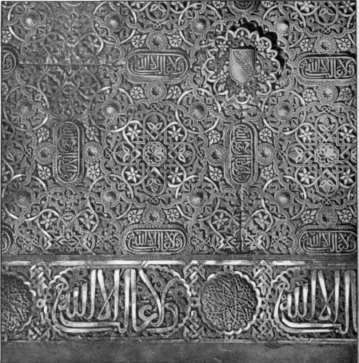
Arabic Inscriptions And Stuccoed Tapestry.
To comprehend better the beauty of the walls of the Alhambra, we must remember that they were formerly colored and gilded, as is evident from the traces of such ornamentation that remain. Truly, they must have then resembled silken nets of gold embroidery, containing countless intricate designs. It is interesting to note how the religious faith of these Moslems affected the architecture of their dwellings; for all this stucco tapestry has, interwoven with its gossamer fretwork, a multitude of Arabic inscriptions, mingling in frostlike tracery with the leaves and flowers, and meaning "Blessing," "Welcome," "God is our Refuge," "Praise be to God," and, above all, the motto, "There is no conqueror but God," words which the Moorish chieftain uttered to his subjects when they came forth to meet him returning victorious to Granada. Accordingly, these walls, many of which were destroyed by the priests as being pagan, are really poems proclaiming the goodness and greatness of God and forever wedded to the silent music of architecture.
Continue to:


My Books

