


Spain. Part 6
Description
This section is from the book "Spain - John L. Stoddard's Lectures", by John L. Stoddard. Also available from Amazon: John L. Stoddard's Lectures 13 Volume Set.
Spain. Part 6

The Picture-Gallery, Madrid.

The Escorial.
Chief among the artists represented here is, of course, Murillo, of whom the Spaniards say that he painted flesh tints with milk and blood. Murillo is not really known outside of Spain. I had always supposed, for example, that his famous "Immaculate Conception" in the Louvre, which represents the Madonna standing on a silver crescent surrounded by a glittering garland of cherubs, whose faces fade away into a golden atmosphere of glory, was the noblest expression of Murillo's genius. Here, however, one gazes upon other "conceptions" by Murillo, even more lovely and tender than that. Moreover, what increases our enjoyment of these paintings is our comparative want of familiarity with them. With other works by Raphael, Titian, Murillo, and Guido one is already well acquainted, through photographs and engravings, if not by actual inspection. But of many of these Spanish masterpieces no engravings have ever been made, nor are photographs of them usually sold outside of Spain. Hence almost every picture is an unexpected revelation of beauty, and has the charm of a complete surprise. Anticipate what you will, you cannot be disappointed here. To have seen and studied them is a joy forever.
One of the most impressive days I passed in Spain was devoted to a visit to the Escorial, twenty-five miles distant from Madrid. To understand the origin and architecture of this combination of mausoleum and palace, one must take into consideration the fact that there once lived in this evil world a holy man known as St. Lawrence. He was-, however, as unfortunate as he was holy, and wicked men put him on a gridiron and roasted him to death. Yet so undaunted was his courage, that after one side of his body had been thoroughly roasted, he is said to have calmly asked his torturers to turn him over and roast the other side. One day, about three hundred years ago, the Spanish sovereign, Philip II, gained a decisive victory over the French; that is to say, his soldiers gained it, for he himself was praying miles away, and ready to flee for his life in case of a defeat. When victory was assured, Philip, unwilling to give the credit to his general, ascribed it to the influence of St. Lawrence, upon whose anniversary the battle had been fought. To honor the saint, therefore, as well as to commemorate the victory, he reared this grim leviathan of architecture. There never was, and I hope never will be, a gloomier building. Even its situation is appalling. Of all the dreary places I have ever seen, except the desert of Sahara and the wilderness of Judea, this carries off the palm for desolation. On one side, savage-looking mountains tower threateningly above the place, without a particle of vegetation on their sides from base to summit; and on the other is a dreary waste of sand and rocks, resembling the lava-beds of old volcanoes. Yet such a site is admirably suited to the Escorial. Cold as the heart of its founder, this granite mass would have been out of keeping with the flowers and sunshine of a fertile valley. In honor of the roasted saint, Philip ordered this palace to be made in the form of a gridiron, and, as his will was law, this enormous structure, one of the largest in the world, and called by the Spaniards the eighth wonder of the world, was actually built after that grotesque design. Vast galleries, seven hundred feet in length, cross it to represent the gridiron bars; an immense projection on one side, containing the royal apartments, typifies the handle; while the feet of the inverted gridiron are indicated by pointed towers rising from the corners. The Escorial is therefore a despot's frightful fancy petrified, - something designed, apparently, by the author of the Inquisition during his hours of sleeplessness or remorse.
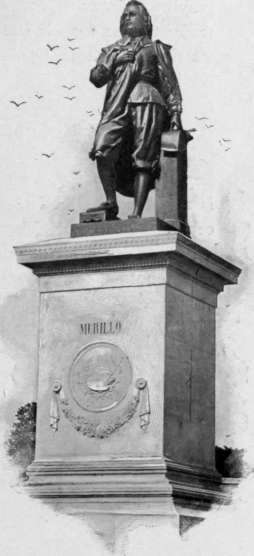
Murillo.

The Escorial Facade.
We entered the Escorial by means of a door in one of the gridiron bars. Over the study of the Grecian sage was written: "Let no one enter here who does not know geometry." If I could inscribe a warning over the portal of the Escorial it would be this: "Let no one enter here without a flask of brandy." Do not smile and deem this idle counsel. I had anticipated a cold place, and had put on an overcoat and gloves, so as to be prepared. But scarcely had we crossed the threshold when we seemed to be pierced to the very marrow with a death-like chill. There was no heat in the entire building, which displayed at every turn nothing but stone walls, stone ceilings, stone floors, and iron doors. It is impossible to describe the Escorial in detail, for this monstrous refrigerator has no less than sixteen granite courtyards, eighty granite staircases, twelve hundred doors, eleven thousand windows (to commemorate the eleven thousand virgins whose bones lie at Cologne), and, in all, about fifty miles of surface to walk over. I did not count all these, but I do not doubt the figures, and I am more certain of the fifty miles of walking than of anything else. Moreover, the Escorial is so terribly monotonous in its eternal garb of granite, that I could with difficulty distinguish the halls I had seen from those which I had not. Even the eleven thousand windows are barricaded with iron gratings, and one hears nothing in the corridors but the hollow echo of his steps, like the laughter of ghosts. Nor is there any beauty to relieve the eye. It is true, there are a few frescoes representing the tortures of heretics in the flames of hell, but these are not at all beautiful, though I am bound to say, they were the warmest things I found in the Escorial.
Continue to:


My Books

