


Spain. Part 5
Description
This section is from the book "Spain - John L. Stoddard's Lectures", by John L. Stoddard. Also available from Amazon: John L. Stoddard's Lectures 13 Volume Set.
Spain. Part 5
Another prominent building in Madrid is the House of Parliament. Before this, in the centre of the square, stands a bronze statue of Spain's greatest literary genius, - the author of the immortal Don Quixote - Cervantes. I was surprised to see him represented with a military cloak and sword; but a little reflection convinced me that these are not unsuited to that man of letters, for in his youth Cervantes was a gallant soldier, and bore the scars of battle till his death. And yet this man who had shed his blood freely for his country, and who has caused the world to call the Spanish tongue "the language of Cervantes," was miserably poor in life, and was buried like a pauper. By a strange coincidence, he died on the very day when the soul of the great Shakespeare also passed away from earth. How little did the world then realize its great loss! For more than a hundred years after Cervantes' death the places of his birth and burial were unknown; and only centuries after the hand that wrote and the brain that labored were but dust, was he honored throughout the world in song and story and by his statue in the Spanish capital.
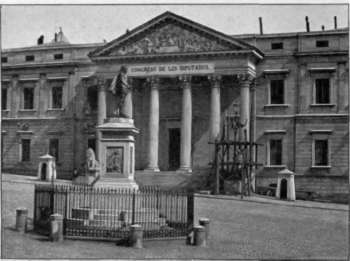
Statue Of Cervantes, Madrid.
The great rendezvous of fashionable life in Madrid corre-sponding to the Champs-Elysees of Paris, is the Prado, - a promenade two and a half miles long, which, as the name indicates,was once an extensive meadow. On summer evenings, this becomes a kind of open-air drawing-room, frequented by the best society of the capital. It is a charming place for romance; for in the favoring twilight the ladies are all beautiful and every cavalier is handsome. The heat and turmoil of the day are gone, and, since the Madrid world has already enjoyed an afternoon siesta.
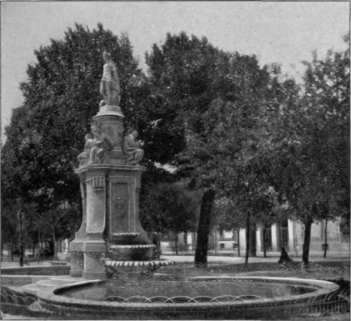
In The Prado, Madrid.
No one desires to retire early, and music floats upon the air from half past nine till after midnight. Here one sees many friendly groups or family parties gathered by themselves, and, in the pauses of the orchestra, the hum of conversation is borne upon the breeze, mingled with the sharp rustle of the ladies' fans, which open and close incessantly, as skillful fingers move them with wonderful rapidity and grace. Apparently the young men of Madrid bestow much time and care upon their toilettes, for they look as if they had just stepped out of a tailor's establishment and were wearing their fine clothes for the first time. It was only in the mature Spaniards, as a rule, that I saw indications of strong character or serious thought. The sight of some of these Spanish exquisites idling along the Prado recalled the remark of a dignified, turbaned Moor to his son, when he first saw a perfumed, effeminate dandy: "My son," he solemnly exclaimed, "if you ever forget your God and Prophet, and forsake the religion of your fathers, may you come to look like that!"
Even the children in the Prado were richly dressed. Soon after our arrival in Madrid a festival was held for the little ones in Spain. The streets were full of lovely children, dressed with elegance and decorated with brilliant colors. Several of them ran up to me on the Prado and held out tiny plates in their little gloved hands. At first I could not understand this, although I willingly gave the coin which they asked for. But I was afterward informed that on this particular day Spanish children are allowed thus to solicit small coins from adults to buy for themselves bonbons, dolls, and toys.
The most prominent building in the Prado is its picture-gallery. Before I went to Spain, a gentleman assured me that I would find the picture-gallery in Madrid superior to any in the world. "Not better than any in Italy!" I exclaimed incredulously. "Yes," he replied, unhesitatingly,
"superior to any in the world." I came to Madrid still skeptical on this point, but having seen the gallery I am entirely of his opinion. Just at the time when art was flourishing in the Netherlands, Spain was the sovereign power in those countries. Hence many of the finest works of Dutch and Flemish artists found their way to the court of Philip II. Whatever may be said in criticism of Spanish monarchs, it must be admitted that they were fond of art and rich enough to buy anything they wished for. Thus in the period of her glory, Spain purchased an enormous number of fine paintings, which subsequently were so effectually hidden away in palaces and convents that men knew nothing of them; but now that they have been brought together in Madrid they form a collection of masterpieces unequaled in the world. Upon the walls of this museum are hung no less than forty-six paintings by Murillo, ten by Raphael, sixteen by Guido, forty-three by Titian, sixty-four by Velasquez (whom Philip IV called "my only painter"), twenty-five by Veronese, thirty-four by Tintoretto, sixty-two by Rubens, and fifty-three by Teniers, not to mention numberless other treasures. Truly, the day when a lover of art enters such a gallery as this marks an epoch in his life. The visions of beauty which surround him here will leave their influence upon him as long as memory lasts. Some one has said that, if a man knew that he would become blind in a year, there is no place where he could garner up so precious a store of memories for the days of darkness as in the Museum of the Prado.
Continue to:


My Books

