


Spain. Part 4
Description
This section is from the book "Spain - John L. Stoddard's Lectures", by John L. Stoddard. Also available from Amazon: John L. Stoddard's Lectures 13 Volume Set.
Spain. Part 4
The Royal Palace in Madrid is universally conceded to be one of the most imposing kingly residences in the world. I can recall but two which are comparable to it: the Winter Palace of the Tsar at St. Petersburg, and one of the Sultan's marble structures on the Bosporus. Its splendid staircase of black and white marble is one of the finest in Europe, and so broad on either side that twenty men abreast could easily ascend it. When Napoleon entered this palace as conqueror of Spain, he is said to have placed his hand on one of these balustrades, exclaiming eagerly, "At last I have this Spain so long desired." Then, gazing on the magnificence before him, he turned to his brother Joseph, whom he had just made King of Spain, remarking: "My brother, you will be better lodged than I."
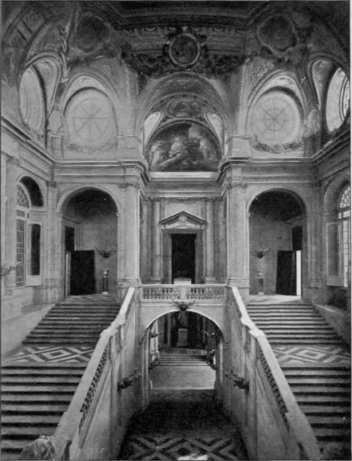
Staircase In The Royal Palace, Madrid.
The throne-room is of enormous size and lavishly adorned. The floor is of marble mosaic, and from the ceiling, which is richly painted and gilded, are suspended huge chandeliers of rock-crystal. The walls, too, are lined with mirrors set in costly marbles; and at every turn one looks on exquisite vases, bronzes, and statuary.
There are, however, few historical associations to lend value to this splendor. The frivolous, dissipated lives which have been led here are hardly worth the trouble of investigation; and, in her sad decadence, Spain has seen little issue from this room save a succession of inglorious reigns. Poor Spain! She has been long and systematically misruled. Bad Governments have well-nigh ruined her.
There is a tradition that King Ferdinand, on being presented to the Holy Virgin after death, asked for his country a long succession of favors, all of which were granted. At last, however, having begged for a good Government, the Virgin refused him pointblank. "If I gave you that," she replied, "not an angel would remain with me in Paradise; they would migrate at once to Spain!"
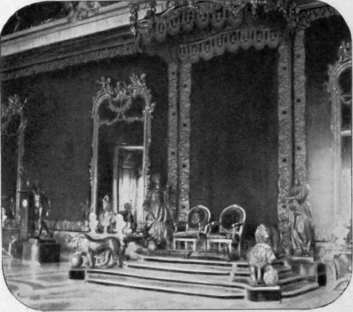
The Throne-Room.
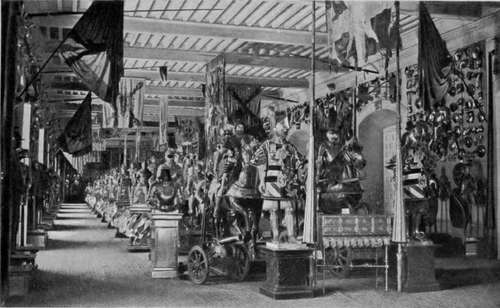
The Royal Armory.
One remarkable feature of this palace is the surprising number of clocks that it contains. There are, if I remember rightly, no less than five in one anteroom alone. In many apartments there are twice as many. A wit has said that this is the more extraordinary, as Spanish sovereigns have always been proverbially behind time. However this may be, some of them have had a mania for collecting clocks. Charles V, especially, bought scores of them, in his determination to make two go precisely alike; but, failing in this after repeated trials, he confessed that it was equally impossible to make men's minds hold exactly the same opinions.
Another very interesting portion of this palace is its celebrated armory. On crossing its threshold we were confronted by an army of warlike effigies - on horseback, and on foot - including kings, emperors, and famous heroes, clad in the finest suits of armor ever made. The walls, too, were covered with helmets, battle-axes, lances, swords, antique muskets, and coats of mail; while from the ceiling hung a multitude of tattered flags, trophies of victories gained in many portions of the globe. Some of these relics have a personal interest connected with the men who wore or wielded them. Thus we beheld here the swords of Cor-tez and Pizarro, the conquerors of Mexico and Peru. Here are magnificent Toledo blades which belonged to Charles V and Philip II. Beside them hangs a suit of armor worn by poor Boabdil, the last of the Moorish sovereigns of Granada. Here also can be seen the armor of Columbus; the sword which King Ferdinand carried in his battles with the Moors; and the litter on which Charles V was carried about when old and suffering. Truly, a soul-stirring room is this old Spanish armory. As I walked through its corridors glistening with steel, I felt myself carried back to the heroic days of Spain, - the age of her conquests and her glory. For here are the swords of her ablest leaders, the helmets of her most intrepid discoverers, and the breastplates beneath which her most valiant hearts have throbbed.
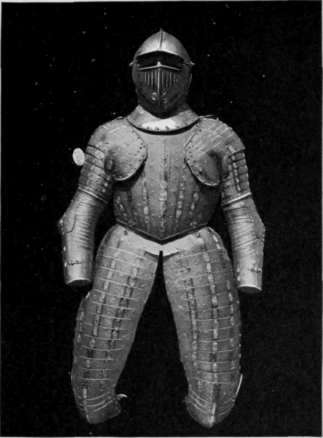
The Armor Of Christopher Columbus.
Continue to:


My Books

