


Spain. Part 3
Description
This section is from the book "Spain - John L. Stoddard's Lectures", by John L. Stoddard. Also available from Amazon: John L. Stoddard's Lectures 13 Volume Set.
Spain. Part 3
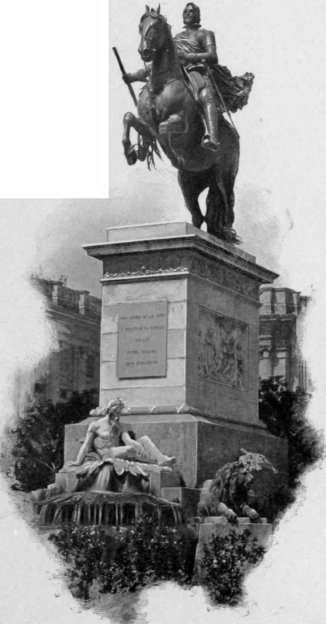
Statue Of Philip IV, Madrid.
Somebody has said that the king who first made Madrid a court residence, cannot yet have gotten out of purgatory, so great was the evil inflicted thereby on the nation. As a matter of fact, three centuries ago Madrid was an insignificant hamlet. Toledo and Seville had been in turn the capitals of Spain: one seated like a king upon a rocky throne; the other rising queen-like from the Guadalquivir, to send her fleets along its silver tide, far out upon the broad Atlantic. But, unfortunately, those were days when one man's whims might affect a nation's welfare; and since Charles V had fewer twinges of the gout in the sharp air of this locality, he chose it as the home of royalty, though Roman, Goth, and Moor had all alike rejected it. Notwithstanding its enormous bridge, it is a farce to claim that Madrid is situated on a river; for the Manzanares, which looked to us like the seashore when the tide is out, is really nothing but a mountain stream, so dry for three-fourths of the year that the washerwomen can hardly procure enough water from it to cleanse the linen of Madrid. It is highly amusing, therefore, to see ponderous arches spanning the little brook; but they are said to be needful when the mountain snows are melting, since then the swollen stream, for a time, threatens to carry everything before it. When Napoleon's soldiers, in pursuit of the fugitive Spaniards, came to the Manzanares, they exclaimed: "What! Do Spanish rivers run away, too?" The Spaniards themselves joke about this feature of Madrid. One, for example, compares this river's god, whose urn is so often dry, to the rich man in hell calling in vain for one drop of water; and it is a standing joke that the king ought either to buy another river or else sell his bridge.
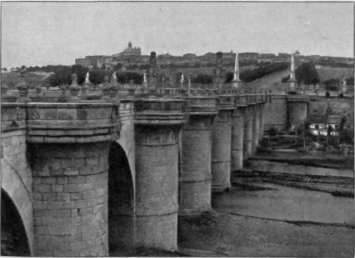
The Bridge At Madrid.
The climate of Madrid is far from healthful. It has been called "nine months hibernal and three months infernal." Built on the highest point of the great table-land, which forms the centre of the peninsula, it lies two thousand four hundred feet above the sea. There are no forests near, to break the force of the piercing winds from the neighboring snow-capped mountains; and though in summer the sun is often as scorching as a blast from a fiery furnace, by crossing to the shady side of the street one may feel cool enough for an overcoat or shawl. The difference between sun and shade is sometimes twenty degrees. After a little experience.
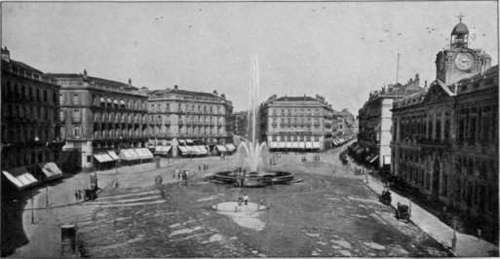
The "Gateway Of The Sun," Madrid.
Therefore, we began to appreciate the Spanish proverb - "The air of Madrid will not blow out a candle, but it kills a man." Soon after our arrival in the Spanish capital, we found ourselves in the famous square of Madrid, - the Puerta del Sol. This "Gateway of the Sun" was formerly the eastern portal of the city, and hence the first to be greeted by the dawn, but now it marks the centre of the great metropolis. As our hotel was situated here and we could view it at any hour of the day or night, we soon discovered the cause of its celebrity. For, although neither beautiful nor imposing, it constitutes the very heart of Madrid and throbs with tireless activity. Here are the best cafes, and the most important banking-houses, in front of which the devotees of pleasure or of business pass to and fro incessantly. Donkeys with tinkling bells, bull-fighters with sombreros, beggars with outstretched hands, and Castilians with folded cloaks, were visible here from dawn to dusk. From time to time wild-looking peasants would appear, making the hot air vibrate with their cries, as they proclaimed their wares for sale. Accompanying them were usually half a dozen mules, which, with their closely shaven backs, looked like gigantic rats. Around the walls a score of men and boys were constantly acquiring fresh coats of tan by sleeping in the sun; and as for priests, the square seemed fairly alive with their three-cornered hats and long black robes, which make them look like monster crows.
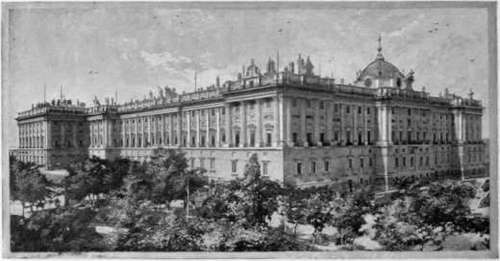
The Royal Palace, Madrid.
If you are in a mood for it, the sight of this animated, sunlit plaza makes you gay; if not, and, above all, if you are here alone, it renders you more sad than would the desert; for you well know that in this motley throng that crowds the Gateway of the Sun, there is not one who knows your name, or cares about your existence or your death.
Continue to:


My Books

