


Spain. Part 2
Description
This section is from the book "Spain - John L. Stoddard's Lectures", by John L. Stoddard. Also available from Amazon: John L. Stoddard's Lectures 13 Volume Set.
Spain. Part 2

Traveling Through The Pyrenees.
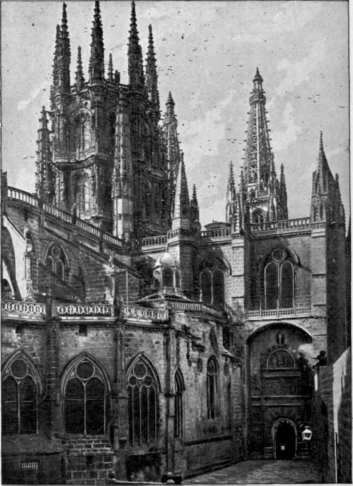
A Tower Of The Burgos Cathedral.
The beautiful cathedral at Burgos tempted us to break the journey midway between the frontier and Madrid, and spend twenty-four hours in the capital of Old Castile. I have never been quite certain whether to be glad or sorry that we did so. For pleasant and unpleasant memories are suggested by the thought of Burgos. It was the witching hour of half-past three in the morning when we arrived there, and the same hour the next morning when we resumed our journey, since there was but one express train daily. It was dark and cold when we dragged our cramped limbs to the hotel omnibus and yawned and shivered while the porter piled our baggage on the roof. Then, with much plunging and floundering, some half-starved mules pulled the lumbering vehicle over a series of rough pavements, and finally brought up in front of the hotel with a jerk that almost threw the passengers in a heap upon the floor. We had come to the only hotel in Burgos that the guide-books had dared to mention, and started bravely through an open door; but we soon discovered that we had entered a stable by mistake. Accordingly, trying a less inviting portal, we stumbled up some straw-covered stairs to a desolate upper hall. A sputtering oil-lamp winked an inflamed eye at us from the wall, but not a human being was visible. We therefore lifted up our voices, "Fondista! Fondista!" [Landlord! Landlord!] rang through the dismal halls, but all was silent as the grave. In despair we appealed to our omnibus driver, who, finally, with an air of conferring a great favor, condescended to show us some apartments. For a time we walked in desperation after this Spanish youth, from one room to another, each of which was a pungent reminder of the stable beneath. As each door was opened, it was as if a new bottle of unsavory odors had been uncorked, and when we stepped within, it seemed as if the bottle were held to our noses. At last, when we had chosen the least offensive rooms, daylight was streaming through the broken shutters, and wrapping the draperies of our couches about us, we lay down to unpleasant dreams.
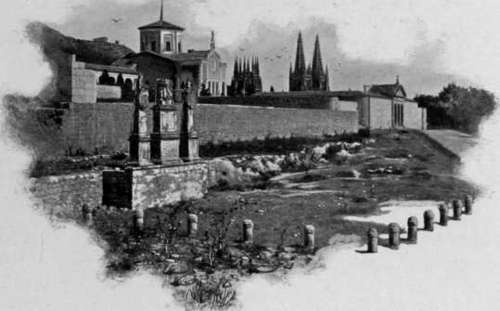
The Monument To The Cid, Burgos.
The great object of attraction in Burgos which induces tourists to put up with such discomforts is its cathedral of white marble - unquestionably one of the noblest specimens of Gothic architecture in the world. Its pointed towers rise like slender pyramids into the blue air to the height of three hundred feet, and are so exquisitely cut in perforated stone, that by night the stars gleam through the chiseled tracery as through the trees. Its splendid central tower resembles a grand tiara, adorned with scores of pinnacles and statues and turrets of wonderful lightness. This elaborate carving and wealth of decoration reminded us of the Milan cathedral, and we could hardly wonder at Philip II's declaration, that parts of it seemed the work of angels rather than of men.
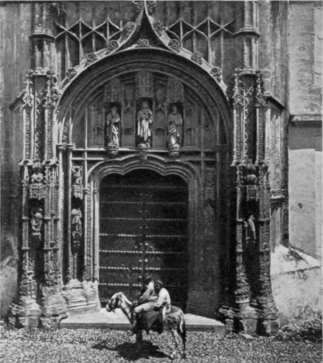
A Beautifully Sculptured Portal.
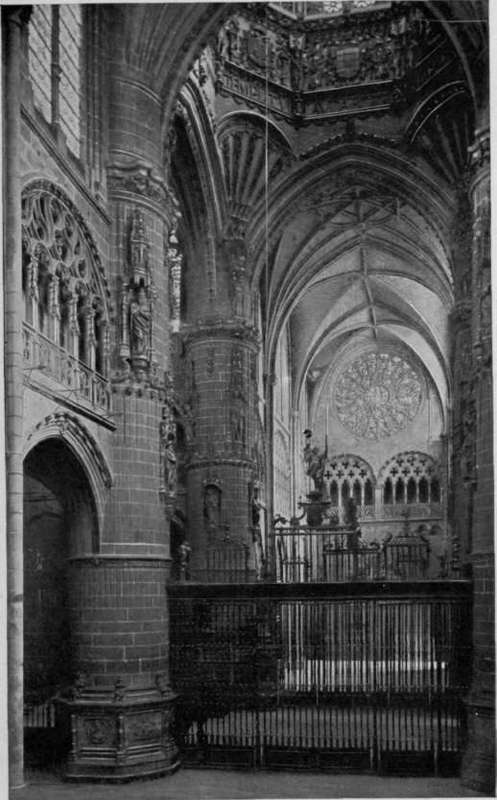
In The Burgos Cathedral.
An extraordinary object in this sanctuary is the old treasure-chest, or strong-box, of the Cid. Burgos is proud of having been the birthplace of this hero, and guards his coffer as a priceless relic. Although the Cid has been for nearly nine hundred years the national hero of the Spaniards, and a kind of modern Hercules, there is no doubt that he was a real character, whose exploits have been embellished and exaggerated by a mass of fables till, in the legends of old Spain, his name, like that of Abou ben Adhem, "led all the rest." He seems to have been a kind of free-lance, - a demigod for subsequent banditti, -warring alike on Moor and Christian to advance his own interests, and always equally feared by both. Certainly the "Poem of the Cid," composed in the twelfth century, is the oldest book of Spanish poetry extant, and it is said that a larger number of ballads have been devoted to his history than to any other subject.
Continue to:


My Books

