


Spain
Description
This section is from the book "Spain - John L. Stoddard's Lectures", by John L. Stoddard. Also available from Amazon: John L. Stoddard's Lectures 13 Volume Set.
Spain
Not many years ago, a tour in Spain was regarded as a dangerous enterprise. Even the Spaniards themselves, when about to travel in their own country, first, by way of preparation, sent for a priest to absolve their sins, a doctor to give them medicine, and a lawyer to make their wills. Within the past few years, however, traveling conveniences there have been so improved that priest, physician, and advocate are now no longer deemed so indispensable for a Spanish journey as a full purse and a reliable guidebook. Nevertheless, although it is easy of access and scarcely to be surpassed in interest by any other country on the globe, comparatively few tourists visit Spain. These few, however, are abundantly repaid. A Spanish preacher once declared that when Satan conveyed the Son of Man to the top of an exceedingly high mountain and showed to Him the kingdoms of the world, it was fortunate that Spain was hidden from view behind the Pyrenees, for otherwise (in his opinion) the temptation would have been irresistible.

A Spanish Diligence.
Does one desire sublime and varied scenery? In Spain it is spread broadcast, skirted by the classic Mediterranean and canopied by a sky of incomparable depth and beauty. Beneath its azure dome not only bloom the olive, the pomegranate, the orange, and the palm; but there, in striking contrast, are rugged mountains, and savage, solitary plains, imposing and majestic even in their severity. Is one in quest of art? Many of the grandest cathedrals in the world rear in Spain their vast proportions; while her famous picture-gallery at Madrid is equal to any in Italy, and superior to all the rest in Europe. Does one seek historic interest? Then surely Spain will prove no disappointment, for ruined structures, dating back to Romans, Goths, and Moors, are still extant there, fanned by the perfumed breath of orange-trees, or shaded by the drooping fringes of the palm, and speaking to us of the successive dominion of many powerful races, each of which has left behind it indestructible evidences of its sway. From Spain have come forth men destined to wield, as Roman emperors, the sceptre of the world. Here, too, the gifted Moors maintained their brilliant court for seven hundred years; and after their expulsion, there were times when Europe trembled at the nod of Spain and when her commerce was supreme. In fact, powerful in Germany, mistress of Italy, Belgium, and Holland, victorious over France, and drawing countless treasures from her colonies, Spain seemed at one time the dominant nation on the globe; while the discovery of America by Columbus and of India by Da Gama, together with her conquests in the New World under Cortez and Pizarro, not only shone like stars on the escutcheon of her history, but placed for years in her controlling hands the destinies of the two hemispheres.
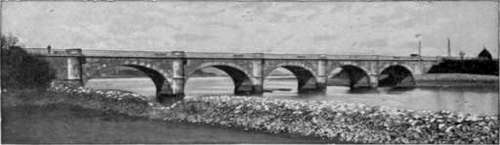
The Bridge Between France And Spain.
It will always be to me a memorable day when, from the southern province of the French republic, I crossed for the first time that majestic boundary between France and Spain - the Pyrenees. Never have I beheld from a railroad train such glorious mountain vistas as those which greeted us at every turn while winding up the Pyrenean heights. The ascent is gradual, but constant; for the centre of Spain is an immense plateau, rising in several places more than two thousand feet above the level of the sea. From whatever direction, therefore, the traveler approaches Madrid, he must ascend to this lofty elevation. Over these mountain ranges, the Spanish railroads, which are splendid specimens of engineering skill, have been constructed at enormous expense and with the greatest difficulty. When once the mountain scenery is passed, however, the railway journey becomes monotonous. Spanish trains run slowly, make frequent stops, and have a fashion of leaving prom-inent places at such unseasonable hours as three, four, or five o'clock in the morning, which after a time would cer-tainly prove ruinous even to the sweetest of American dispositions. We observed beggars at every station and peasants in all degrees of rags and poverty. The principal business at these halting places seemed to be that of selling cooling drinks to the passengers. The hot-blooded Spaniards seem always thirsty, and absorb liquids like sponges. Possibly this may be a consequence of their continuous smoking; for, mingled with the cries of Agua, agua fresca! [Water, fresh water!] are those of Fosforos, fosforos! [Matches, matches!] and both fire and water seemed equally in demand. I wonder if a Spaniard exists who does not use tobacco! Some wit has said that to a Spaniard a cigar is a cloud by day and a pillar of fire by night; and that the tobacco-plant springs spontaneously from every Spaniard's grave.
Continue to:


My Books

