


Spain. Part 8
Description
This section is from the book "Spain - John L. Stoddard's Lectures", by John L. Stoddard. Also available from Amazon: John L. Stoddard's Lectures 13 Volume Set.
Spain. Part 8
I never shall forget how delightful it was to leave the Escorial. When once again we breathed fresh air and saw the open sky, we laughed for joy. They seemed to be features of another world from which we had been exiled.
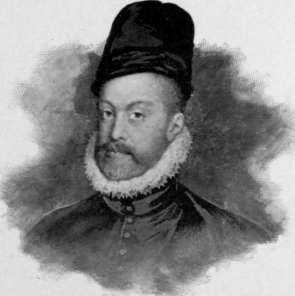
Philip II.
As we rode away from the prodigious edifice, our guide pointed out to us one of its corners into which Philip caused to be inserted a plate of gold an inch thick and a yard square. It was done in mere bravado. The Escorial had already cost the enormous sum of fifty million dollars, and the world predicted Philip's ruin. He, therefore, needlessly inserted here the precious metal to show his critics that he had gold enough to waste. Fortunately for its preservation it is above the dome, and glitters inaccessible to thieves.

Church Of ST. John Of The Kings, Toledo.
Theophile Gautier advises every one who thinks himself unhappy to go to the Escorial; for learning there how utterly wretched existence might be, he will be more contented all the rest of his life, from being able to say in the most deplorable circumstances: "I might be in the Escorial - and I am not."
Another very interesting excursion from Madrid was that which took us to the neighboring city of Toledo. Viewed from near or far, the situation of Toledo is magnificent. With the exception of Jerusalem, it is probably the most picturesquely located city in the world. Enthroned upon a rocky bluff twenty-four hundred feet above the sea, it rises almost perpendicularly from the river Tagus, which, surging through a chasm in the granite hills girdles the city al most completely.
The hill on which Toledo stands is terraced with houses, churches, palaces, convents, and old Moorish walls and towers, till finally the summit is surmounted by the enormous, orange-colored citadel of the Alcazar, frowning for miles over the surrounding plain.
What wonder that with such a situation Toledo has been besieged more than a score of times? What marvel that every conqueror who beholds it covets and resolves to have it? This gloomy castle-crowned city possesses an eventful history. Founded long before the Christian era by the Phoenicians, it was afterward a place of refuge for the Jews, who fled hither after the destruction of Jerusalem, only to find this city also ruled by the all-conquering Romans. Then came the Goths, who drove the Romans out of Spain, as they had previously crushed Rome in Italy. These were succeeded by the Moors, who, perched like eagles on these rocky heights, bade defiance to their foes for centuries. But finally they too were driven forth by another set of conquerors, - the Christians, who, having gained possession of these historic cliffs, have ever since retained them.

Toledo And The Alcazar.
Around this Spanish town are several picturesque bridges, which, one after the other, in the course of centuries, have flung across the Tagus their gigantic forms. With one of these, erected more than seven hundred years ago to replace a Moorish structure, is connected a singular story of womanly stratagem. It seems that the architect discovered, when too late, that his work was not strong enough, and must inevitably fall under a heavy weight. To his wife alone he whispered his unhappy secret. "All is not lost," exclaimed the lady of Toledo, "trust me, and you can still retrieve yourself."
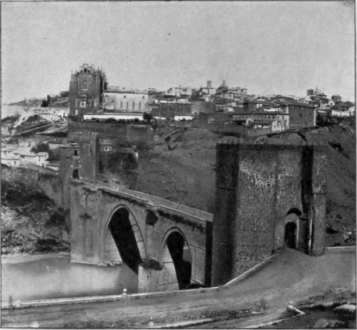
Old Bridge At Toledo.
Accordingly that very night she caused the bridge to be set on fire, and by burning down the entire structure saved her husband's reputation; for, profiting by his former error, he made in the construction of this arch no such fault. Less ancient than this, but wonderfully graceful, is the bridge of Alcantara, which spans the Tagus in a single arch. Near this point formerly lived that lovely girl whose charms were destined to overthrow the Gothic empire in Spain. The last of the Gothic kings who sat upon the throne of Toledo was Roderick, the base betrayer of an innocent maiden entrusted to him by her father, who was his intimate friend. The father of the injured girl implored the Moors to avenge him, and, nothing loth, the 'saracens advanced to attack Toledo. The Gothic sovereign went forth to meet them in a chariot of ivory, and dressed in gold and purple, but soon, in spite of his magnificence, suffered ignominious defeat and death on the banks of the Guadalquivir at the hands of the resistless Moors.
Continue to:


My Books

