


Spain. Part 9
Description
This section is from the book "Spain - John L. Stoddard's Lectures", by John L. Stoddard. Also available from Amazon: John L. Stoddard's Lectures 13 Volume Set.
Spain. Part 9
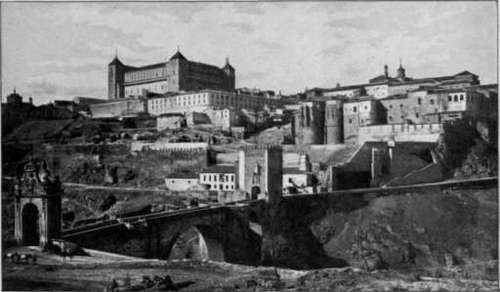
The Bridge Of Alcantara.
Beyond the portcullis and tower which mark the two extremities of the bridge, the road winds gradually around the hill like an Alpine pass, up to the Alcazar, a stronghold that has sheltered many conquerors. This was once so magnificent, alike in decoration and dimensions, that Charles V, when he first entered it, exclaimed: "To-day I feel as never before that I am an Emperor and a King." But the ravages of time and man have so defaced its stately halls that the old fortress-palace is nothing but a shell of granite, looking profoundly desolate above the lonely river.
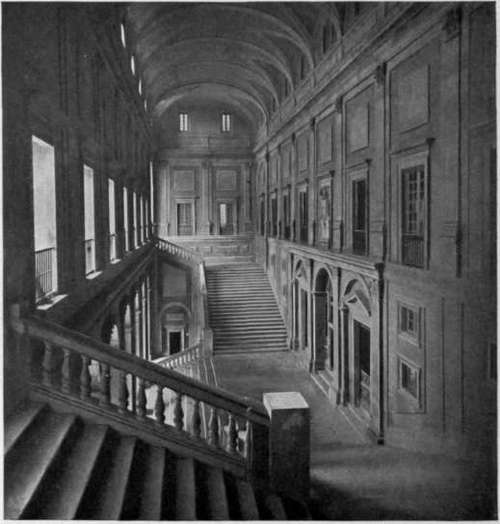
In The Alcazar Of Toledo.
We entered Toledo by the Gateway of the Sun. It is a splendid relic of its ancient glory, - an eloquent reminder of the fact that formerly this city was the pride of Spain, as famous in the world as Constantinople or Damascus. It was the favorite city of the exiled Jew, the stronghold of the Goth, the metropolis of the Moor, and the capital of the Christian, and it still bears the seal of grandeur in its walls and towers. Yet when I passed beneath this Moorish arch, although it was the hour of noon, few people were visible; the grass was growing in the neighboring pavement, the sleep of a thousand years seemed to have fallen upon the inhabitants. Ilium fuit! The glory of Toledo has departed.
Once in our walks through this city of the past, we heard a rumbling like distant thunder, which gradually came nearer and nearer, startling us by its contrast to the usual tomb-like stillness of the place. The cause was soon apparent. It was the hotel omnibus - one of the few vehicles of which Toledo can boast. We were in one of the comparatively broad streets, yet had to step into a doorway to avoid being crushed by the passing wheels, which almost grazed the houses in their course.
On both sides of the Toledo streets rise tall houses, severe and melancholy in appearance, solid as citadels and pierced with occasional grated windows. The dwellings are not open here as in the south of Spain. No charming courtyards reveal their flowers and fountains behind trellises of open iron-work. On the contrary, the gateways look like the portals of a fortress, flanked as they are with granite columns, while their heavy oaken doors are studded with enormous nails. Usually two ponderous iron knockers hang upon these doors - one to be used by pedestrians, the other, much higher, for horsemen. Everything in Toledo seems sombre, stern, and mysterious. It is a city of the past, - almost as sad and silent as a tomb. I can recall no town more utterly devoid of modern characteristics. It is the ghost of a departed glory.

A Toledo Street.
Spain is richer in cathedrals than any other country in the world, and one of the grandest of them all is at Toledo. The Virgin Mary is said to have a special liking for it, and to have paid it frequent visits - on one occasion actually descending for the special purpose of putting a new robe on St. Ilde-fonso, one of the archbishops. In fact, the scene is represented in sculpture and painting in all parts of the cathedral, and, to preclude all doubt about it, the very stone is shown on which the Virgin alighted. It is encased in red marble, and over it is the inscription: "We will worship in the place where her feet have stood."
There are several statues of the Virgin in the Toledo cathedral, each of which possesses a gorgeous toilette. One wears a mantle upon which are embroidered seventy-eight thousand pearls. Not content with that, the same statue is adorned with many diamonds, rubies, and emeralds. Her crown alone cost more than twenty-five thousand dollars, and her bracelets are valued at half that sum. All these are presents from kings and queens, popes, archbishops, and private ladies of wealth. Nor is this strange; for the Virgin ranks as a queen in Spain, and always wears the royal crown.
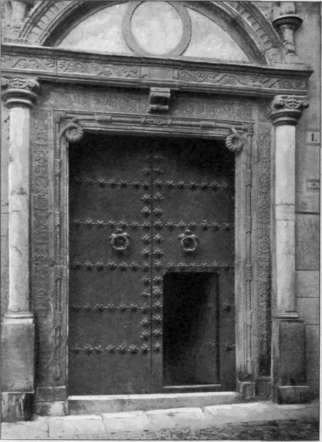
A Toledo Doorway.
The grand proportions and beautiful architecture of the cathedral of Toledo cannot be too highly praised. After the bright glare of the Spanish sunlight, it was a pleasure to find ourselves in the grateful twilight of the interior, for its seven hundred and fifty iris-colored windows flood the vast edifice with a beautiful combination of light and shade. The pavement is of variegated marble, and around the walls are twenty-three elaborate chapels. The greatest artists of Spain labored on this cathedral for six centuries. It is not strange, therefore, that it excited our enthusiasm. The choir, for example, is decorated with probably the most elaborate wood-carving in the world. Around a pavement of white marble rise, on three sides, two rows of seats for the priests, one above the other. Their arms, back, feet, head-pieces, and railings are exquisitely carved into sacred, grotesque, mythological, or historical subjects in bas-relief. The upper row is the work of the celebrated rivals, Berruguete and Philip of Borgona, who undertook their tasks, each determined to excel the other. One carved the seats on one side of the choir, the other the opposite ones. It is difficult to say which sculptor deserves the palm; but it is safe to say that no other wood-carving in Spain, rich as its cathedrals are in this respect, is equal to these sacerdotal chairs at Toledo. Moreover, to enhance their beauty, these seats are separated by beautiful jasper pillars, with alabaster bases and capitals; and over them extends a series of medallions, with figures of saints and patriarchs in relief. Leaving this splendid work of mediaeval artists, we entered one of the side aisles of the cathedral. As these approach the head of the Latin cross which forms the ground-plan of the edifice, they wind about the high altar in a curve which is not only charming from its grace, but awe-inspiring from its lofty and majestic sweep. As we advanced along this stately avenue, there burst upon our view a sight that hushed our voices into whispers, and held us spellbound where we stood. The lofty roof of the cathedral seemed to have opened, and there, in the glory of ten thousand sunbeams, we saw a multitude of angels, cherubs, saints, and apostles, apparently descending from the opened skies. For an instant the illusion was as perfect as if we were witnessing a celestial vision. The cause was soon explained. Directly behind the high altar is a circular opening in the ceiling, through which the light freely enters. Around and within this, as far as the eye can reach, havebeen sculptured a multitude of marble figures, whose appearance is that of saints and angels descending on the clouds of heaven. In no other cathedral of the world have I ever seen such a design, and I can recall few more effective. Possibly at some other time the impression might have been different. But we beheld it when the long aisles were darkening in the twilight and the storied windows glowed like tablets of rubies and emeralds. At such an hour, the statues in this lofty-passageway, through which the rays of sunset poured like a noiseless cataract of gold, appeared the wondrous revelation of another world.
Continue to:


My Books

