


Switzerland. Part 10
Description
This section is from the book "Switzerland - John L. Stoddard's Lectures", by John L. Stoddard. Also available from Amazon: John L. Stoddard's Lectures 13 Volume Set.
Switzerland. Part 10
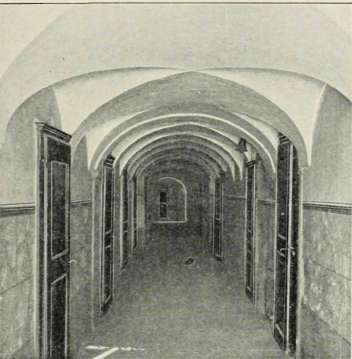
A Corridor In The Hospice.

Dogs Of St. Bernard.
How good the hot soup and wine instantly brought us by the kind friars! How comforting the thought of our surroundings, as the baffled storm beat against the frost - covered windows, and seemed to shriek with rage at being cheated of its victims!
Never, while memory lasts, shall I cease to remember with love and gratitude those noble-hearted brothers of the St. Bernard. Next morning the storm had cleared away; yet even in pleasant weather it is difficult to imagine anything more dreary than the situation of this monastery, locked thus in snow and ice, and sentineled by savage peaks, eight thousand feet above the sea.
Even the pond adjoining it is gloomy from its contrast to all other lakes. Its waters are too cold for any kind of fish, and therefore fail to attract hither any kind of bird.
Animal life has fallen off in making the ascent. Man and the dog alone have reached the summit.

Brothers Of St. Bernard.
It was with admiration that I looked upon the self-sacrificing heroes who reside here. What praise can be too high for these devoted men, who say farewell to parents and to friends, and leave the smiling vales of Switzerland and Italy to live upon this glacial height? Few of them can endure the hardship and exposure of the situation longer than eight years, and then, with broken health, they return (perhaps to die) to the milder climate of the valleys. During the long winter which binds them here with icy chains for nine months of the year, they give themselves to the noble work of rescuing, often amid terrible exposure, those who are then obliged to cross the pass. In this they are aided by their famous dogs, which, like themselves, shrink from no danger, and in their courage and intelligence rival the masters they so bravely serve. The travelers whom they receive in winter are not the rich, whose heavy purses might recompense them for their toil. They are mostly humble peasants, unable to give more compensation than the outpouring of a grateful heart. But there will come a day when these brave men will have their full reward; when He, who with unerring wisdom weighs all motives and all deeds, will say to them: "Inasmuch as ye have done it unto one of the least of these my brethren, ye have done it unto Me".
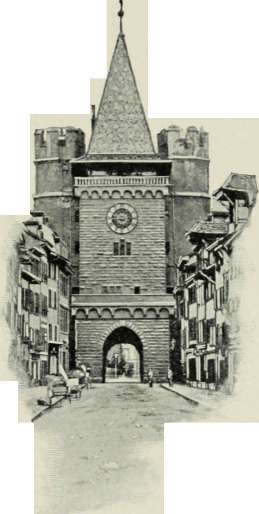
Old City Gate, Basle.
One of the most attractive of all the pleasure resorts in Switzerland is the lovely Vale of Chamonix. The first view one obtains of it, in coming over the mountains from Martigny, is superb. Three monstrous glaciers, creeping out from their icy lairs, lie beneath ice-fringed buttresses of snow, like glittering serpents watching for a favorable chance to seize and swallow their prey. Looking across the valley at them, it is true, they seem quite harmless; but in reality, such glaciers are the mighty wedges which have for ages carved these mountains into shape, and are still keeping them apart in solitary grandeur. What from a distance seems a little bank of snow is probably a wall of ice, one hundred feet in height. What look like wrinkles are crevasses of an unknown depth; and the seeming puff of smoke which one at times discerns upon them, is really a tremendous avalanche of snow and ice. Of the three glaciers which descend into the Vale of Chamonix, the one most frequently visited by tourists is the Mer de Glace. It is well called the "Sea of Ice," for its irregular surface looks precisely like a mass of tossing waves which have been crystallized when in their wildest agitation. To right and left, the ice is partially concealed by rocks and earth, which have been ground off from the adjacent mountain-sides, or which have fallen there, as the result of avalanches. Sometimes huge boulders are discernible, tossed here and there like nut-shells, the rocky debris of ages. What is there more suggestive of mysterious power than a frozen cataract like this? Apparently as cold and motionless as death, it nevertheless is moving downward with a slow, resistless march, whose progress can be accurately traced from day to day; so accurately, indeed, that objects lost to-day in one of these crevasses may be confidently looked for at the glacier's terminus after a certain number of years. Forever nourished on the heights, forever wasting in the valleys, these glaciers are the moving mysteries of the upper world; vast, irresistible, congealed processions, - the frozen reservoirs of rivers that glide at last from their reluctant arms in a mad haste to reach the sea.
Continue to:


My Books

