


Switzerland. Part 11
Description
This section is from the book "Switzerland - John L. Stoddard's Lectures", by John L. Stoddard. Also available from Amazon: John L. Stoddard's Lectures 13 Volume Set.
Switzerland. Part 11

Mer De Glace From Hotel Montaverde.

Appalling Precipices.

Zurich, With Distant. Alps.
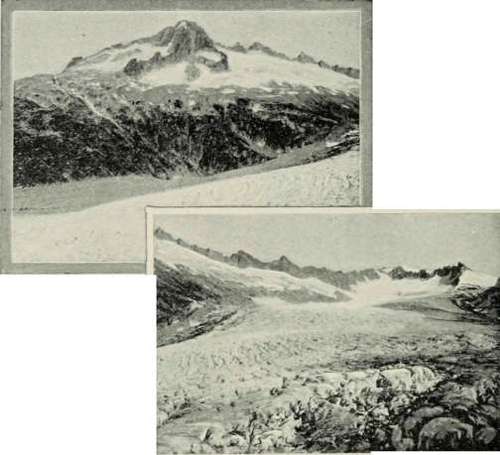
Frozen Cataracts.
"Perennial snow, perennial stream, Perennial motion, all things seem; Nor time, nor space will ever show The world that was an hour ago".
When we examine any portion of a glacier's surface, we find abundant evidence of its motion. It has been forced into a million strange, distorted shapes, many of which are larger than the grandest cathedrals man has ever framed.
Between them are vast chasms of unknown depth. As it descends thus, inch by inch, obedient to the pressure from above, it flings its frigid waves to the right and left, close to the orchards and the homes of man. It is the ghastly synonym of death in life; for here a man may swing the scythe or gather flowers, while a hundred yards away his brother may be perishing in a crevasse!
To really understand a glacier one must venture out upon its icy flood. One day while on the Mer de Glace, I was (as usual in such expeditions) preceded and followed by a guide, to both of whom I was attached by a stout rope. On that occasion one thing impressed me greatly. It was a strange sound, called by the guides "brullen," or growling, which is in reality the mysterious moaning of the glacier, caused by the rending asunder of huge blocks of ice in its slow, grinding descent.
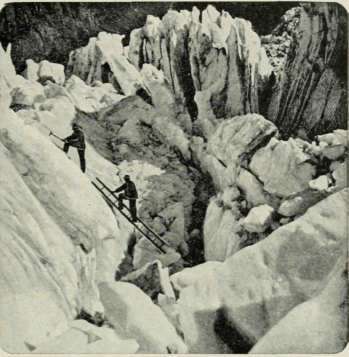
Crossing A Glacier.

A Perilous Seat.
At times it seemed to me impossible to proceed, but the experienced guide who led the way laughed at my fears; and finally, to increase my confidence, actually entered one of the appalling caverns of the glacier, which like the jaws of some huge polar bear, seemed capable of closing with dire consequences.
For a few minutes he remained seated beneath a mass of overhanging ice, apparently as calm as I was apprehensive for his safety. No accident occurred, and yet my fears were not unfounded. For though there is a fascination in thus venturing beneath the frozen billows of a glacier, there may be treachery in its siren loveliness. Huge blocks of ice frequently fall without the slightest warning, and many a reckless tourist has thus been killed, or perhaps maimed for life.

Irresistible Congealed Processions.

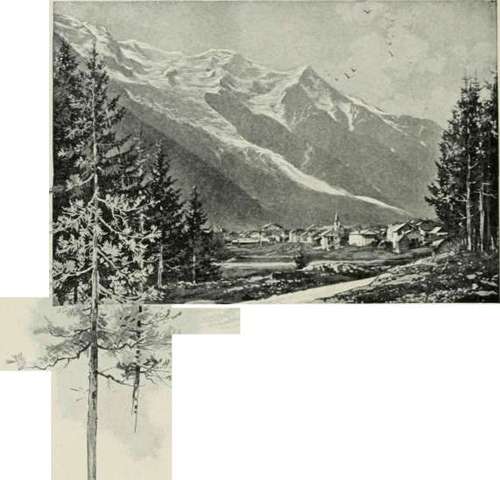
Chamonix And Mont Blanc.
On entering the little town of Chamonix, the tourist sees in front of one of the hotels a group in bronze that rivets his attention and awakens thought. It represents the famous guide, Balmat, who first ascended Mont Blanc in 1786, enthusiastically pointing out the path of victory to the Swiss scientist, De Saussure, who had for years been offering a reward to any one who should discover a way to reach the summit. The face of the brave conqueror of Mont Blanc and that of the distinguished scholar are both turned toward the monarch of the Alps. Instinctively the traveler also looks in that direction.
It is a memorable moment when one gazes for the first time upon Mont Blanc. We understand at once the reason for its being called preeminently the "White Mountain." The title was bestowed upon it because of the magnificent snow-white mantle which it wears, at a height of almost sixteen thousand feet. Probably no other mountain in the world has so towered up on the horizon of our imaginations. Long before we have actually seen it, we have repeated Byron's words:

Mont Blanc From Chamonix.

"Mount Blanc is the monarch of mountains; They crowned him long ago, On a throne of rocks, in a robe of clouds, With a diadem of snow".
Continue to:


My Books

