


Yellowstone National Park. Part 10
Description
This section is from the book "Yellowstone National Park - John L. Stoddard's Lectures", by John L. Stoddard. Also available from Amazon: John L. Stoddard's Lectures 13 Volume Set.
Yellowstone National Park. Part 10
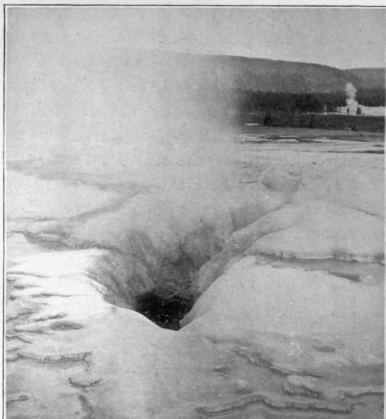
The Crater Of Old Faithful.

Castle And Old Faithful Geysers.
Within this area of the active geysers is a place called Hell's Half Acre. It is rightly named. Rough, perpendicular ledges project over a monstrous gulf of unknown depth, from which great clouds of steam are constantly emerging. When the wind draws back for a moment a portion of this sulphur-laden curtain, the visitor perceives a lake below, seething and boiling from internal heat. For years no one suspected this to be a geyser; but suddenly, in 1881, the underlying force hurled the entire lake up bodily to the height of two hundred and fifty feet, and even repeated the eruption frequently. After some months the exhibition ceased, and all was calm again for seven years. In 1888, however, it once more burst forth with prodigious energy, ejecting at each explosion more boiling water than all the other geysers in the Park combined. Even the surrounding ledges could not withstand this terrible upheaval, and tons of rock were sometimes thrown up, with the water, more than two hundred feet. It is not strange, therefore, that this is called Excelsior, the King of Geysers. It is the most tremendous, awe-inspiring fountain in the world. When it will be again aroused, no one can tell. Its interval would seem to be from seven to ten years. Said an enthusiastic traveler to me: "If the Excelsior ever plays again, I will gladly travel three thousand miles to see it".
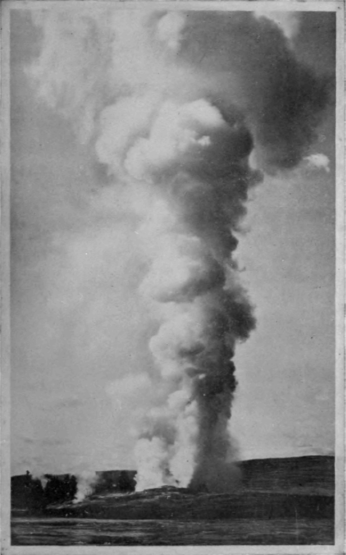
Old Faithful In Action.
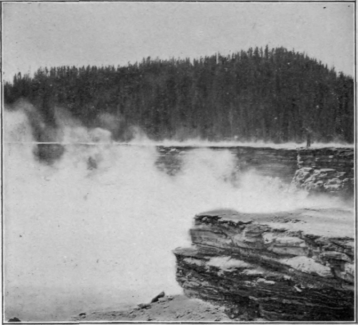
Hell's Half Acre.
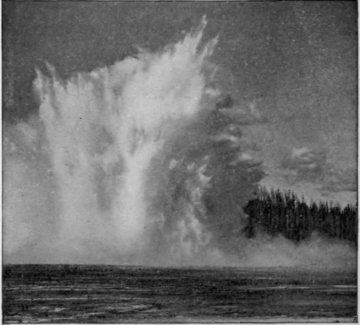
The Excelsior, In 1888.
I have a vivid remembrance of my last night at the Upper Basin. The hush of evening hallowed it. Alone and undisturbed we looked upon a scene unequaled in the world. Around us liquid columns rose and fell with ceaseless regularity. The cooler air of evening made many shafts of vapor visible which in the glare of day had vanished unperceived. So perfect were their images in the adjoining stream, that it was easy to believe the veil had been at last withdrawn, and that the hidden source of all this wonderful display had been revealed. No sound from them was audible; no breeze disturbed their steadfast flight toward heaven; and in the deepening twilight, the slender, white-robed columns seemed like the ghosts of geysers, long since dead, revisiting the scenes of their activity.
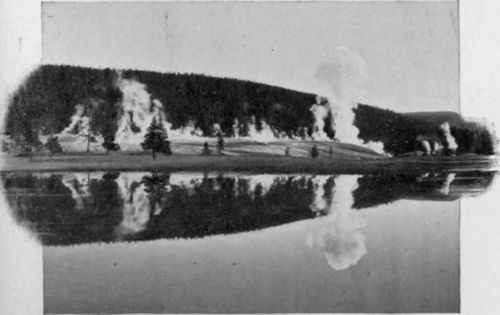
Evening In The Upper Basin.
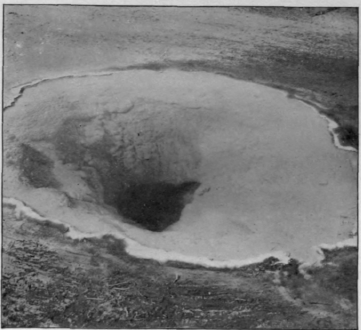
The Morning-Glory Pool.
But geysers do not constitute the only marvels of these volcanic basins. The beauty of their pools of boiling water is almost inconceivable to those who have not seen them. No illustration can do them justice; for no photographer can adequately reproduce their clear, transparent depths, nor can an artist's brush ever quite portray their peculiar coloring, due to the minerals held in solution, or else deposited upon their sides. I can deliberately say, however, that some of the most exquisitely beautiful objects I have ever seen in any portion of the world are the superbly tinted caldrons of the Yellowstone.
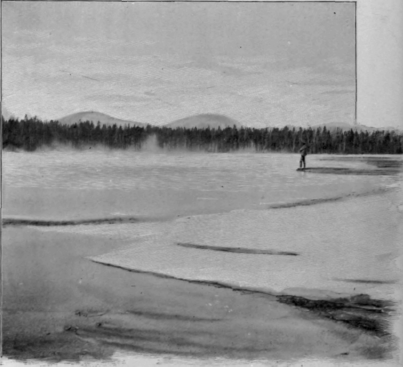
Prismatic Lake.

The Road Near The Golden Gate.
Their hues are infinitely varied. Many are blue, some green, some golden, and some wine-colored, in all gradations of tone; and could we soar aloft and take of them a bird's-eye view, the glittering basin might seem to us a silver shield, studded with rubies, emeralds, turquoises, and sapphires. Moreover, these miniature lakes are lined with exquisite ornamentation. One sees in them, with absolute distinctness, a reproduction of the loveliest forms that he has ever found in floral or in vegetable life. Gardens of mushrooms, banks of goldenrod, or clusters of asparagus, appear to be growing here, created by the Architect and colored by the Artist of these mineral springs.
Continue to:


My Books

