


Yellowstone National Park. Part 11
Description
This section is from the book "Yellowstone National Park - John L. Stoddard's Lectures", by John L. Stoddard. Also available from Amazon: John L. Stoddard's Lectures 13 Volume Set.
Yellowstone National Park. Part 11
The most renowned of all these reservoirs of color is called the Emerald Pool. Painters from this and other lands have tried repeatedly to depict this faithfully upon canvas, but, finally, have left it in despair. In fact, its coloring is so intense, that as the bubbles, rising to its surface, lift from this bowl their rounded forms, and pause a second in the air before they break, they are still just as richly tinted as the flood beneath. Accordingly this pool appeared to me like a colossal casket, filled with emeralds, which spirit hands from time to time drew gently upward from its jeweled depths.
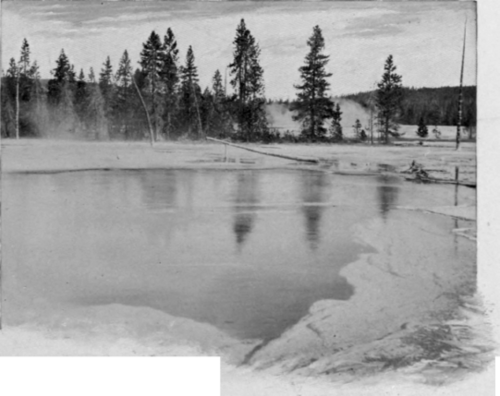
The Emerald Pool.
Close by this is another boiling pool called the Sunlight Lake. On this I saw one of the most marvelous phenomena I have ever looked upon. The colors of this tiny sheet of water appeared not only in concentric circles, like the rings of a tree, but also in the order of the spectrum. The outer band was crimson, and then the unbroken sequence came: red, orange, yellow, green, blue, and violet in the centre! Moreover, the very steam arising from it (reflecting as it did the varied tints beneath) was exquisitely colored, and vanished into air like a dissolving rainbow. All these prismatic pools are clasped by beautifully decorated curbs of silica, and seem to be set in rings of gold, with mineral colors running through them like enamel. So delicate are the touches of the magic water, as the persistent heart-beats of old Mother Earth propel it over their ornamental rims, that every ripple leaves its tiny mark. Hence it is no exaggeration, but literal truth, to say that beautiful mosaic work is being formed each time the films of boiling water are dimpled by the passing breeze.
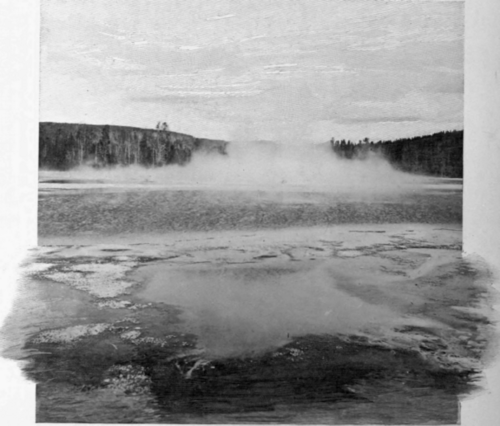
Sunlight Lake.
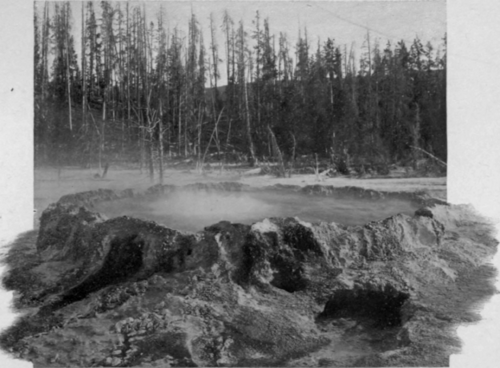
The Devil's Punch-Bowl.
The great variety of wonders in our National Park was a continual source of pleasure and surprise to me. Thus, in the midst of all the pools and geysers in the Upper Basin is one known as the Mammoth Paint Pot. The earth surrounding it is cracked and blistered by heat, and from this rises a parapet five feet high, enclosing a space resembling a circus ring. Within this area is a mixture of soft clay and boiling water, suggesting an enormous caldron of hot mush. This bubbling slime is almost as diversely tinted as the pools themselves. It seemed to me that I was looking into a huge vat, where unseen painters were engaged in mixing colors. The fact is easily explained. The mineral ingredients of the volcanic soil produce these different hues. In a new form, it is the same old story of the Mammoth Terraces. Fire supplies the pigments, and hot water uses them. All other features of the Park are solemn and impressive; but the Mammoth Paint Pot provokes a smile. There is no grandeur here. It seems a burlesque on volcanic power. The steam which oozes through the plastic mass tosses its substance into curious Liliputian shapes, which rise and break like bubbles. A mirthful demon seems to be engaged in molding grotesque images in clay, which turn a somersault, and then fall back to vanish in the seething depths. Now it will be a flower, then a face, then, possibly, a manikin resembling toys for children. Meanwhile one hears constantly a low accompaniment of groan-ings, hiccoughs, and expectorations, as if the aforesaid demon found this pudding difficult to digest.
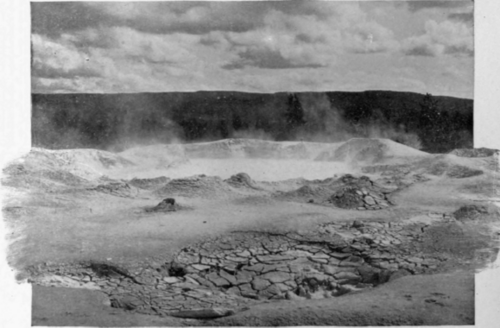
The Mammoth Paint Pot.
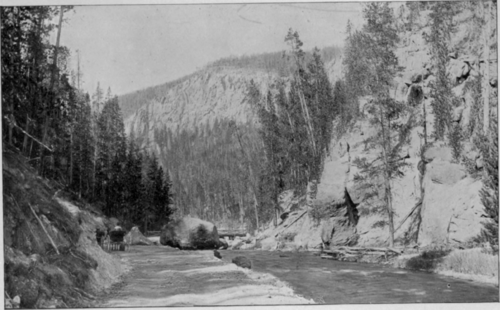
The Road By Gibbon River.
Soon after leaving the Upper Geyser Basin, we approached a tiny lake which has, in some respects, no equal in the world. With the exception of some isolated mountain peaks, it marks the highest portion of our country. In winter, therefore, when encircled by mounds of snow, it rests upon the summit of our continent like a crown of sapphire set with pearls. So evenly is it balanced, that when it overflows, one part of it descends to the Atlantic, another part to the Pacific. This little streamlet, therefore, is a silver thread connecting two great oceans three thousand miles apart. Accordingly, one might easily fancy that every drop in this pure mountain reservoir possessed a separate individuality, and that a passing breeze or falling leaf might decide its destiny, propelling it with gentle force into a current which should lead it eastward to be silvered by the dawn, or westward to be gilded by the setting sun.
Continue to:


My Books

