


Yellowstone National Park. Part 14
Description
This section is from the book "Yellowstone National Park - John L. Stoddard's Lectures", by John L. Stoddard. Also available from Amazon: John L. Stoddard's Lectures 13 Volume Set.
Yellowstone National Park. Part 14
Leaving the lake, we presently entered the loveliest portion of the Park, - a level, sheltered area of some fifty square miles, to which has been given the appropriate name of Hay-den Valley, in commemoration of the distinguished geologist, Doctor Ferdinand V. Hayden, who did so much to explore this region and to impress upon the Government the necessity of preserving its incomparable natural features. Even this tranquil portion of the Park is undermined by just such fiery forces as are elsewhere visible, but which here manifest themselves in different ways. Thus, in the midst of this natural beauty is a horrible object, known as the Mud Geyser. We crawled up a steep bank, and shudderingly gazed over it into the crater. Forty feet below us, the earth yawned open like a cavernous mouth, from which a long black throat, some six feet in diameter, extended to an unknown depth. This throat was filled with boiling mud, which rose and fell in nauseating gulps, as if some monster were strangling from a slimy paste which all its efforts could not possibly dislodge. Occasionally the sickening mixture would sink from view, as if the tortured wretch had swallowed it. Then we could hear, hundreds of feet below, unearthly retching; and, in a moment, it would all come up again, belched out with an explosive force that hurled a boiling spray of mud so high that we rushed down the slope. A single drop of it would have burned like molten lead. Five minutes of this was enough; and even now, when I reflect that every moment, day and night, the same regurgitation of black slime is going on, I feel as I have often felt, when, on a stormy night at sea, I have tried to sit through a course-dinner on an ocean steamer.
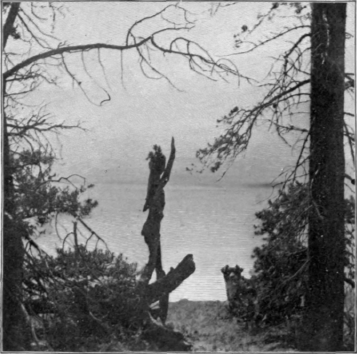
A False Alarm.
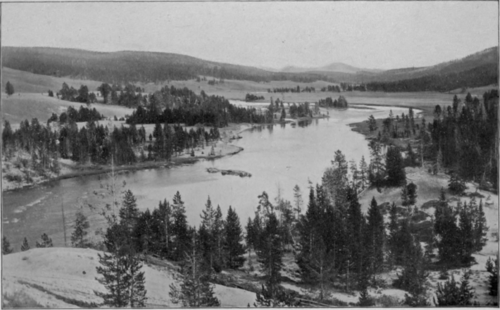
Hayden Valley.

Approaching The Mud Geyser.
Not far from this perpetually active object is one that has been motionless for ages, - a granite boulder enclosed by trees as by the bars of a gigantic cage. It is a proof that glaciers once plowed through this region, and it was, no doubt, brought hither in the glacial period on a flood of ice, which, melting in this heated basin, left its burden, a grim reminder of how worlds are made. Think what a combination of terrific forces must have been at work here, when the volcanoes were in full activity, and when the mass of ice which then encased our northern world strove to enclose this prison-house of fire within its glacial arms! One of our party remarked that the covering of this seething, boiling area with ice must have been the nearest approach to "hell's freezing over" that our earth has ever seen.
Another striking feature of our National Park is its Petrified Forest, where, scattered over a large area, are solitary columns, which once were trunks of trees, but now are solid shafts of agate. The substance of the wood, however, is still apparent, the bark, the worm-holes, and even the rings of growth being distinctly visible; but every fibre has been petrified by the mysterious substitution of a mineral deposit. No doubt these trees were once submerged in a strong mineral solution, tinted with every color of the rainbow. Still, more marvelous to relate, an excavation on the hillside proves that there are eleven layers of such forests, one above another, divided by as many cushions of lava. Think of the ages represented here, during which all these different forests grew, and were successively turned to stone! This, therefore, is another illustration of the conflict between Life and Death. Each was in turn a victor, and rested on his laurels for unnumbered centuries. Life is triumphant now; but who shall say that Death may not again prove conqueror? If not immediately, Death may well be patient. He will rule all this planet in the end.
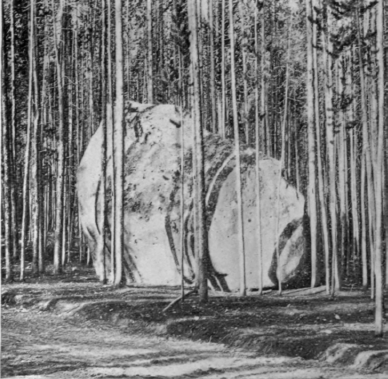
A Stranger In The Yellowstone.
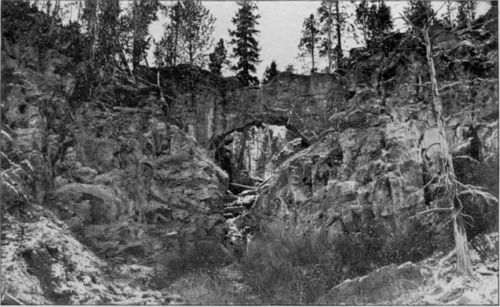
A Natural Bridge.
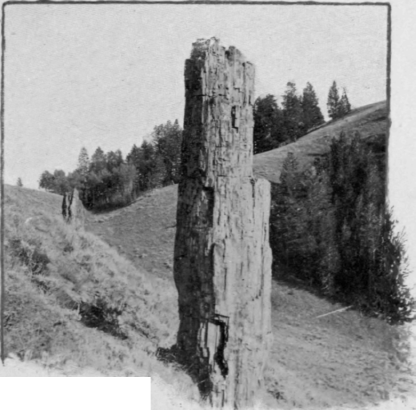
A Petrified Forest.
No one can travel through the Yellowstone Park without imagining how it looks in winter. The snowfall is enormous, some drifts in the ravines being hundreds of feet deep, and, owing to the increased supply of water, the geysers throw higher streams. No traveling is possible then except on snow-shoes; and it is with difficulty that some of the Park hotels are reached as late as the middle of May. Of course, in such a frigid atmosphere, the steam arising from the geysers is almost instantly congealed; and eye-witnesses affirm that, in a temperature of forty degrees below zero, the clouds of vapor sent up by Old Faithful rose fully two thousand feet, and were seen ten miles away.
Continue to:


My Books

