


Yellowstone National Park. Part 15
Description
This section is from the book "Yellowstone National Park - John L. Stoddard's Lectures", by John L. Stoddard. Also available from Amazon: John L. Stoddard's Lectures 13 Volume Set.
Yellowstone National Park. Part 15
It can be well imagined that to do much exploration here, in winter, is not alone immensely difficult, but dangerous. In 1887 an expedition was formed, headed by Lieutenant Frederick Schwatka; but, though he was experienced as an Arctic traveler, in three days he advanced only twenty miles, and finally gave out completely. Most of the exploring party turned back with him; but four kept heroically on, one of whom was the photographer, Mr. F. J. Haynes, of St. Paul. Undismayed by Schwatka's failure, he and his comrades bravely persisted in their undertaking. For thirty days the mercury never rose higher than ten degrees below zero. Once it marked fifty-two degrees below! Yet these men were obliged to camp out every night, and carry on their shoulders provisions, sleeping-bags, and photographic instruments. But, finally, they triumphed over every obstacle, having in midwinter made a tour of two hundred miles through the Park. Nevertheless, they almost lost their lives in the attempt. At one point, ten thousand feet above the sea, a fearful blizzard overtook them. The cold and wind seemed unendurable, even for an hour, but they endured them for three days. A sharp sleet cut their faces like a rain of needles, and made it perilous to look ahead. Almost dead from sheer exhaustion, they were unable to lie down for fear of freezing; chilled to the bone, they could make no fire; and, although fainting, they had not a mouthful for seventy-two hours. What a terrific chapter for any man to add to the mysterious volume we call life!
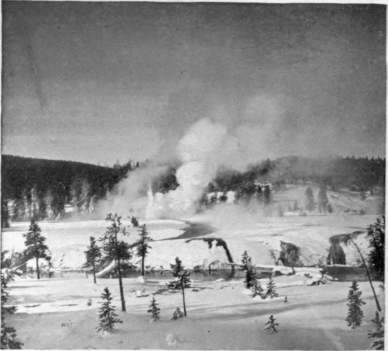
The Park In Winter.
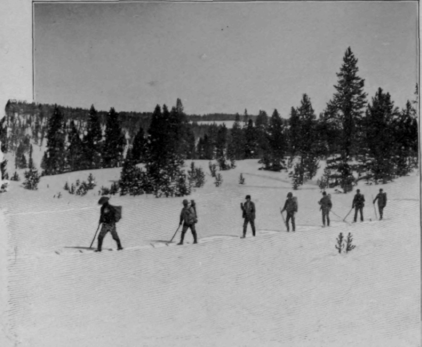
The Expedition Of 1887.
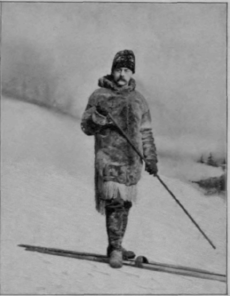
F. J. Haynes.
One might suppose by this time that all the marvels of our National Park had been described; but, on the contrary, so far is it from being true, that I have yet to mention the most stupendous of them all, - the world-renowned Cañon of the Yellowstone. The introduction to this is sublime. It is a waterfall, the height of which is more than twice as great as that of Niagara. To understand the reason for the presence of such a cataract, we should remember that the entire region for miles was once a geyser basin. The river was then near the surface; and has been cutting down the walls of the Cañon ever since. The volcanic soil, decomposed by heat, could not resist the constant action of the water. Only a granite bluff at the upper end of the Cañon has held firm; and over that the baffled stream now leaps to wreak its vengeance on the weaker foe beneath.
Through a colossal gateway of vast height, yet only seventy feet in breadth, falls the entire volume of the Yellowstone River.
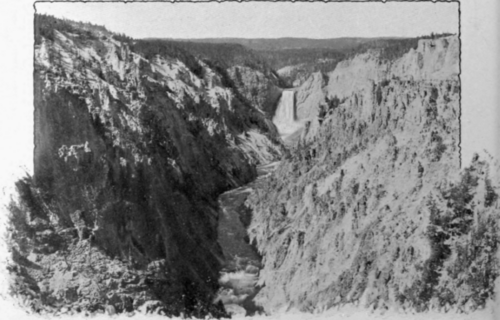
The Canon From A Distance.
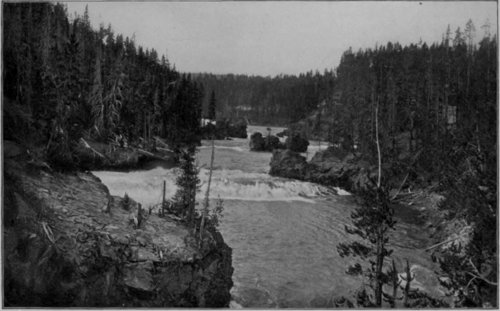
Yellowstone River Above The Falls.
It seems enraged at being suddenly compressed into that narrow space; for, with a roar of anger and defiance and without an instant's hesitation, it leaps into the yawning gulf in one great flood of dazzling foam. When looked upon from a little dis-tance, a clasp of emerald apparently surmounts it, from which descends a spotless robe of ermine, nearly four hundred feet in length. The lower portion is concealed by clouds of mist, which vainly try to climb the surrounding cliffs, like ghosts of submerged mountains striving to escape from their eternal prison. We ask ourselves instinctively : What gives this river its tremendous impetus, and causes it to fill the air with diamond-tinted spray, and send up to the cliffs a cease-1ess roar which echoes and reechoes down the cañon ? How awe-inspiring seems the answer to this question, when we think upon it seriously!
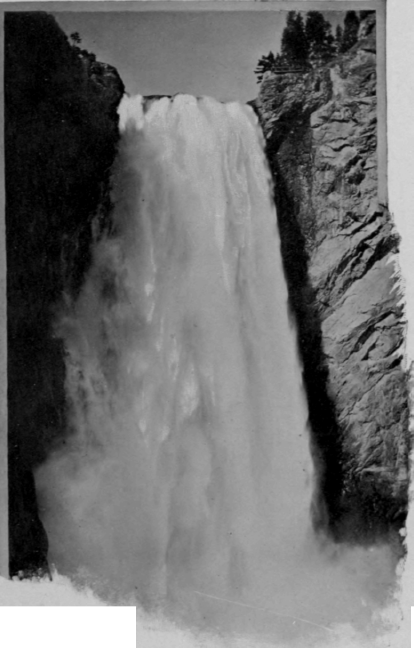
The Great Falls.
Of The Yellowstone.
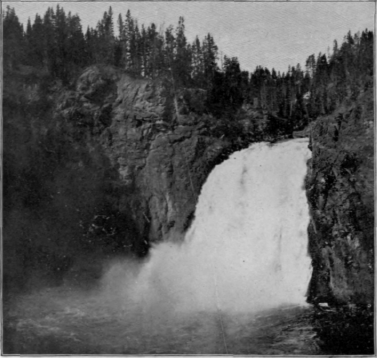
Upper Falls Of The Yellowstone.
The subtle force which draws this torrent down is the same power that holds the planets in their courses, retains the comets in their fearful paths, and guides the movements of the stellar universe. What is this power ?
Continue to:


My Books

