


Bees In California. Continued
Description
This section is from the book "History Of American Beekeeping", by Frank Chapman Pellett. Also available from Amazon: History Of American Beekeeping.
Bees In California. Continued
In 1876, he shipped a trainload of ten cars of honey, a total of 200,000 pounds, from his apiaries in San Diego County, direct to New York City. His first shipment was a full carload of section honey, the first ever shipped east from California. This was sent to Chicago, where it was sold to C. O. Perrine and Mathew Graf & Co. Other carlot shipments to Chicago and New York followed in 1874.
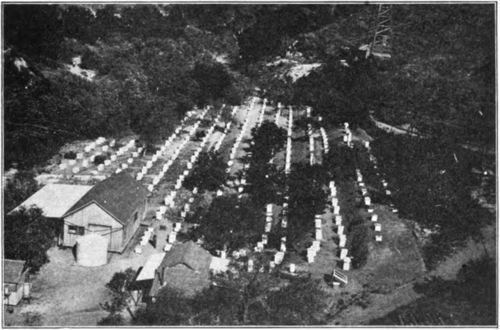
Mendelson's famous Piru apiary in which at one time he had 700 colonies.
In 1878, Harbison reported that three million pounds of honey were produced in San Diego County and about seven million pounds in southern California.
It was during the pioneer period when the country was covered with wild plants, that California beekeepers reaped a harvest. In 1889 the American Bee Journal reported a crop of about 228 tons from Ventura County. In that year, Harbison reported in the same magazine that the rapid settlement and clearing of the wild lands had, in a great measure, destroyed the beekeeping industry.
Harbison's shipment of ten cars of honey to New York in 1876 created a sensation in the East. Beekeeping at that time was generally an insignificant side line and few beekeepers produced as much as a ton of honey in one year. When a single beekeeper brought a hundred tons to market at one time it resulted in wide publicity. A reporter for the New York Sun interviewed the shipper, who gave an interesting account of his shipment and his experiences in its production. He is quoted as saying that he would not clear to exceed a thousand dollars for the entire shipment since he had employed fifteen men in its production. He had also found it necessary to move his equipment and product over rough mountain trails for long distances, and then pay freight across the continent to reach the market.
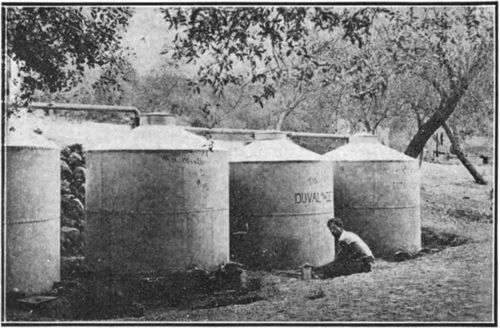
Storage tanks for holding the large crops of honey produced in the Mendelson apiaries.
This hardly agrees with a statement in King's Beekeeper's Textbook, published in 1878, which credits him with an income of more than $25,000 per year from honey alone, above expenses.
It is interesting to note that M. H. Mendleson, a young man then keeping bees in the East, was attracted by the news stories concerning Harbison's big shipment and went to New York to see for himself. He became so enthusiastic over the possibilities of beekeeping in the West that he soon followed and likewise became a famous honey producer in California.
When Harbison made his first trip east in 1857, he learned of the Langstroth invention. After his first winter's experience with Langstroth hives he wrote:
Most of the bees that had been put into them had died of starvation, they having eaten all of the stores from the bottom to the top of the hive in the center of a diameter equal to the size of the cluster, leaving an abundance of stores still within the hive, but owing to the severe cold the bees were unable to reach them. As an offset to this, I found the bees in my old improved hive were strong and vigorous, proving most conclusively the superiority of a hive deep from top to bottom over low flat ones.
This shortcoming of the Langstroth hive has been universally recognized in cold climates.
On his return to California, Harbison developed what he called the California Hive, which he patented. He made use of the Langstroth principle of the bee space and frame, but made a tall square hive instead of a low flat one. It was especially adapted to the use of the section honey boxes which he invented. This is discussed elsewhere. The Harbison hive never became popular outside of California, but was widely used in that state for a long period.
The deep frame was correct and, in this respect, he had made an improvement over Langstroth. Otherwise, however, the hive was cumbersome and expensive, and poorly suited to commercial use.
In the eighties and early nineties there was a serious conflict between California fruit growers and beekeepers. The fruit men accused the bees of injury to the fruit and numerous lawsuits were a natural result. In several instances the apiaries were burned by incendiaries. Harbison thus lost 350 hives in one year and himself broke up 700 more to avoid conflict. At one time he owned 3, 750 hives in twelve apiaries.
After the flush profits of the early years, there followed a period of low prices and reduced yields which discouraged many of the less efficient beekeepers. For a time honey sold at three cents or less.
Mendleson's apiaries at their height reached 2,000 colonies and his largest crop was 101 tons. At one time he had 700 colonies in his Piru apiary, a picture of which was widely used and which made the apiary famous. In later years a number of men had a thousand colonies or more, so that large holdings ceased to be regarded as unusual.
Continue to:


My Books

