


Chapter X. Bees In California
Description
This section is from the book "History Of American Beekeeping", by Frank Chapman Pellett. Also available from Amazon: History Of American Beekeeping.
Chapter X. Bees In California
There are numerous statements as to the first shipment of bees to California but, at this date, it appears to be impossible to determine positively when and by whom they were introduced. The Rural Press for November 2, 1889, stated that the original importer of bees into that state was W. B. Hay ford, of Colfax, who brought bees to that place in 1856. There are, however, well authenticated shipments prior to that date. J. S. Harbison, an early settler who imported large numbers of bees and engaged in honey production on a large scale, credited the first introduction to a person whose name was unknown who brought them to California in March, 1853. It is said that all the bees died after landing in San Francisco except one colony, which was taken to San Jose and threw off three swarms the first season. The purchaser, a man named Shelton, was killed soon after his arrival by the explosion of the steamer Jenny Lind. Two of the swarms were sold the following December to settle his estate and brought $105 and $110, respectively. A William Buck brought in another lot in November, 1855, He started from New York with thirty-six swarms and saved eighteen of them. He returned east again and brought out more, arriving in February, 1856, with seven colonies alive out of the forty-two with which he had started. F. G. Appleton bought a half interest in the first shipment which Buck brought out, and reported in a letter to Harbison some years later that the increase from twenty-eight colonies in 1856 was seventy-three, and that they secured 400 pounds of honey in boxes which they sold at $1. 50 to $2. 00 per pound.
H. B. Parks, who spent some years in Alaska, states that from translations of the records of the Orthodox Russo-Greek church at Sitka, he learned that bees were introduced into Alaska by a monk named Cherepenin in 1809. About 1830, bees were taken from Sitka to Ft. Ross in California. The author has been able to find no other reference to the shipment of bees to Ft. Ross and it is quite possible that none of them survived. However, W. H. Lewis, who went to California in 1856, wrote of finding grey-banded bees in the woods which he did not believe were descended from the New York importations. Since the Alaska bees came from Siberia, they probably were grey-banded bees.
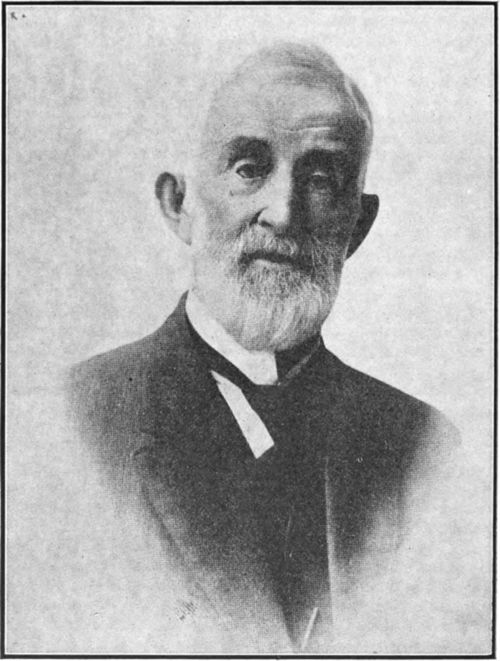
J. S. Harbison was best known among California pioneer beekeepers.
Harbison is authority for the statement that the first bees in the Sacramento Valley were brought from San Jose by A. P.
Smith in 1855, but they soon died, which gave the impression that bees would not do well there.

Hive used by Harbison for his successful shipment to California in 1857.
Chief interest lies in Harbison's own importations, since he made several shipments and succeeded in both importing and honey production. His first attempt was in the fall of 1855, when he sent east and had one hive sent out. They arrived in Sacramento in February, 1856, with only a few live bees left. On May 5, 1857, he left San Francisco on board the steamship "Golden Gate" for the purpose of bringing back a shipment of bees.
Sixty-seven hives were prepared for shipment from his own apiary in Lawrence County, Pennsylvania. They were taken to New York and started on their long voyage on November 5. On the fifteenth of that month he arrived at As-pinwall, where he released the bees for a flight before the next lap of the journey. They were carried across to Panama, where they were again placed aboard a ship bound for San Francisco. Harbiscn arrived in that city with his bees on the thirtieth, and sent them forward to Sacramento by another boat, which reached its destination on the second of December. The bees had been given ample stores for the long trip and were neither fed nor watered. Five colonies were dead and the weak ones were then united until the number was reduced to fifty. This was a remarkable success considering the difficulties to be met and the long confinement. With other importations attempted during the winter of 1857 and 1858, a large proportion of the bees died. Harbison records that the bees were carried a distance of 5, 900 miles, the longest distance which bees at that time were known to have been carried in one continuous voyage.
Harbison's next attempt was equally successful when, in company with his brother, W. C. Harbison, he brought 103 living colonies from Illinois and Pennsylvania, arriving at Sacramento January 1, 1859. Due to unfavorable weather after arrival, they lost so many that only sixty-two remained at the opening of the season. From these and the six good colonies remaining unsold from the previous shipment, they increased to 422 colonies by means of division. Not one natural swarm issued that season.
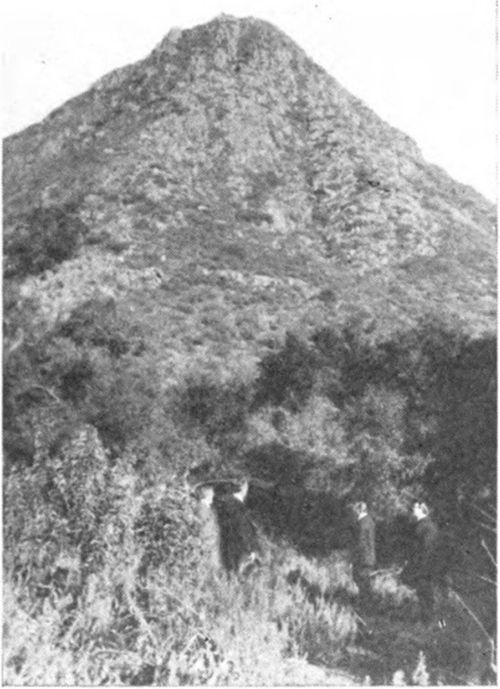
Harbison Mountain in San Diego County, California, near which Harbison had large apiaries in the early days.
Between October, 1858, and April, 1859, more than 1000 hives of bees were shipped from New York, and not more than 200 survived by May.
A certain J. Gridley took four hives all the way from Michigan to California in his spring wagon, arriving at Sacramento in August, 1859. His plan was to feed them and, also, to stop from time to time and release them for a few hours' flight in the afternoon.
By the winter of 1859-60 interest in importations was keen and more than
6. 000 colonies were shipped. Many of them were infected with foulbrood and thus the disease was carried to the far west at the beginning of its beekeeping history. Although better success attended these shipments than the average of previous years, about half of them were lost.
During the time when Harbison was importing bees from the East, he sold a total of 240 colonies at an average price of about $100 per colony. When a sufficient supply of bees was secured to meet the demands of the state, Harbison turned to honey production on a large scale.
Continue to:


My Books

