


Chapter III. The Comb Honey Era
Description
This section is from the book "History Of American Beekeeping", by Frank Chapman Pellett. Also available from Amazon: History Of American Beekeeping.
Chapter III. The Comb Honey Era
The year 1851, when Langstroth made his fundamental discovery of the bee space, marked a very definite turning point in the history of beekeeping. Improvements followed each other in rapid succession, and although they were somewhat slow in general adoption, the end of the box hive era was definitely in sight.
Although hundreds of different patterns were used in the making of hives, Langstroth had pointed the way in which the industry was to move. Once the beekeeper had found the means to control his bees, the next object was to separate surplus honey from the brood nest and to find ready means of expansion when the crop came in.
"Box honey" came into popularity, and for a time much of the honey went to market in small boxes, holding about five pounds, with glass in one end. These boxes were set under a big cover above the brood nest to be filled. Once full, they were removed from the hive and sent to market without any attempt to remove the honey from the box.
To J. S. Harbison, of California, belongs the credit of originating the comb honey section, which he called the "section honey-box. " This, according to his book, Beekeepers' Directory, he perfected on December 25, 1857. Although he used drawings to show the manner in which these sections were held together by coupling straps for use in the hive, the details of construction of these sections are not clear. They appear to have been larger than those in common use at a later period and nailed together at the corners.
Bees and Beekeeping, by W. C. Harbison, brother of the inventor, gives the following information about these sections:
The rings or sections are made of soft wood, top pieces 1 1/2 inches wide, 6 1/4 inches long, 3/8 inch thick; sides 5 1/2 long, same width and thickness as top. Bottom is a piece 5/8 inch square, set with one edge up, the opposite one downward, the edge flush with the end pieces. A triangular comb-guide should be put in the center of the top piece, and all nailed together with 7/8 finishing nails.
These sections were patented by J. S. Harbison, and, once the idea became public, it required only a little time to bring about improvements and refinements which approached present perfection.
In the eighteen-seventies improvement of the comb honey section received the attention of several prominent beemen. At that time most of the bee supplies were made at home and, accordingly, there was great variation in size of hives and other equipment. Every beekeeper had his own idea of correct size and it was seldom in agreement with his neighbor.

Comb honey sections such as above were first used by J. S. Harbison in his chamber hive.
In 1876, A. J. Cook, in his Manual of the Apiary, suggested a strip of clean, white veneer cut from basswood, two inches wide and twenty inches long, from which to cut the section. He gave detailed instruction for cutting and bending around a square block to form the honey box.
He also described a section made of white pine by the Hetheringtons. This is described as five and a half inches square.
The parts were grooved together and glued, a rather tedious process where large numbers were used.
In 1869 D. L. Adair, of Hawesville, Kentucky, had patented a section beehive which had a surplus chamber made by fitting a series of sections together, nine in a clamp. Each section was 5 by 6 by 1 1/2 in. This seems to have met with some favor, and for a time Adair sold the rights for use to individual beekeepers with one sample section for three dollars.

Interior of Harbison's hive with standing frames.
When the sections were first coming into use, many attempts were made to continue the use of the glass cover to which the public had become accustomed with the five-pound boxes. A glass cover for an individual section was not very practical since it required too much expense and was not easy to attach to the light frame in which the honey was stored.
In the April, 1876, issue of Gleanings, A. I. Root discussed the need of a uniform section and quoted C. O. Perrine to the effect that if beekeepers could be induced to adopt such a section, which could be packed together like bricks, the labor of the honey dealers would be lessened and the prices for the product advanced.
Root suggested that the section should be exactly square. He called attention to the honey boxes advertised in Gleanings at that time and mentions the sections made by George T. Wheeler, of Mexico, New York, of strawberry box material. Wheeler had secured a patent in 1870 and has the distinction of being the first to use sections in connection with a tin separator. Instead of making the bottom of his section narrower to permit the passage of the bees, he made openings in the bottoms of his sections. His section appears to have offered nothing of permanent value, but the idea of a separator was permanently adopted and became an important item in the comb honey producer's equipment.
Out of the numerous contributions which came to him, A. I. Root brought the idea of a four-piece section, all of equal length and dovetailed together at the corners. This he called the Universal Section.
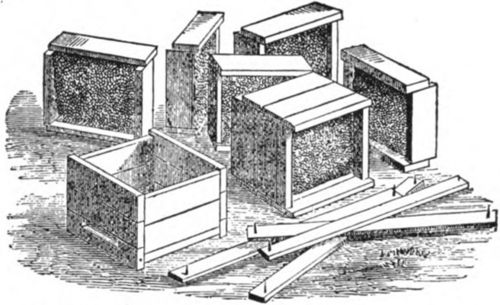
Adair's sections were fitted together nine in a clamp.
Only one important improvement remained to be made-the one-piece section. This improvement is generally credited to a man named James Forncrook, employed in the factory of Lewis and Parks, Watertown, Wisconsin. A picture of this section with the V-shaped grooves to permit folding, was shown in Gleanings in February, 1879. Thos. T. Delzell made the first announcement of a one-piece section in the American Bee Journal, June, 1878, but it was crude and imperfect.
A very unpleasant situation arose when Forncrook, while still an employee of the Lewis Company, applied for a patent on the one-piece section. At about the same time the company applied for a patent on the machinery used in its manufacture. Wishing to avoid litigation if possible, Lewis proposed to A. I. Root that both concerns continue to manufacture one-piece sections and both together defend any suit that might arise under the Forncrook claims. Root declined the offer but continued to manufacture. Lewis, on the other hand, devised a two-piece section which found a ready sale for a time.
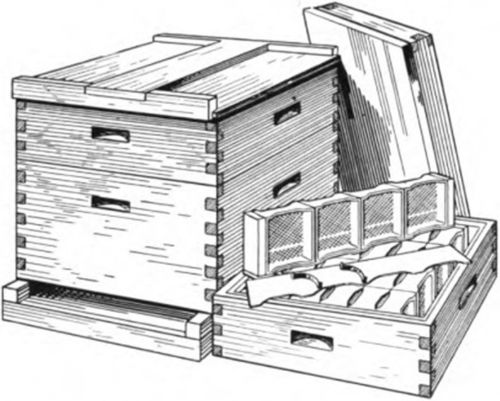
Langstroth comb honey hive as finally commonly adopted.
A suit was brought against Root for infringement of patent and finally resulted in a decision that the one-piece section was unpatentable. Following this decision the one-piece section replaced all others in common use among comb honey producers.
The years from about 1876 to 1910 may be regarded as the comb honey era. During that period the leaders of the industry were producers of comb honey, and most of the discussions in the bee magazines centered on its production.
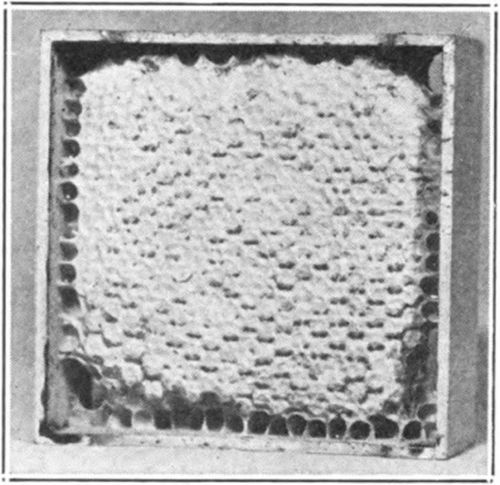
With the general adoption of comb honey in sections the tendency was more and more toward small hives.
It is interesting to note that J. S. Harbison, the inventor of the section, brought it to the attention of eastern beemen when his famous carload of section honey was shipped to C. O. Per-rine in Chicago, in 1873.
This was followed by other and larger shipments the following year, as told elsewhere.
California beekeepers were familiar with the section some years in advance of those farther east. In those days of slow communication, improvements were slow in passing from one region to another.
Following the invention in 1857, Harbison produced some honey in sections the following year and exhibited 500 pounds of section honey in two-pound combs at the California State Fair in September, 1858. In 1876, he exhibited section honey at the Centennial Exposition at Philadelphia and received the highest award. With the first carload of fresh fruits shipped from California to Chicago over the Central and Union Pacific Railroad soon after its completion, went a case of comb honey from Harbison.
Continue to:


My Books

