


Langstroth's Invention Of The Bee Space. Part 3
Description
This section is from the book "History Of American Beekeeping", by Frank Chapman Pellett. Also available from Amazon: History Of American Beekeeping.
Langstroth's Invention Of The Bee Space. Part 3
R. C. Otis, of Kenosha, Wisconsin, who was interested with Langstroth in the patent, resented King's action and stated that King advertised the inventor as an object of charity and that he would give $500 to obtain justice for Langstroth. King replied that he would give $1,000 and draw the check immediately. Otis replied that King should be prosecuted for infringement of the patents. This unfortunate controversy served to bring the matter to public attention.
Langstroth published a letter in the American Bee Journal in which he declined to accept funds to be raised in this manner and asked for justice, not charity.
Facing a test in court, King made a trip to Europe in search of proof that the principles of Langstroth's invention had been known prior to his time. On his return he published long articles in his Beekeepers Magazine in which he set forth that W. Augustus Munn, of Dover, England, was the first inventor of such a frame, making his first hive with frames in 1834. This, he contended, invalidated the pretended claims of Langstroth. He also mentioned the frames used by Huber, De Beauvoys in France, and von Berlepsch in Germany to prove that Langstroth's claims were ridiculous. King's contentions were copied in the American Bee Journal by the editor, Samuel Wagner, who was a friend of Langstroth, and they were followed by articles by Langstroth who quite successfully refuted King's claims.
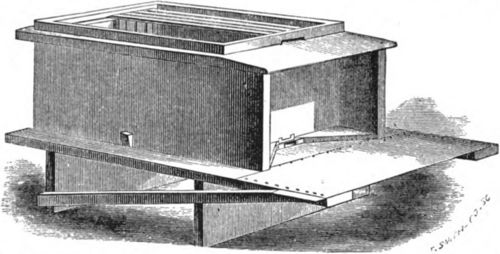
The Langstroth hive as it appeared in the early years. The public failed to understand that the fundamental part of his patent was the bee space.
At this point, when things were at a critical stage, Charles Dadant appeared upon the scene with an article entitled "Honor to Whom Honor is Due. " Because of his familiarity with the hives in use in Europe, he was able to point out clearly the essential differences in the hives under dispute and clear up much of the confusion. He is generally credited with having done much to assist Langstroth in obtaining proper recognition.
The strain of the suit, however, and the unfortunate controversy which arose among the beekeepers because of it, was too much for the sensitive Langstroth. After the death of his wife and his partner, Otis, he was again overcome by illness and was unable to press the suit to a conclusion. He accordingly dropped it and left King free to continue the manufacture and sale of hives unhampered.
The issue of the American Bee Journal which contained so much regarding the contentions of the two men in regard to the patent, also announced the death of the editor, Samuel Wagner. A comment which he added to Dadant's article, in which he stated that "King may begin to suspect that his efforts at deception have not been quite as successful as he hoped they would, " was probably the last thing written by Wagner.
In addition to the hives with hanging frames utilizing the bee space, which were patterned after Langstroth's invention, there also had appeared a number of others with the frames placed in other ways, similar to the old world hives which had preceded the discovery of the principle of the bee space. When Langstroth retired from the field and gave up the attempt to protect his patent, these were gradually replaced. Although frames of many sizes and shapes continued to be used, nearly all hive makers adopted the loose hanging feature with the bee space.
When A. I. Root started his magazine he began agitating for a cheap hive and contended that a good hive should be sold for a dollar. Numerous references to dollar hives appeared in his publication for several years. Later he was to engage in the manufacture of hives himself and ship the product of his factory to the ends of the earth.
The arguments concerning hives were to continue for half a century before the demand settled down to a very small number which had proved their worth by extensive trial from Maine to California. In Chapter IV (The Hive Controversy) follows something of this extended hive controversy, the details of which would fill many volumes.
Continue to:


My Books

