


Langstroth's Invention Of The Bee Space. Part 2
Description
This section is from the book "History Of American Beekeeping", by Frank Chapman Pellett. Also available from Amazon: History Of American Beekeeping.
Langstroth's Invention Of The Bee Space. Part 2
Thus was born the idea for the modern beehive, and on the 6th of January, 1852, application was filed at Washington for a patent. The patent was issued on the fifth of the following October. While the patent secured for the inventor the credit which was his due, it was otherwise but a source of vexation and annoyance, and he would have been far better off to have given his invention freely to the world.
The following spring the bars were carefully removed from his hives, and end pieces and bottom bars added so as to make them movable frame hives instead of bar hives. That season he also had more than a hundred new hives made. A few were sold but the greater number was used in his own apiary in west Philadelphia. In the spring of 1852 he disposed of his school for young ladies and decided to give all his attention to his bees and to forwarding his invention. In the autumn of that year he was prostrated by a peculiar illness which he called his "head trouble. " This illness became so severe that he was compelled to dispose of his bees and abandon his business. He left his wife and daughters in Philadelphia and went to make his home with his brother-in-law, Almon Brainard, of Greenfield, Massachusetts. For a period of nearly six years he had no settled home, and much of the time was separated from his family. This was a trying period to the sensitive man, who looked forward with great longing to the time when he should be reunited with his family.
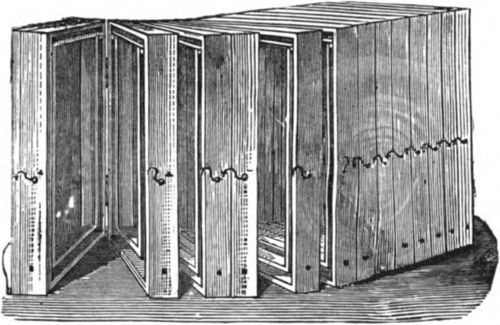
In the Huber Leaf Hive the frames moved apart like turning the leaves of a book.
While Langstroth was living in Greenfield a Dr. Joseph Beals offered to provide means to manufacture the hive for an interest in the patent. The doctor appears to have lacked the business experience necessary to success with a venture of this kind, and after a few years the partnership was closed without loss of money but of much time.
When Langstroth published his book he devoted a chapter to the advantages to be found in an improved hive. He stated that unless the combs are in entire command of the apiarian he can have no effective control over the bees, and that was the chief advantage of his hive.

At the time of Langstroth's invention the only step forward in America had been to place a cap over the box in which the bees were kept to permit storing surplus honey above the brood chamber.
It is significant that the dimensions which he adopted have been generally adopted by beekeepers over a wide territory. The Langstroth hive was built to contain ten frames 17 5/8 by 9 1/8 in. in size. His idea was to adopt a size suited to the natural instincts of the bee and capable of adjustment by expansion or contraction to meet changing conditions. He called attention to the fact that because the hive was low in comparison with other dimensions it was not upset easily by the wind.
With the introduction of the Langstroth hive there was a rush to invent new and improved patterns. The public failed to understand that the fundamental part of the patent was the bee space, and that any hive with this feature would be an infringement of the Langstroth invention. Hives appeared with shorter frames, deeper frames, and with every possible variation in details of minor parts until the patent office was deluged with applications. Literally hundreds of new hives made their appearance until it seemed that every beekeeper was impressed with the idea of a new kind of hive.
With little means and being in poor health, Langstroth was ill-prepared to contest these numerous claims and to protect his rights in an invention destined to revolutionize beekeeping and develop into an industry that which had been a very minor pursuit. He had, however, formed a partnership with a man named Otis for the manufacture and sale of his hive, and they finally started suit against H. A. King, who was the most flagrant in his infringement of the Langstroth patent.
In the spring of 1867 King had entered into contract with
Invention of the Bee Space
11
Langstroth to pay a certain sum as royalty for the privilege of manufacturing hives including features covered by his patent. In the spring of 1870 King notified Langstroth that because of changes in his hive he could no longer be obliged to pay royalty. In commenting on the approaching legal contest with King, Langstroth wrote at length concerning his difficulties with the patent in the American Bee Journal, April, 1871. He said:
The application for the extension of my patent was hotly contested. Most of the parties who fought it have passed off the bee stage, and I have never regretted that I did not spread before the public, the testimony now in the records of the patent office which would have consigned some of them to infamy; and which might if pressed home, have placed others in the penitentiary.
It was said that there probably never had been a case in the office in which there was more fraud and perjury than was furnished in the attempt to discredit Langstroth in obtaining his patent.
Langstroth received an unusual endorsement in being elected to the presidency of the North American Beekeepers' Association at the convention in 1871 and then being given a like recognition at another meeting of a rival organization called by King to meet in Cincinnati a short time later. King was evidently trying to put himself in a favorable light before the bee-men of the country by posing as a friend of Langstroth since it was he who proposed his name for the presidency. Later, he arose in the convention and stated that the beekeepers of America owed a debt of gratitude to Langstroth for his service to the industry and proposed that a fund of $5,000 be raised. King led off with a subscription of fifty dollars.
Continue to:


My Books

