


Chapter XXI. Improving Bee Pasture
Description
This section is from the book "History Of American Beekeeping", by Frank Chapman Pellett. Also available from Amazon: History Of American Beekeeping.
Chapter XXI. Improving Bee Pasture
From the first volume of the first bee magazine until the present time, beekeepers have devoted much attention to the search of better bee plants. Since the pasture from which the honey is gathered is of fundamental importance, this has been a very natural activity. Many plants which seemed promising have proved to be disappointing in the result, while others have added untold wealth to the beekeepers of the nation.
Beekeepers have been active in extending the use of forage crops which yield nectar freely, and thus have aided the growth of the agriculture of the neighborhoods in which they live. This has been especially true of alsike clover and sweet clover. With alsike the farmers were friendly, while with sweet clover the opposite was true. Sweet clover has had such an interesting history and has so greatly changed the situation of the industry that a special chapter is devoted to its consideration.
In the first volume of the American Bee Journal, the readers were urged to plant maple, locust, chestnut, and linden trees, and to encourage others to do so for the purpose of increasing their bee pasture. Alsike clover, however, appears to have been the first plant to receive the serious attention of the beekeepers. In the sixties the seed was advertised extensively in the American Bee Journal, and frequent discussions of the plant appeared in the reading columns. Beekeepers of that time had much to do with the rapid spread of that plant among the farmers.
Alsike clover is a native of northern Europe and is also known as Swedish clover. This name probably was given to indicate the country from which the plant originally came. Seed was brought to England in 1834, * and to America in 1839 by the editors of the Genesee Farmer, who distributed it to their readers. Langstroth credits its introduction to B. C. Rogers, of Philadelphia, but does not say when.
* A. J. Pieters, Farmers Bulletin 1151.
In 1868, J. M. Thorburn and Company, of New York, advertised alsike, Bokara clover, mignonette, and chicory for sale. Numerous references to buckwheat as a honey plant also began to appear. Rape, sweet clover, and catnip also attracted attention.
Within a few years, the interest in honey plants had developed to the point where beekeepers were making extensive plantings of anything which seemed promising. In the seventies, Prof. A. J. Cook, of the Michigan College of Agriculture, established experimental gardens for the special study of nectar yields. In this he seems to have cooperated with Professor Beal, who wrote much about honey plants for the bee papers of that period. In 1878 the American Bee Journal published a paper prepared for the Michigan convention by Fisk Bangs, in which some interesting notes are recorded concerning this experimental work. Yellow sweet clover is reported as worthless for Michigan, while the white sweet clover is reported as one of the best honey plants. It would be interesting to know what changes in weather may have occurred between the blooming dates of the two species.
Sainfoin was reported as not sufficiently hardy. It is interesting to note that, while numerous attempts have since been made to introduce sainfoin, it has met with little success in this country; whether for lack of suitable innoculation, too tender, or whether not adapted to our soils, it would be interesting to know.
This Michigan honey plant garden attracted much interest among American beemen and many plants, including cleome, catnip, mustard, borage, rape, and various clovers, were tried.
Mignonette was a popular favorite for a time and many plots were sown. It was much discussed in the bee papers, and one correspondent became so enthusiastic that he stated that an acre would provide sufficient pasture for a hundred colonies of bees. But since such yields as would justify the planting of mignonette for bee pasture failed to materialize, it remained only a subject of curiosity to the industry.
In May, 1877, a man named Jas. A. Simpson sent to A. I. Root seeds of a plant which he described as the coming honey plant. Since he did not know the name, a little time elapsed before the fact became known that it was the figwort or carpenter's square (Scrophularia marilandica), and very naturally the beemen adopted it under the name "Simpson's Honey Plant. " It was a native plant of wide distribution, attractive to the bees, and easy to grow.
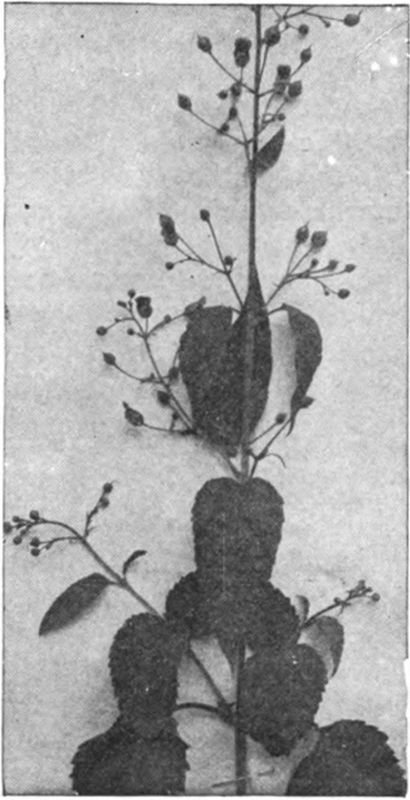
Figwort was boomed under the same of Simpson's Honey Plant.
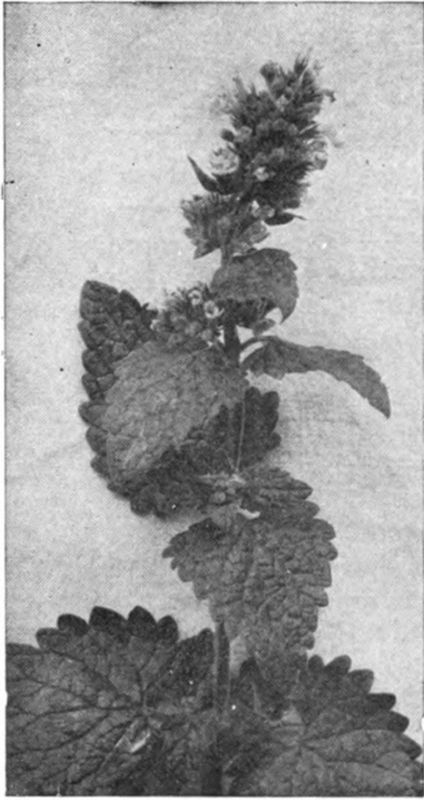
Catnip received much attention in bee magazines.
As a result of the publicity concerning it in the bee magazines, something of a boom developed. In 1882 Gleanings published two articles about raising plants for honey, one by H. A. March and the other by Dr. C. C. Miller, both of which discussed this plant at length. Interest continued for a number of years, and as long as honey plant gardens remained popular it continued to be planted.
About 1885 the globe thistle (Echinops) was introduced into this country from France. It was brought to the attention of the beekeepers by Hiram Chapman, of Versailles, New York, who planted about three acres of it. He reported in such glowing terms that the National Beekeepers' Association appointed a committee to visit his home and investigate. L. C. Root, A. I. Root, and N. W. McLain met on July 28, 1886, for the purpose of visiting the Chapman place and reported very favorably. They stated that they confidently recommended the plant as a valuable acquisition, and no doubt it would have been had there been any use to which the plant could be put with sufficient profit to assure its extensive cultivation. Like Simpson, Chapman received much publicity because of his connection with the plant for a period of several years. However, when the interest subsided the plants became known by their proper names and the acquired ones are no longer heard.
Continue to:


My Books

