


The Trade In Live Bees. Continued
Description
This section is from the book "History Of American Beekeeping", by Frank Chapman Pellett. Also available from Amazon: History Of American Beekeeping.
The Trade In Live Bees. Continued
Revival of interest came with the spread of sweet clover into the farming regions of the West. With expansion of the bee pasture came a new and imperative demand for bees, and this was all that was needed to insure a source of supply. The new interest started where it had been dropped so long before, and the pioneer shippers found themselves faced with all the problems which had confronted an earlier generation.
About 1911 an occasional line began to appear in the advertisements for queens, offering a half pound of bees. A year or two later such ads often carried a line, "Bees by the pound. "
In the April 15, 1913, issue of Gleanings, E. R. Root wrote that they had sent bees in half-pound and one-pound packages for years, but that only within the last two years had they obtained any degree of success. After failure had attended the many efforts in years past, the necessity of finding some way to ship bees without danger of spreading disease had caused them to renew their efforts in this direction. A package that called for neither combs nor honey, and which could be moved at greatly reduced cost, thus became the object sought. In that article he gave as the reasons for former failure the lack of water in hot weather and, also, the lack of suitable supports for the cluster.
The new cage was provided with narrow wood slats on which the bees could cluster, and a water supply was provided in a tin can, in the under side of which was a hole not much larger than a pin point. Food was provided in the form of queen cage candy in a small pan, turned over a small slit in the top of the cage.
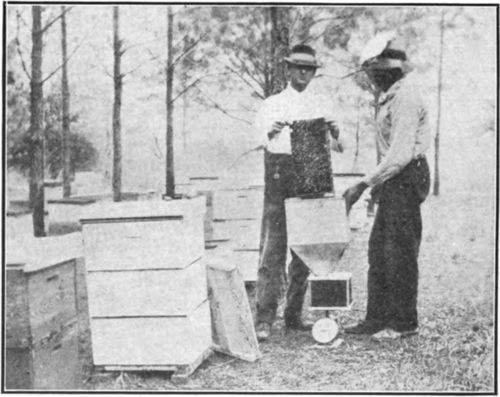
Preparing package bees for shipment in the early days of the industry.
April, 1913, appears to have marked an important milepost in the history of beekeeping. In the American Bee Journal of that month, A. B. Marchant, of Apalachicola, Florida, and D. D. Stover, of Mississippi, put forward small display advertisements offering to take orders for pound packages. It would be interesting to know whether it brought any orders. Its appearance at the time of the Root article probably was fortunate and it is likely that the article aroused interest in the offerings. The beginning of the package business appears very definitely to have dated from that time. Root's article was illustrated with a number of good pictures showing the cages with which success finally had been attained and which made it possible for any competent beekeeper to enter the field with confidence.
From this time forward the development of the package business was phenomenal. By 1917 at least a dozen concerns were shipping bees in packages in large quantities. In the spring of that year the American Bee Journal sent the writer into Mississippi, Alabama, and Georgia to visit the pioneers in the new business. For the first time the shippers were getting orders for shipments of a considerable number of packages to a single purchaser. In previous years most of the orders had been for from one to a half dozen, for fear of loss. So successfully did the shippers make deliveries in 1916 that the buyers were ready to depend upon package bees for replacement or for increase, and most of the shippers visited at that time reported record breaking orders.
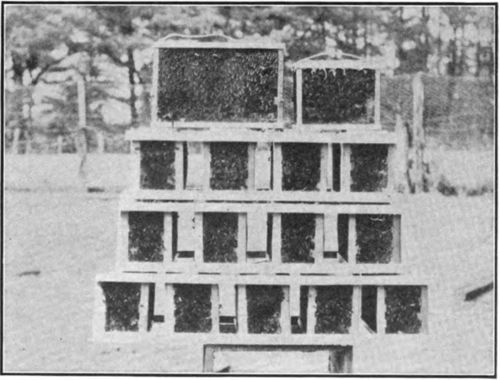
One of the early shipments of live bees in screened cages.
Soon after, the United States entered the World War and a great demand for sweets developed. The demand for package bees seemed unlimited, and the business expanded amazingly.
The development of the western Canadian provinces and the expansion of the sweet clover area in our own country offered a new and extensive market for bees which has continued to grow. The future of the package business appears to be secure, with single shippers selling as high as 15,000 packages in a single season. And the end is not yet in sight.
In order to save transportation expense, nuclei, composed of one or more frames of brood with queen, were commonly substituted for full colonies when buying bees at a distance. The shipment of nuclei continued to be the common method of meeting this need until the spread of disease made it necessary to move bees without combs or honey. When the package was perfected to the point that losses were negligible, the demand for nucei subsided and many states prohibited the shipment into their territory of bees on combs.
Until the rapid development of the sweet clover areas, the shipments of nuclei were ample to meet all demands for live bees, but the increase in demand, together with the fear of disease, soon replaced them with packages.
By far the greater part of package bees are moved by express even now, but they have been permitted to go by mail within recent years. In a letter which he wrote to Newman, then editor of the American Bee Journal, in 1889, G. M. Doolittle told of what was probably the first shipment of a package of bees by mail. A triangular wire cloth cage, eleven and a half inches in length with the sides four inches across, was sent by E. L. Pratt, of Marlboro, Massachusetts, to Doolittle. The package contained a half pound of live bees, and the package was of equal weight. Doolittle was enthusiastic about getting the bees admitted to the mails and pictured the time when northern beemen would send south in spring for bees with queens to stock their hives.
The idea, however, was not popular with the post office department and many years were destined to pass before bees in screen cages were authorized to go by mail.
Continue to:


My Books

