


Search For Controlled Mating. Part 3
Description
This section is from the book "History Of American Beekeeping", by Frank Chapman Pellett. Also available from Amazon: History Of American Beekeeping.
Search For Controlled Mating. Part 3
In 1886 Nelson W. McLain, apicultural agent of the United States Department of Agriculture, published a report in which he gave the results of his own numerous experiments. He seems to have given attention to all the proposed methods which offered any promise of success. He tried squeezing the contents of the generative organs of nymph drones upon the larvae of queens, with the result that the bees removed the larvae and destroyed the cells, as would be expected.
Later, he tried cutting an opening at the base of capped queen cells to expose the queen pupa. Through the opening he squeezed the liquid contents of the generative organs of imago drones. The opening was then closed and sealed with melted beeswax. He states: "On being hatched they resembled fecundated laying queens more than virgin queens. " Repeated experiments, however, failed to produce a queen capable of laying fecundated eggs.
His most important result came from attempts at artificial insemination. When a virgin queen was six days old, he noted that the generative organs were highly excited and much distended. On the evening of the seventh day, he placed drops of male sperm upon the open vulva as she was held back downward between the thumb and forefinger. Twelve hours later her appearance and action was that common to fertile queens. She laid in apparently normal manner, and worker bees developed. Two queens were reared from her brood, and these, in turn, were fertilized in like manner. This result seems to have been lost sight of for many years, and, when similar experiments were tried by Quinn and Watson, the public had forgotten McLain's attempts.
The following year there appeared, in the American Bee Journal, the report of his later experiments. For the purpose of holding the queen in position he made a queen clamp of a small block of wood two inches square and four inches long, in one end of which is an opening in size and shape like the upper two-thirds of a queen cell. For the purpose of insemination, he used a hypodermic syringe, removing the needle and replacing it with a nozzle with an opening the size of a knitting needle. Over this nozzle he slipped a tube drawn to a fine point, through which to force the sperm into the body of the queen. Of twenty-seven queens treated by this method, six were reported as successfully fertilized.
At the same time, he reported success with a few queens without the use of the syringe. He also described a visit to Otis N. Baldwin, of Clarksville, Missouri, who had succeeded by the same method which he had described in his report of the preceding year. Baldwin claimed that he had thus fertilized 200 queens during the season, with but few failures. The drone is mentioned as the important element in the experiment, it being difficult to ascertain whether the male is in the proper condition. Drones bursting with an abundance of seminal fluid, resembling albumen, are said to be the ones at the proper stage, which he called ripe.
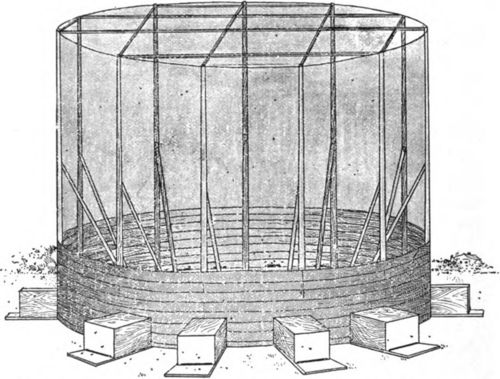
A tent of mosquito netting was built by J. S. Davitte for mating queens under controlled conditions.
McLain also obtained a few matings in a wire cloth house ten by sixteen feet, and eight feet in height, in which a colony was confined. On the whole, he secured just enough of success to offer some encouragement, but no method which brought dependable results.
The subject of controlled mating was never permitted to remain inactive for long at a time. In the February, 1901, issue of the Beekeepers' Review, J. S. Davitte, of Georgia, described an elaborate tent which he built for the purpose. He built such a tent of mosquito netting which was thirty feet in diameter and thirty feet high. The hives containing normal colonies of bees were placed against the wall of the tent on the outside. The entrance of the hive was covered with an excluder, which prevented either queens or drones from passing, but gave free movement to the workers. After the bees had become accustomed to the situation, another entrance was provided which opened inside the big tent and permitted both queens and drones to fly within the enclosure.
This is the one experiment at mating in confinement in which success was reported without serious question at the time. It would seem that such a tent so large in size should, in fact, result in success, but the number of failures in other enclosures leaves some question in the minds of students of the problem.
Davitte reported that once the drones became accustomed to the bounds of the tent, they flew rapidly, and that seldom did a virgin queen reach the top of the tent before she was overtaken by a drone and the mating accomplished. He claimed in one season to have reared about a hundred queens which were mated in this enclosure.
Even though successful, the cost of such an enclosure would make it impractical for use. Editor Hutchinson, of the Review, commented at the time on the article and indicated that he was convinced of the success of the experiment. R. F. Holterman later reported failure with a similar attempt.
On numerous occasions some enterprising beekeeper established a mating station in some isolated situation, where the hives containing the drones were carried to be released at the same time that the young queens were freed from the nuclei. An island in Georgian Bay was used by Ontario beekeepers at the time when D. A. Jones was active and, later, F. W. L. Sladen, the Dominion apiarist, carried on some similar attempts. If no other bees were present such a station would serve all purposes, but it is inconvenient and expensive to carry many queens to a distant point for mating, and nobody ever showed much enthusiasm for results obtained in isolated mating stations.
Continue to:


My Books

