


Search For Controlled Mating. Part 4
Description
This section is from the book "History Of American Beekeeping", by Frank Chapman Pellett. Also available from Amazon: History Of American Beekeeping.
Search For Controlled Mating. Part 4
In 1901, in his report of Ontario Agricultural College, Mr. Rowsome, who was a lecturer on beekeeping, reported that he had turned a big glass carboy upside down and released two virgin queens in it. As they were flying up inside the big bottle, seeking to escape, he put in about a dozen drones. As they flew upward and met the queens, mating took place. With a total of eight queens tried, he succeeded in mating seven successfully, according to this report. Although this incident was commented on by the editor of Gleanings when reported by
R. F. Holterman, it seems not to have attracted sufficient interest to be followed up by other observers.
Little more was heard about controlled mating until 1914, when Jager and Howard, in the University of Minnesota, reported a successful instrumental insemination of a queen. This was reported in Science and attracted much attention among the beekeepers. They were not able to follow their first success with much encouragement, however. In the two years that followed, Howard and France, of the same institution, tried 55 additional experiments with only three partially successful. They reported their efforts and stated their failure in the American Bee Journal, November, 1917.
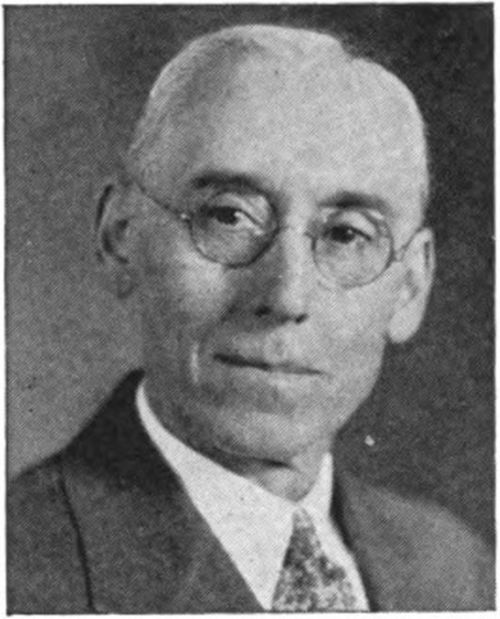
Dr. Lloyd R. Watson succeeded with controlled mating where others had failed.
In 1916 George D. Shafer of the Michigan Agricultural College, attempted to secure mating by fastening both queen and drone at the end of a fine elastic wire holder, and set to humming their wings. The holders permitted sufficient freedom to permit the insects to fly. The hope was that when they bumped together mating might take place. The attempt was a failure. He also tried to accomplish forced mating by pressure of the hands. Results likewise proved disappointing.
George H. Bishop was another worker entering this field at about the same time who failed to accomplish the results aimed at, but who did make a considerable contribution to the knowledge of the subject of fertilization of the honeybee.
In 1917, the A. I. Root Company tried some experiments by placing hives of bees in an immense greenhouse nearly six hundred feet long and sixty feet in width. A strong colony was installed on a platform about fifteen feet above ground and the bees permitted to fly at will in the big enclosure. The attempt was featured in several illustrated articles in Gleanings during the year. At first there was some show of enthusiasm as to the possibilities of success, but in the final article in the July number the editor wrote: "We have failed to accomplish mating under cover under what we believe to have been the most favorable conditions that have ever surrounded this experiment. "
In 1919, Gilbert Barratt, a well-known English beeman, attracted some attention in this country by an experiment in which he applied sperm to the surface of eggs laid in drone cells. He assumed that for a time after the egg was deposited a small aperture remained open and that active spermatozoa might enter. Barratt claimed success and some American workers, notably Lloyd Watson, attempted similar experiments in this country. Only failure was reported by Watson, although some others were less doubtful. Langstroth appears to have tried such an experiment without success.
About 1923 or '24, Charles W. Quinn offered advertising to the bee magazines, in which he claimed his queens were mated to selected drones by controlled methods. In view of the long history of failure and misplaced claims, it is not surprising that the publishers were skeptical and refused space to such claims. Some time elapsed before Quinn was able to secure recognition for his work. With the assistance of his grandson, Harry Laid-law, he secured mating by forced contact by hand. He was able to convince a number of persons of his success and, for a time, Laidlaw worked in connection with the Southern States Field Station in Louisiana. This method appears to have been used by McLain and by Otis Baldwin many years previously.
It remained for Lloyd R. Watson, of Alfred, New York, to succeed where others had failed. He reviewed the work of his predecessors and tried again the various methods of approach which they had used. After many failures, he finally was able to improve the method used by McLain to secure instrumental insemination to the point where a reasonable degree of success could be depended upon and, more important, where similar results could be obtained in the hands of others. It is needless to repeat the details of his attempts or his exact procedure. These are available in Watson's book, Controlled Mating of Queen Bees, published by the American Bee Journal.
In 1926 Watson offered a demonstration of his method at Cornell University. The world at large was frankly skeptical of his method-of any method of controlled mating-but the committee of scientific men were left no room for doubt. From that day forward controlled mating was a thing to be depended upon. Men could select the individuals from which to breed their bees, as they had long done with other animals. Watson had provided the technique and the tools. Others have repeated his work again and again, until there is no longer any question. It only remains to simplify and improve. Workers in several foreign countries, together with a number in America, are looking ahead to work in the field of breeding of bees by controlled methods. The value of the work will depend largely upon our ability to select proper breeding stock. We have yet to learn how to recognize the best individuals among the bees.
Continue to:


My Books

