


Maintenance Of Colony Balance In Requeening
Description
This section is from the book "Honey Getting", by Edward Lloyd Sechrist. Also available from Amazon: Honey Getting.
Maintenance Of Colony Balance In Requeening
In normal requeening, brood rearing slows up or ceases altogether, and a point is reached where there are no very young larvae and little production of larval food. The normal balance of the colony is not upset by any sudden removal of the queen, and the colony is ready for the young queen to begin her normal procedure of laying sparingly at first and then gradually increasing her production. This important point must be considered if requeening by any plan is to be successful.
The commercial operator cannot afford this long, normal process in the wholesale requeening of a thousand colonies. He may want to put in the new queen at the same time he removes the old one. Then, if the queens he introduces are not actively laying the colony balance may be upset. Too often this unbalance results in Supersedure of the new queen soon after she has laid a few eggs. This is because a colony conditioned to an actively laying queen often supersedes a queen that lays only sparingly, as does a queen from a cage after a journey through the mails.
If, however, the colony has become full of brood and honey, and, as a consequence, the laying rate of the old queen has been cut down; or if the honey flow is slowing up and brood rearing is on the decrease, the new queen, with her minimum egg-laying, balances the condition of the colony and Supersedure is not likely.
It should always be remembered that there are two different conditions in colonies to which queens are introduced: (1) That in which the egg-laying of the queen is at a maximum when she is removed and (2) that in which egg-laying is at a minimum.
To balance the colony condition, a queen in the same condition as the one removed should be introduced.
To avoid upsetting colony balance when an actively laying queen is to be replaced, some beekeepers have a stock of queens in nuclei in their own yards. If, however, the beekeeper lacks either time or skill to rear his own queens for the nuclei he makes, queens may be bought from his chosen breeder, introduced to these nuclei and the poor queens eliminated. Those that remain are tested queens, ready to be used when they have begun laying in the nucleus. They can be used to replace, with comparative ease, queens in full colonies that need to be eliminated because of poor work, vicious temper, or other faults; or they may be used to replace queens that are just beginning to fail and thus many a colony can be saved that would become unprofitable for honey getting if a good laying queen was not immediately available.
Usually, if that comb of the nucleus on which the queen is found is carried to the colony from which the queen is to be removed, and, as soon as the old queen has been found and killed, the young queen is placed on the comb in the exact spot from which the old queen was taken, she will, if not frightened, and if the old colony has been handled quietly and not much disturbed, go about the business of egg laying just as the old queen was doing, and will be accepted.
But sometimes the queen will be missing when the colony is next inspected and cells will be present. Why is this? Simply because the balance of the colony was upset.
As has just been stated, there are two conditions of balance in the hives; one in which the queen is laying at her maximum and the other in which her laying is at a minimum. And it is just the same with the nuclei from which queens are taken.
For safe introduction, the colony condition must balance the condition of the nucleus from which the queen is taken.
If the young queen had filled her nucleus with brood and had temporarily ceased laying eggs, she would be in no condition to take the place of a queen removed from a full colony at the peak of her laying. Supersedure should then be expected. But such a queen could be safely put into a colony which, like the nucleus, had become honey bound.
The colony balance would then be kept and there is probably no other one thing so important in safe queen introduction. Always remember that the queen must balance the colony condition. When colony and queen are in balance, introduction is safe by almost any method. If out of balance, introduction is always risky.
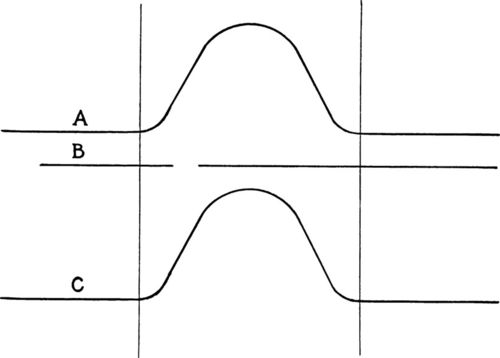
The perpendicular lines in this diagram divide the bee season into spring (left), summer or honeyflow period (center), and fall (right). A. A normal spring colony grows from one with little brood to a final maximum peak of summer brood, again to become a colony with few eggs and little brood in fall. B. A queen from a small nucleus, is like either the fall or spring colony. It seldom is in balance with the summer colony. C. A queen in a large nucleus, established early, is continuously in balance with the producing colony throughout the season. For safe introduction the condition of the nucleus from which the queen is taken must balance the condition of the colony to be requeened. Also the queen must never be inferior to the queen being replaced.
As an instance, I may cite the case of one of the most careful queen breeders I have known. He found out, by his own experience, that he could take an actively laying queen from a nucleus and introduce her into any colony in which the balance required such a queen; but if he put her into a cage and used her some days later, it was risky to introduce her into such a colony. He could, however, introduce her into a colony in which but little brood was being reared and in which, therefore, she then balanced the colony condition.
He also found that if the queen he took from a nucleus had filled her combs with brood and had reached the point of minimum egg-laying, as mentioned above, she would stand confinement better and would come back to maximum egg-laying more quickly than if caged when she was reaching the maximum rate of laying.
Then he made use of this in shipping queens to his customers, never shipping a queen until her nucleus was well filled with brood and her egg-laying at the minimum, because then, she would travel more safely, and because, usually, queens received through the mails are introduced into colonies which have been queenless for some days. Even when introduced into a colony from which a queen has just been removed, she has a good chance to be accepted because she will return to active laying condition in the shortest possible time. The queens he ships have a very low loss by Supersedure.
These principles can be used easily when only a few queens are involved, but the man who orders a hundred queens by mail and introduces them to unselected colonies faces a serious supesedure problem.
Continue to:


My Books

