


Activities Within The Hive, Division Of Labor
Description
This section is from the book "A Living From Bees", by Frank C. Pellett. Also available from Amazon: A Living From Bees.
Activities Within The Hive, Division Of Labor
Perhaps nowhere else in all the world do we find such complete and harmonious organization as among the honeybees. If there is any shirking of disagreeable duty, any rivalry for preferred position, or failure to perform a fair share of labor, the most careful observer has failed to detect it. Among social insects we find large numbers of individuals working together for a common end. They are thus able to supply a more abundant store of food, better protection against cold, and greater security from enemies.
Mankind has long recognized an ideal state where each would work for all, but human selfishness has prevented success in any large-scale attempt at socialism. Too many of us are willing to let others perform an undue share of the labor while we insist on more than a fair portion of the benefits. It thus becomes of special interest to find among insects an exemplification of the ideal toward which man is slowly and painfully working.
We look in vain for the authority which determines the order of labor and wonder how it is decided that a particular bee shall serve as a guard today while another nurses the young and a third goes afield in search of food. No duty is neglected; for every task there is a ready worker.
Although the colony, as a whole, appears to be in a fever of excitement and the busy workers come and go in apparent haste, one has only to watch individual bees for a time to see that, after all, they are working leisurely. One may work busily for a few minutes and then stop to rest and make her toilet. She alternates periods of rest and labor in such a manner that the work moves forward efficiently and even hurriedly, while individually each bee has time for a caress for a fellow worker which chances to pass by or perhaps a bit of gossip concerning the weather or the state of the colony. One cannot but wonder as to just what is passing between two workers which stop to communicate for a moment in passing. Insects live in a world apart from us. They are so wholly different that we are unable to comprehend whether they have sensations similar to ours. We cannot tell whether they have anything which serves as language or whether communication depends entirely upon the sense of touch. Perhaps they have senses of which we are not conscious and which permit of even more perfect communication than our crude sounds which so often convey impressions to our fellows quite different from that intended. Certain it is that the fifty thousand bees composing a populous colony live together in harmony and work together effectively. It is certain also that they are able to communicate to each other such facts as are necessary.
Man regards himself as the lord of the earth and the masterpiece of the Creator's handiwork, but are we really certain that the bee is not, after all, a step higher in the scale? Man is the most wasteful of living creatures. There is no waste with the honeybee.
Our fifty thousand bees work throughout the entire twenty-four hours during the height of the season when the harvest is on. Individually they may rest, while collectively they work. We find them busy with a hundred different tasks, every one of which is carried forward equally well. First we note the guards at the entrance, ever alert to detect robbers who would carry away their hard-earned store. At the door we also find the ventilators, fanning vigorously to establish air currents which are kept moving through the hive to carry out impure air and the surplus moisture from the ripening honey. At other points, also within the hive, are other fanning bees to assist with the process of ventilation, which is very thorough.
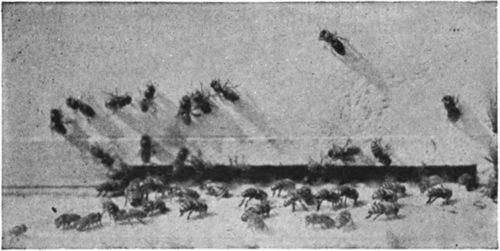
Bees fanning at entrance of the hive during honeyflow.
If we look closely, we will find house bees which take the nectar from incoming field bees and continue the evaporation necessary to convert it into honey. We will find nurse bees busy feeding the young; we will find a group surrounding the queen, feeding and caressing her that she may continue her egg laying without interruption. We will find wax workers building new combs to serve the need for storage of food for the growing community and we will find the cleaners carrying out refuse; for the bees have due regard for cleanliness and sanitation.
Man has never ceased to marvel at the efficiency with which the work is carried on and the complete harmony which seems to prevail. As nearly as we can tell, there is a progression of duty beginning with such house work as cleaning and nursing and ending with bringing in the harvest. Under normal conditions, it is probable that each worker bee takes her turn at nearly every duty connected with the hive at some time in her life. However, there must be much adjustment to meet unusual conditions and many cases where the young bees are forced to take up the duties usually performed by older ones.
We can observe their actions and take note of what they do, but the forces which direct them are beyond our knowledge; and whether or not they know anything of emotions such as ours we cannot tell.
Continue to:


My Books

