


Raising Bees Or Honey, Selling Live Bees
Description
This section is from the book "A Living From Bees", by Frank C. Pellett. Also available from Amazon: A Living From Bees.
Raising Bees Or Honey, Selling Live Bees
Raising Bees Or Honey
Not many years ago there was little to beekeeping practice except to hive the swarms and put on the supers. Management as we follow it now was unknown. Under such conditions the crops harvested were usually small, but since there was little labor and less expense in the care of the bees, the owners were easily satisfied.
If left to themselves the bees would usually swarm soon after the honeyflow started and a single colony would often make such a natural division several times during the season. Boxes or hollow logs served as hives.
In later years the observing beekeeper learned that it takes double the number of house bees to carry on colony activities in two hives than it does in one. When the bees swarm during the harvest, the number of field bees is thus correspondingly reduced by the demands of the extra household. The beeman now endeavors to make his increase at a time when it will not reduce his honey crop and he bends every energy toward getting all his colonies as strong as possible for the honeyflow.
The fact that a large number of field bees can harvest more honey than a small number is so plain that it is surprising that it took mankind so many centuries to recognize the fact. Modern beekeeping practice all centers in an attempt to build the bees up to maximum strength at the beginning of the harvest and to avoid division of the colonies until the harvest is over. The larger the number of bees in a hive, the larger the proportion of field bees among them. The old time beekeeper permitted the bees to follow their natural inclination which was to increase as fast as possible when conditions were favorable. At the end of the season, he found himself with a large number of bees and but a small crop of honey.
In the North, every natural process is speeded up because of the short season and nature concentrates into the summer period the same activities which farther south are accomplished in a longer time. Days are longer, plants grow faster, nectar is secreted more abundantly all to the end that the annual cycle may be completed within the time available from frost to frost. The farther north we go, the faster must be the pace to accomplish this result.
The large development of honey production in the Dakotas and on the western Canada prairies has been one of the surprises of recent years. In a region formerly thought to be too far north for successful beekeeping, we now find the largest annual crops of honey produced.
Selling Live Bees
Along the Gulf Coast and our southern border states, we have a mild climate and a long growing season. The bees are active throughout the greater part of the year. As a result one cycle of brood succeeds another and the bees consume the principal part of the honey harvested in continuous brood rearing. Under such conditions the beekeeper rarely harvests such crops of surplus as are gathered in the shorter and more intense season in the northern states.
Within recent years, there has grown up a business of considerable extent of selling live bees in combless packages to beekeepers in the north. The Texas beekeeper whose bees have reached swarming strength by April is in position to take away as many bees as would issue with a swarm and sell them for cash to the beekeeper up north.
The buyer of these packages of live bees in effect buys swarms. The bees are shaken from the combs into cages made of wire screen and with each cage is
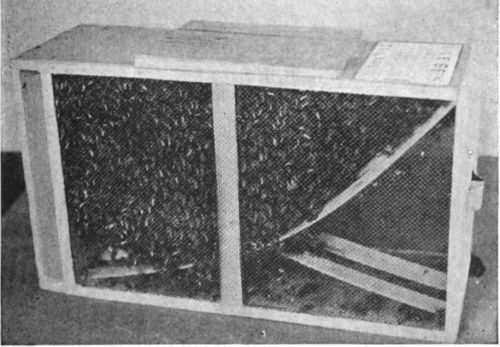
Many beekeepers in the south sell live bees in packages.
shipped a young queen, but recently mated. On arrival at the northern apiary, the package is hived. The newly hived bees behave much as a swarm would do. They begin building combs and carrying in nectar and pollen at once. The queen begins laying and a new colony is soon at work.
In all our southern states the climate is much better adapted to the rearing of bees than the production of large crops of surplus honey. Accordingly the business of rearing bees and queens has developed into a specialty of large extent. More than ten thousand packages of live bees enter Canada through Winnipeg alone each year. In becoming thus specialized, beekeeping is following the trend of other industries where a single product is turned out in large volume. There are a number of dealers in the South who now ship several thousand packages of live bees and many thousand queens to buyers in the North in a single season. Because of his more favorable situation for honey production, the northern beeman often finds it to his advantage to buy his bees and queens rather than to raise them.
There is, perhaps, no agricultural activity where a thorough understanding of the peculiarities of the locality where one operates, is more important than with beekeeping. In one location twenty colonies may be the limit that can be kept profitably in one apiary. In another because of better natural forage available, two hundred or more may be kept together. In one place the honey may all be of inferior quality, bringing but a low price in the market. In another the honey may be of the best and command top prices. As already stated, the yield in one spot may be small while it may be high in another. Yields of 200 or more pounds per hive are not uncommon in places, while an average yield of more than fifty pounds per hive is rare in many localities. One's location will thus determine whether it will be more profitable for him to specialize in the production of bees or of honey.
Continue to:


My Books

