


I. Beekeeping-Business Or Sideline
Description
This section is from the book "A Living From Bees", by Frank C. Pellett. Also available from Amazon: A Living From Bees.
I. Beekeeping-Business Or Sideline
In most localities the returns from the bees vary greatly from year to year. The uninformed, unfortunately, too often measure the probable returns from fat years rather than the lean ones. What counts with the beekeeper is the average return over a long period of time. If the average return is sufficient to provide the necessities of life with a reasonable amount of the luxuries also, then his location will justify making beekeeping a business rather than a sideline.
A friend of the author, a salaried man, kept bees quite successfully as a sideline for many years. His location was a rather uncertain one. Some years his crops were good and some years they were poor, but the ten year average was hardly sufficient to justify following honey production as an exclusive business. As a sideline, the bees paid him very well, indeed, for he sold as high as $1200 to $1500 worth of honey in a good year. This provided many luxuries and substantial savings not otherwise within reach of the family. He was a good beekeeper and his enthusiasm for the business led him to resign his position and depend entirely upon the bees. When a series of poor years came, he found it necessary to forego many comforts which he had previously regarded as necessary.
Another friend in a somewhat better location profited by the change when he decided to depend entirely upon his bees. By giving his attention to more bees, he was able to make up for the loss of income from outside labor. The bees paid for a comfortable home, provided for his family and educated his children.
There are large areas where a few hives of bees furnish a profitable sideline, which would offer scant return for a man who wished to make honey production an exclusive business. A few men have succeeded on a commercial scale in poor locations by means of careful management and widely scattered apiaries. It would seem wiser, however, in such a situation to combine honey production with some other enterprise or to move to a more favorable locality.
Under conditions when business is depressed and prices are low, large production is necessary, at low cost, to provide a satisfactory income. The beekeeper who can keep several hundred hives in one location, has a big advantage over the man who is so situated that he cannot keep more than fifty hives in one spot. The saving in travel, cost of rental of apiary sites and other running expenses necessary to operation of scattered apiaries, provides a substantial item of income.
A few men are making substantial incomes from bees, incomes that provide good homes, fine cars, send the children to college and give the family an
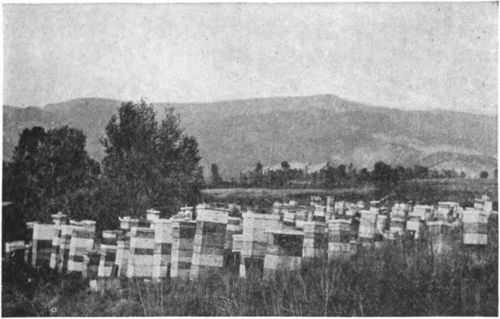
One of several apiaries owned by a beekeeper in the mountains of Colorado.
opportunity to travel. Such beekeepers are nearly all situated where some major honey producing plant is generally grown in large acreage as a farm crop. Many of them live in the alfalfa and sweet clover regions of the west.
To maintain a high standard of living requires either a large volume of production or a high price. There are few places now where the beekeeper can get a high price for his honey in normal times and it therefore becomes necessary for him to increase his output.
The business beekeeper is looking for means of reducing his cost of operation and thus increasing the net return. Better bees, better combs, labor saving equipment are all important. More honey at less cost is the object sought. The coming of sweet clover has saved the day for many a bee man in recent years since it has made possible a great increase in the output of the outfit he already had without increasing his investment or overhead. In many cases sweet clover has made possible the production of several pounds of honey where only one was produced before.
One who is so situated that he cannot keep at least one hundred hives of bees in one apiary and secure an average of at least fifty pounds of surplus honey one year with another will probably do better to make beekeeping a sideline with his principal dependence upon some other source of income. If his location will support one hundred or more colonies in one spot with an average return of 100 pounds or more of honey per year, he may very well expand the business to the point where it requires his entire attention.
Continue to:


My Books

