


Regional Differences, The South
Description
This section is from the book "A Living From Bees", by Frank C. Pellett. Also available from Amazon: A Living From Bees.
Regional Differences, The South
Regional Differences
While the fundamentals of beekeeping practice are always the same, there is a great variation in the necessary manipulations and the time of their application because of climatic differences in localities. The relative abundance and the variety of honey yielding plants as well as the time of their flowering determines the time or necessity for many activities in the apiary. Some of these things are discussed in the chapter dealing with bee pasture.
It is probable that New York has a larger number of commercial honey producers than any state. The census shows that some states have a larger number of bees but New York probably has a larger number of men who depend upon the bees for a livelihood. There are some important advantages enjoyed by beemen in this region, the greatest of which is the world's best market. Within a small area of a few hundred miles, is concentrated a population greater than is to be found in several whole states in the West.
The western beekeeper finds that the price of his product is likely to be fixed by the price at which honey is selling in New York. From his receipts he must deduct a freight rate sufficient to carry his honey to the eastern market. The New Yorker sells at his door and pockets that much additional income.
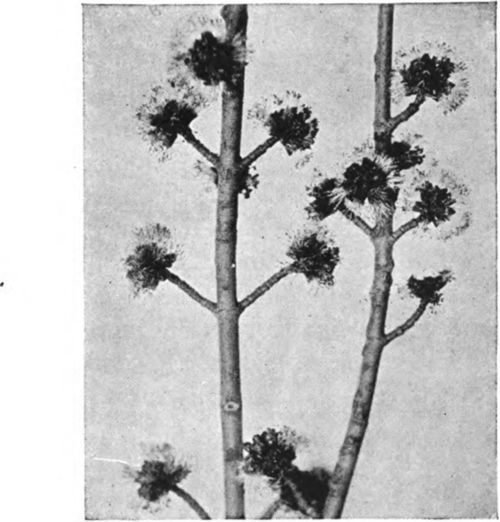
Soft maple offers first spring forage in many localities.
Again it is well known that there are few places within our borders where as many bees can be kept in one locality as it has been possible to maintain in one yard in some New York neighborhoods where buckwheat is the principal farm crop. The buckwheat region of New York is widely known because the large apiaries have given it a peculiar distinction. However, only a small part of the state is in this region. The clovers probably furnish the greater part of the honey going to market from this state. New York beemen who harvest crops from this source follow essentially the same management as is the case of the man who depends upon clover in Michigan, Indiana or Illinois since the season would be very similar.
A few beekeepers have found special opportunity with some source of limited distribution as in the case of wild thyme in the vicinity of Prattville. Local beekeepers report that in 25 years there has never been a failure from that plant with yields as high as 125 pounds per colony. Yet thyme appears to be confined principally to Delaware and surrounding counties.
The New England beekeeper enjoys market opportunities similar to those of New York yet there are few localities which favor large scale honey production. With a few notable exceptions the dependence is upon special sources of limited distribution. Where sufficient clover is available a few have done well with commercial outfits.
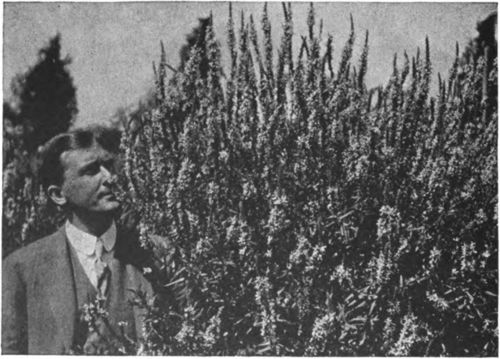
Purple loosestrife in Mohawk valley of New York.
The South
In the southeastern states most beemen depend upon wild plants or forest trees for their principal crops. Although the plants from which honey comes vary widely, the honeyflows are similar with much variation in yields from year to year. In the hill country of most of the southern states, small apiaries are the rule and conditions are favorable for the production of bees rather than honey. It is only as we approach the dry areas in Texas that we find it necessary to change the practice to meet local conditions. In order to appreciate the vast stretch of country within the state of Texas one must study the map and note something of the variety of climate within its borders. Orange, Texas is very nearly south of Des Moines, Iowa, while El Paso is farther west than Denver, Colorado. The northern limit of the state is almost as far north as Southern Kansas, while the southern point is farther south than San Diego, California. One can describe almost any condition of soil or climate with which he is familiar in any part of the United States and say with truth that it is like some section of Texas. Texas is divided into several natural divisions as far as beekeeping is concerned. Each of these divisions has a flora and season peculiar to itself.
The Rio Grande Valley has a light flow from one source or another throughout most of the year. Swarms in late December may find sufficient stores to survive the short period when no nectar is available. The valley is subject to extremes of wet and drouth and farmers depend upon irrigation to insure their crops. With brood rearing continuous throughout the year it is not surprising that surplus yields are small and many beemen regard fifty pounds per colony as a favorable return. On the other hand queen rearing can be carried on under very favorable conditions.
Continue to:


My Books

