


Bee Pasture, Major Sources Of Surplus, Some Problems In Nectar Secretion
Description
This section is from the book "A Living From Bees", by Frank C. Pellett. Also available from Amazon: A Living From Bees.
Bee Pasture, Major Sources Of Surplus, Some Problems In Nectar Secretion
Bee Pasture
The source of his bee pasture is usually a matter of indifference to the side-line beekeeper. With only a few colonies of bees he has little to worry about since there is likely to be something to provide for his small outfit. He is likely to choose his location with little regard to the amount of forage within reach. A few pounds of honey more or less from each colony is not important.
With the commercial honey producer, however, it is a very vital matter since his prosperity depends upon securing maximum crops. It is often possible to double his income by a relatively short move and he is short sighted if he fails to make a careful survey of the nectar resources of the region within reach. He needs to know every important source of both nectar and pollen, the amount of each plant within flying distance of his bees and the time of bloom.
Not only is it important to be within reach of major sources of surplus honey but it is almost equally important to be within reach of ample supplies of nectar and pollen to insure strong colonies of bees in early spring and that there will be nectar and pollen to prepare the bees for winter. Without strong colonies at the beginning of a good honey flow the beekeeper makes but poor use of his opportunity and without a good cluster of young bees at the end of the season his chances of bringing the bees through the winter in good condition are greatly reduced. The value of a location is often determined by the plants which supply forage at the season when no surplus is harvested.
With a good variety of plants to provide an ample pollen supply in early spring, the queen will soon be laying heavily and brood rearing will expand as rapidly as weather will permit. In fact brood rearing is likely to continue as long as fresh food is coming from the field and to be curtailed sharply as soon as the supply fails.
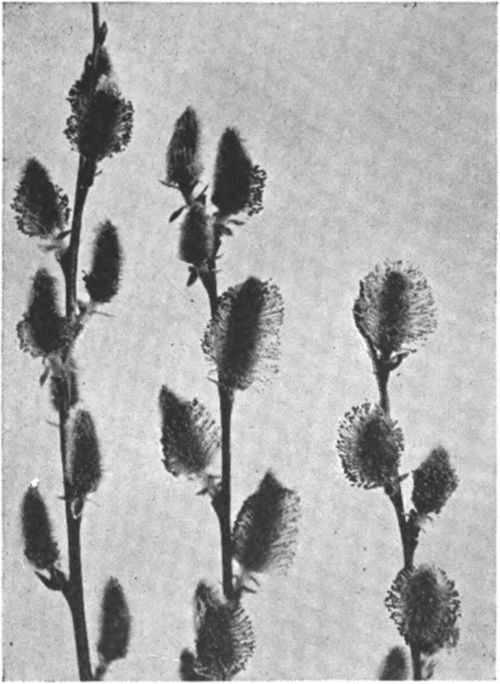
Willow is an abundant source of early pollen.
The beekeeper who is so situated that he has ample spring and fall forage and in addition has a large acreage of one or more sources of major surplus within reach is very fortunate.
Major Sources Of Surplus
Over the greater part of the United States and Canada the main honey crop comes from some cultivated crop. The beekeeper thus depends upon the crops grown by the farmers of his neighborhood. Alfalfa, sweet clover, alsike and white Dutch clover, buckwheat and cotton provide the pasture for a large portion of America's bees.
In a few important areas the surplus honey comes from wild plants such as willowherb, wild raspberry, milkweed, mesquite, basswood, horsemint or heartsease.
In addition there are many minor sources which yield surplus in limited areas. These may provide abundantly for local beekeepers and yet be but little known in the markets. An example is the wild thyme in limited areas in New York, sage in southern California, sourwood in the Carolinas and sumac in New England.
The nature and time of the honeyflows will largely determine the system of practice which the beekeeper must follow for best results. If he is located where the honeyflow is slow and comes sparingly he can hardly produce a good article of comb honey in sections. To get well finished sections requires a heavy flow.
Where the main flow comes late he may have ample time to make increase and build up the new colonies to storing strength in time for the crop. Where the flow comes early he must buy package bees to provide increase and thus with numerous other operations.
Some Problems In Nectar Secretion
It is surprising that so little attention has been given to the problems of nectar secretion. Until very recently scant notice has been paid to the variations of the honey plants under different environmental conditions. It is doubtful whether botanists have long been familiar with the fact that a plant will secrete nectar freely under certain conditions and not at all under others.
Certain plants were known to be valuable for honey production and beekeepers assumed that they would produce wherever they might be found. An example of this idea is the buckwheat which is generally grown as a farm crop in parts of New York, Ontario and surrounding territory. Because buckwheat is a good source of nectar in this region where conditions are favorable, it was once very generally planted in the Mississippi Valley by beekeepers, who expected to find it equally valuable in the Middle West, where it seldom yields to any extent. For many years I heard buckwheat recommended for planting in Iowa for the benefit of the beekeeper, yet after careful investigation in all sections of the state I found only one case where buckwheat could be credited as the source of an important yield of honey and there was some reason to doubt even the one. Bees do work on the buckwheat plant to some extent in Iowa but the results seldom show to any extent in the hives.
In central New York, buckwheat was formerly the principal source of nectar and large crops were the rule. In this region it was common to find from 200 to 400 colonies in the single yard and those who tried the experiment of dividing their apiaries into smaller number and establishing outapiaries, insisted that they did not get sufficient increase in yield to pay the extra cost of operating. In that region there is much humidity in the atmosphere and the soils are inclined to acidity. In general it may be said that where buckwheat does best, clover is not to be depended upon and where clover is a reliable yielder, buckwheat is likely to fail. There are neighborhoods, of course, where both yield nectar, for some soils are acid and on these the buckwheat will yield, and other soils are sweet and clover demands such a soil.
J. E. Crane of Vermont, wrote that in sixty years he had only two crops of buckwheat honey on clay soil. He further stated that this crop does best on light or sandy soils. Perhaps the explanation may lie in the fact that the lighter soils are more likely to be deficient in lime in his locality.
Continue to:


My Books

