


High Tide Of Summer, Ripening The Honey
Description
This section is from the book "A Living From Bees", by Frank C. Pellett. Also available from Amazon: A Living From Bees.
High Tide Of Summer, Ripening The Honey
High Tide Of Summer
If we are to judge by appearances, the bee reaches her greatest period of exultation during the honey harvest. Many an hour have I watched beside the hives at this season. The air is vibrant with the music of their wings. The very atmosphere seems to be charged with some intangible force which permeates my being and leaves me at peace with all the world. The field bees seem to be in a great hurry and dash away like children rushing to a fire. Those returning alight heavily and run into the hive as though in haste to deposit their loads. There is a great buzzing and bustling, pushing and jostling among the busy throng at the entrance of the hive. Yet there is a peculiar attitude of cordial relationship, as an incoming field bee shares the contents of her honey sac with an expectant guard, or an apparent idler greets another with a waving of the antennae.
The guards are at the gate as usual, but they lack that tense appearance of determination to be noticed when no honey is coming in and when robbers are buzzing about in an effort to slip into the hive and get away with a load of ill-gotten spoils. No robbers are to be seen now; honey is too easy to secure in the field to make banditry worth while.
From some of my hives I can remove the covers without the usual precaution of smoke and veil. I can even remove the frames and watch the bees without any show of resentment on their part. They are seemingly so intent upon the gathering and storing of the harvest that they have no other thought. Even the queen continues to move from cell to cell upon the comb which I hold in my hands and deposit her eggs with entire unconcern before my very eyes. It is as though they recognized me as a friendly visitor who wished to share in the joy of the harvest season.
We see something of the same spirit among human beings in the old-time harvest occasions, when neighbors came together to husk the corn, or thresh the wheat, while their wives prepared a bountiful dinner. There was friendly rivalry among the men as to who could handle the most grain and, in spite of tired muscles, a happy revelry among the whole group as they gathered round the well-filled table.
Ripening The Honey
In all the kingdom of nature but few creatures have learned to store up food against the day of scarcity. Millions of creatures perish miserably with cold and hunger because they have not discovered the way to provide food against the day of need and have not learned how to warm themselves against the cold. The honeybee does both, and right efficient is her housekeeping.
Both animals and birds have long hoarded nuts or grains in a well-ripened condition by simply placing them in some convenient location where they can be had as needed. Few indeed are the creatures which preserve a perishable product, seal it up in sanitary containers and defend it against marauders. It appears that the bee perfected her system of preserving long before even man himself had discovered a similar secret.
She gathers an otherwise waste product, preserves it and stores it in the waxen cells, containers which she herself builds for the purpose. Many less provident creatures envy her the store and but for her defense would rob her of the hard-earned fruits of her labor.
Let us visit her laboratory and observe, if we may, the routine of her day. Let us learn how her affairs are managed and how she prepares her store against the days when the flowers are gone and the days are cold. It will be interesting to see how she conducts herself with her fellows, how she converts the nectar into the finest sweet known, and how she is able to preserve it until the day of need, though it may be many years hence.
In the warm summer time she labors while less provident insects loiter in the sunshine. The thrifty lay up their stores during the season of abundance while idlers enjoy their leisure. In the human race it is only the foresight of the few that guards the race against disaster as a result of the prodigality of the many. Many labor under the spur of necessity, but few are willing to continue to toil when necessity has passed. It appears to be the exception, rather than the rule, to prepare for adversity in the season of prosperity. The foresight of the thrifty manufacturer provides employment for many workers, who but for him would suffer through lack of ability to provide for themselves.
But let us go back to the hive. It is summer and the honeyflow is just beginning. The field bees have been idle because there was nothing for them to find in the open. Every day scouts have gone out in search of the nectar, but little has been found. Today the flowers are beginning to yield their sweets. Now and then a field bee comes in, loaded, and drops heavily on the alighting board. She rests for an instant as though to get her breath before running excitedly into the hive. As she moves among her fellows she offers her tongue first to one and then another, as though to give them a sample of her load. Suddenly she begins a funny dancing about as though to rid herself of some clinging substance. She moves first one way and then another, all the time performing a wild dance, which attracts the attention of the idle workers near at hand. It is assumed that this dance is for the purpose of informing the inmates of the hive that vacation is over and that the harvest is now ready. One after another of the workers which approach the dancer to sample her spoils, makes a hasty toilet and departs for the fields. As each one returns she behaves in similar manner and soon the excitement of the first fielder pervades the whole hive. Whether it be a source of water to provide for the needs of the brood in early spring, of pollen to supply the need of bread, or of nectar from which the main harvest is stored, the returning scouts advertise the fact in the same manner. It is when the honey flow comes on in earnest that the great excitement begins. The finding of a source of water or pollen will start enough bees afield to supply the colony needs, but when nectar is abundant the entire working force exerts itself to the limit. The air will be filled with flying bees going and coming with their loads. The excited dancers communicate the good news to first one part of the hive and then another, until every bee feels the urge to add to the incoming store.
Instead of depositing her load of nectar directly in the cells herself, the field bee transfers it to one or more house bees. While the house bee takes over the load, she strokes the field bee with her forefeet and the antennae of both insects are in motion, one striking against the other. As soon as the load is disposed of, the field bee takes a bit of food, cleans herself, takes a short rest and then returns to the field for another load.
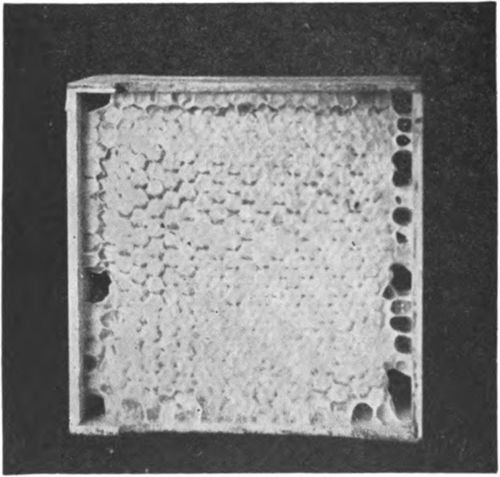
Comb honey in one pound section.
Now begins the process of ripening the raw nectar into honey. This is the house bee's job, and it goes on continually during the harvest season. Visit the hives at any hour, day or night, and listen to their humming. All is activity. Air currents are kept moving, the honey is taken from one cell and placed in another, probably in much the same way the maker of sorghum molasses moves it from one pan to another as it progresses in the boiling.
Evidently, the bees add something to the raw nectar which they bring in. Enzymes start a mild fermentation of the sugars and the process of evaporation results in a product which, under proper conditions, will keep for an indefinite period.
The house bee with her load of fresh nectar looks for an uncrowded corner where she can begin her work. She forces the nectar out upon her tongue, pushes it forward and sucks it back again and again. For several seconds she keeps it moving thus, then rests briefly and continues again for a quarter hour or more. Apparently one purpose of this movement is to concentrate the nectar by elimination of excess moisture. She then enters a cell and deposits the honey. If nectar is thin and there is plenty of storage room in the hive, she may divide her drop in several cells to secure additional surface exposure to hasten evaporation.
A further look will disclose the fanning bees, as previously mentioned, starting air currents by violent motion of their wings, which, like a series of electric fans, keeps the air moving and thus carries off the excess moisture from the ripening honey.
Such are the activities which my friend Park observed.
Continue to:


My Books

