


The Honey Harvest
Description
This section is from the book "A Living From Bees", by Frank C. Pellett. Also available from Amazon: A Living From Bees.
The Honey Harvest
Who can describe a honeyflow-outpouring of wealth? All nature is at her best; good honeyflows come at no other time. The air is balmy, the days are warm, even hot. The nights are cool, the change in temperature when the sun goes down serving to precipitate the sugar in the nectaries of the flowers. Blossoms are abundant, for only with an abundance of bloom do we find that generous outflowing of nectar which stirs the bees and their keepers alike; which sets every nerve a-tingle and creates an atmosphere of tense excitement akin to that of children at a circus or a nation at war.
There may be a long procession of blossoms from one plant or another which provide sufficient nectar and pollen for ordinary activities within the hive, yet all is outwardly calm. There may even be immense areas of white Dutch clover, buckwheat, or sweet clover in bloom without arousing undue activity. Some seasons may pass with flowers in abundance and yet no such flow occurs.
At times the flow starts suddenly. After days of quiet the bees are aroused from their apathy and such excitement prevails as is seen only when a swarm issues. Now, however, every colony in the apiary is affected. Hundreds of workers will push and jostle each other on the alighting board in their haste to depart for the fields or their eagerness to enter the hive with their loads. A loud humming is to be heard within the hive, which indicates the greatest activity. The harvest is on, wealth is pouring into the community treasury, and every individual bee is doing her utmost to save it all. There is no time for nursing the indigent, and, if perchance, a bee is injured in her flight, she is dragged from the hive or goes forth alone to die unattended.
There is only one purpose apparent in the whole community-to bring the largest possible quantity of nectar from the field and store it in the hive. At a short distance one who hears the harvest song of the busy insects is sure that swarms must be in the air. The coming of night stops field activities but the humming continues and the work inside is not stopped, for the excess moisture must be evaporated before another day's garnering begins. The house bees take the raw nectar from the cells in which it was first stored and move it from place to place, all the time keeping up a steady flow of air to carry off the water. When they need rest, others take their places. Thus the fanning and the moving go on through the long night, which to them may seem short because of the work to be done.
The nectar is thin and watery like the juice that comes from the cane before it has been made into molasses. Lacking fire, the process of boiling down the sweet must be accomplished by slower means, but it is done as well.
When large areas of nectariferous flowers thus give forth so generously, a rich harvest is possible if the bees are provided with sufficient room with good combs in which to store the incoming nectar. Whereas our fathers, with their crude straw skeps, were satisfied with thirty pounds and some excess swarms from each, our present-day apiarist, with his hives which permit indefinite expansion by the giving of additional units in the way of hive bodies or supers, gets one hundred, two hundred, or more pounds of honey from each one.
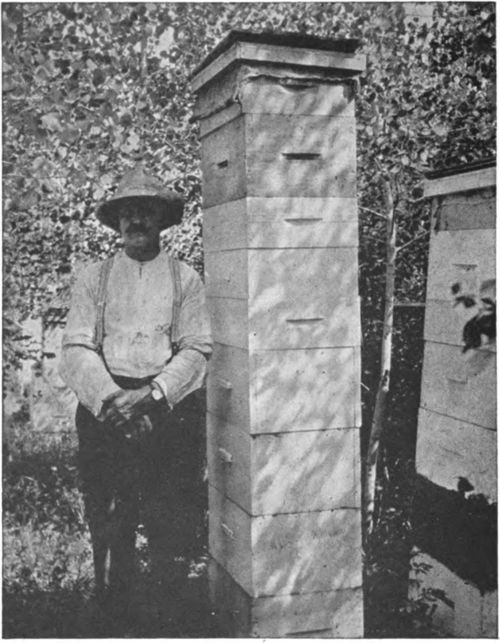
A yield of 200 or more pounds of surplus honey is not unusual in a good location.
The honeyflow, however, may stop as suddenly as it began. The time may be too short to permit a large harvest. The feverish activity may last but a few days and the take of honey be small as a result. A change in the weather-cold rain or a frost-may spoil it all. There are few localities where such generous flows come with regularity. Such a rich harvest may be succeeded by several years of indifferent crops. The man who would live from the labor of the bees must understand the vagaries of the seasons and expect that lean years will follow the fat ones. A harvest of two hundred pounds from each hive may be followed the next season by an average of only twenty, or perhaps none at all.
When such a flow is on, the beekeeper finds such joy in his labor as comes to few men. The days are long and something of the excitement of the bees overtakes him as well. At times he is fairly intoxicated by the activity which surrounds him. He must hurry to remove the ripened honey and provide new supers to care for the nectar coming in. The size of the crop will depend upon the storage room available, and he must do his best to make it ample. When a single colony of bees piles up four or five hundred pounds of ripe honey, as sometimes happens, the owner becomes an optimist. He feels as prosperous as his bees. At such times the novice feels that he must own a hundred hives of bees and the commercial beekeeper feels that not less than a thousand will satisfy him. Let the next season be a poor one and the opposite feeling is as likely to prevail. Discouragement follows enthusiasm. Beekeepers are often temperamental folks whose emotions follow the activities of the insects from whose labor they live.
Continue to:


My Books

