


Southwest Texas, Increase For Late Flows, Migratory Beekeeping
Description
This section is from the book "A Living From Bees", by Frank C. Pellett. Also available from Amazon: A Living From Bees.
Southwest Texas, Increase For Late Flows, Migratory Beekeeping
Southwest Texas
In former years this was a famous honey producing region. It was in this area that large scale beekeeping first came prominently to public attention. Many carloads of honey from huajillo, catclaw and mesquite were shipped annually from Uvalde. One great problem in this region is to time operations so as to bring the peak of brood rearing to a point in advance of the honeyflow. Since the honeyflow depends upon rainfall and time of rains is so uncertain it is impossible to tell in advance when the crop will be coming in. Conditions here are similar to those of other sections which are deficient in rainfall and will be discussed at length later in this chapter under Problems of the Desert Beekeeper.
In the cotton belt of Texas, or that part of the state where cotton is the principal source of surplus we find a more stable beekeeping. This area is largely determined by soil since cotton yields but little on sandy soils while producing regularly on heavy or waxy lands. In this region we find a prosperous general agriculture with cotton a staple crop.
Here we find the beekeeper with a serious problem to control swarming in advance of his honey-flow. With a favorable spring the bees often reach swarming strength in April, yet the honeyflow from cotton does not come until mid-June. There is ample time to make increase and to double the number of colonies in preparation for the crop should this be desired. A few beemen have solved the problem by selling the early bees in packages for the northern trade and building up again just in time for the flow.
It is in localities where the flow comes early in spring that we are likely to find the most expert beekeepers. Where there is a long season for breeding ahead of the crop, little attention is given to wintering since even a weak colony has time to recover. In areas where the crop comes early, weak colonies are of little value since they build up only when the flow is over and add little to the beekeepers income.
Such a locality is found in Virginia and Maryland and adjacent region where the tulip-poplar is the source of the crop. Tulip-poplar is a heavy yielder and strong colonies store honey very fast but the bloom comes so early that there are few strong colonies. In areas where there is no important flow later in the season it requires expert management to produce profitable crops. To get all colonies up to the point of profitable storing in time for such an early flow is evidence of a master beekeeper.
Increase For Late Flows
In the higher altitudes of Colorado, Idaho and adjacent territory much of the surplus is harvested from Alfalfa which does not start yielding until late July or August. In this area even weak colonies have ample time to build up in time for the flow and colonies of moderate strength can readily be divided and built up again to storing strength. Such divisions help to solve the problem of swarm control and give opportunity to replace winter losses or to enlarge the size of the outfit. It is common practice to winter in double hive bodies in this area and to split the colony by setting off the upper body and giving a queen to the queenless section as soon as bees become strong in spring. If no increase is wanted the two parts are reunited at the start of the main honey-flow.
Whereas the beeman who lives where the flow comes early must depend upon buying live bees in combless packages for increase, this mountain area with a late flow enables the beekeeper to avoid this expense and provide for his own needs at little cost.
Migratory Beekeeping
There are many localities where it is impossible to maintain large outfits profitably except by moving one or more times during the year. The valley of the Apalachicola River in Florida is a famous honey producing region where large apiaries are able to harvest high averages from tupelo. Shortage of pollen for the remainder of the season makes it impossible to maintain colony strength and compels moving the bees to more favorable breeding range for a portion of the year.
Many California beekeepers move their bees for the purpose of harvesting a crop from more than one source. It is common for some of the larger outfits to move three times during the year and some have moved to as many as five different locations. Such a season would start perhaps in the almond orchards. When citrus bloom opened the bees would be carried to the orange groves and from there to the seed belt. From there they might be moved again to alfalfa fields or to some other late blooming source. California offers a great variety of bee pasture in various localities and some of it is of quite limited area.
Migratory beekeeping is carried on to some extent in the mid-continent region although less extensively than in California. To move frequently involves heavy expense and is only justified by a substantial addition to the crop. The man who finds a location with ample spring and fall breeding forage combined with two sources of surplus at different times is extremely fortunate. Where the bees can be maintained throughout the year in the same location and harvest a satisfactory crop is the spot to insure a profitable enterprise.
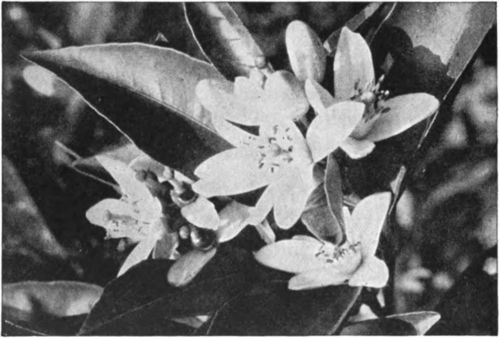
Orange blossoms are an important source of honey in California.
Every action of the beekeeper throughout the year is timed to meet the objective of securing a maximum number of bees in every hive at the start of the major honeyflow. Every locality will present peculiar problems of its own which must be recognized by the successful beekeeper. The more uncertain the honeyflow the greater the skill that is necessary to insure a harvest.
The beeman who is accustomed to the small crops harvested in north Georgia could hardly believe such yields possible as are gathered in the Dakotas or the prairie provinces of Canada. Yet greater skill is required to get an average of fifty pounds in the one than to secure two hundred to three hundred in the other.
The plains area which a generation ago was thought to be unsuited to beekeeping is now the source of the largest crops and the highest average yields. Many beemen kill their bees in the fall and replace them with live bees from the south the following spring. With drawn combs amply supplied with sealed honey and pollen the bees build up rapidly and the cost is no greater than the value of the honey which would be consumed to carry the bees through the long winter.
Continue to:


My Books

