


Problems Of The Desert Beekeeper, The Winter Problem, The Uncertain Flows
Description
This section is from the book "A Living From Bees", by Frank C. Pellett. Also available from Amazon: A Living From Bees.
Problems Of The Desert Beekeeper, The Winter Problem, The Uncertain Flows
Problems Of The Desert Beekeeper
The beekeeper who operates in the irrigated valleys finds the conditions surrounding his honey flows quite similar to those in the rain belt. With controlled moisture the time of blooming of alfalfa, sweet clover or cotton can be anticipated with some degree of confidence. The man, however, who depends upon the desert flora, finds the time of the
coming of the honeyflows very uncertain, as rainfall rather than season, is the determining factor.
Beekeepers in all that region, whether in Utah, Texas, or Arizona, describe certain problems which we of the East do not often meet. Three things are especially of great importance in those states: the conservation of bees and stores during the winter months, the building up of colony strength in anticipation of a honeyflow coming at an uncertain time, and the preservation of a supply of pollen for brood rearing at times when none is to be had from the field.
The Winter Problem
There is no part of the United States where the beekeepers do not have a serious winter problem. In the warmer portions of the Southwest, however, it is not a question of protecting the bees from cold so much as one of conservation of bees and stores at times when there is nothing to gather. In the southern portion of Texas, New Mexico, Arizona, and California, the winters are mild and there are few days when the bees do not fly. During the middle of the day the temperature rises high enough as a rule that the bees break the cluster and little honey is consumed in the generation of heat. Due to the thin atmosphere, temperatures fall rapidly after nightfall, but there is little freezing weather. The great problem, is to keep the bees quiet and prevent them from wearing themselves out with useless searching for nectar when there is none to be had. During January the bees work rather freely on mistletoe in the vicinity of San Antonio, Texas, but do not get enough of either nectar or pollen to amount to much. Such light stimulation is likely to start brood rearing at an unseasonably early time and results in the consumption of an undue proportion of their stores too long in advance of a honeyflow. In Arizona the temperatures frequently rise to 85 degrees during the afternoon, making it very comfortable in the open without a coat. Although the bees are flying freely there is nothing of importance for them to gather. An occasional creosote bush or squaw-bush is blooming and the leafless mistletoe also attracts them. There is just enough to be found to keep them active without compensating return in nectar brought to the hive.
In Texas, New Mexico, and Arizona greatest losses come in March. Several beekeepers tell the same story, that their bees apparently came through until March in good condition. With March comes the season of heavy brood rearing with much high wind. By this time most of the bees are old from the frequent winter flights and when taxed with the support of the young brood there is a heavy death rate and many colonies dwindle badly. The solution for this, of course, is plenty of young bees. How to secure the young bees at the right time without excessive brood rearing or raising bees which will wear themselves out too soon is the beekeeper's big winter problem. If brood rearing is encouraged too far ahead of the season, enormous quantities of honey will be consumed without proper returns in surplus stored.
A good windbreak or a sheltered situation pays the biggest kind of dividends, for cold winds cost the beekeeper dearly. Some of the best informed bee-men in this region venture the assertion that special protection to be applied during the spring brood rearing period would be a good investment.
The Uncertain Flows
Outside the irrigated valleys mesquite and cat-claw are the principal sources of honey. There are several other plants, which like the huajillo in Texas and the ironwood in Arizona, yield heavy crops locally but are limited in their distribution.
The time of the honeyflow is greatly influenced by the rainfall and sometimes in wet seasons there may be two or more flows from the same source at different times. Since we have not yet been able to tell very long in advance when it will rain, the beekeeper can only guess when the flow will come. The beekeepers report a variation of as much as two months in the time of the principal flow from mesquite in different seasons. There is a great difference in the condition of the bees in February in different locations. In some apiaries they are very weak and have very little reserve stores. A few men were visited who have their bees in big hives and who left a large reserve of stores with the bees. Since this proved to be an unusually dry winter with very little nectar available this was a wise provision. These bees were in good condition and, although at that time it looked as though there would be nothing much for them to do, they did in fact harvest a good crop. Mesquite bloomed extremely early and a sudden flow came in April with no previous supporting flow to enable the bees to build up. One of the men whose bees were in the big hives with liberal stores wrote that he harvested the biggest crop in five years. Others in the same locality whose bees were not in equal condition found it necessary to build up colonies on this good flow. The difference in the crop harvested in this one season will pay big returns on the investment in large hives and ample stores.
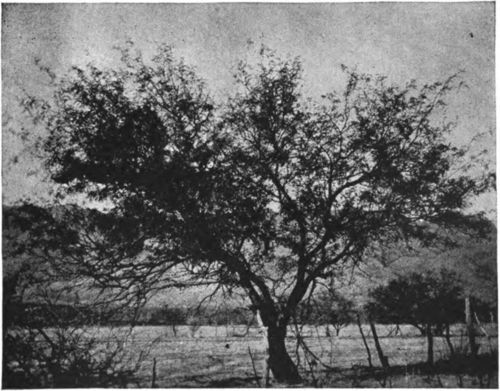
Mesquite is the source of much honey in the southwest.
A serious problem is offered by the shortage of pollen that often comes during these long dry spells. No matter how much sugar or syrup the beekeeper may feed, if there is not a natural pollen supply available, he can do but little toward building up his colonies. In 1918, in western Texas, many bees died from this cause even though their owners were doing their best to save them by feeding syrup. In such a region large numbers of combs of stored pollen would be worth a big price.
There are many good beekeepers in that region but it takes a better beekeeper to succeed under such uncertain conditions than it does in the irrigated valleys where the regularity of the blooming of the honey plants can be depended upon, or in the humid regions where pollen is always plentiful and the time of the honeyflows vary but little from year to year. We talk much about our winter problem in the north, but it appears to be a simple one compared to the winter problem of the beekeeper in the arid regions where the bees fly every day. With us, when we supply our bees with ample stores of good quality, plenty of protection and large clusters of young bees, we can very nearly depend upon their coming up to the spring honeyflow ready for business.
In the Southwest the fellow with big hives and plenty of stores in a well sheltered position is the one who is most likely to get the honey when it does come. The hive does not necessarily need to be all in one body, for two or more Langstroth bodies accomplish the same purpose when stores are available. There is always some danger, however, that the stores will be consumed in rearing brood out of season when a light flow stimulates such activity.
When the big crops do come in those dry countries, the honey comes in in a way to astonish a man who is unacquainted with the possibilities of the desert flora.
Continue to:


My Books

