


Need Of Bees In Agriculture
Description
This section is from the book "A Living From Bees", by Frank C. Pellett. Also available from Amazon: A Living From Bees.
Need Of Bees In Agriculture
Appreciation of the part of the honeybee in a prosperous agriculture is of recent development. It is but a few years since it was thought that the returns from the services of honeybees were measured by the honey they stored. In many cases the gardeners and farmers were jealous of their presence and contended that they should be prevented from visiting the fields of others than their owners. In some localities serious attempts were made to restrain the bees from vineyards, gardens, and even alfalfa fields.
The change in sentiment has come slowly and even now there are many who have little appreciation of the place which the bees fill in pollination of the flowers.
The present day trend toward intensive specialization has developed many new problems which our forefathers never knew. Devoting large areas to a single crop and, in some cases, to a single variety, is so unlike the way plants grow in a state of nature that many complications arise.
Not only is it much more difficult to control pests under such conditions, but pollination offers an acute problem also for some crops. When men first began planting specialty orchards in large blocks, there was much speculation as to why they should be unfruitful. Gradually we have come to understand something of the relationship of varieties, but new facts continue to come to light.
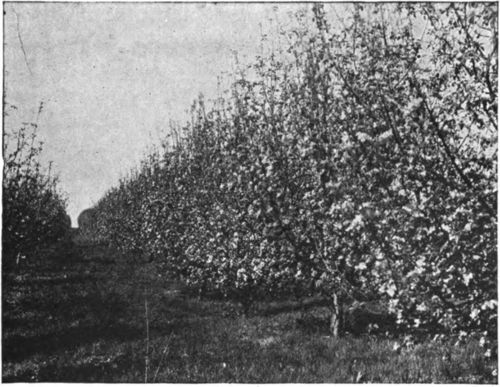
With the planting of large orchards it was found that one must also have bees to insure a heavy crop of fruit.
As an example of the importance of the honeybee to the market gardener, we find a recent study of the cucumber at the Michigan State College by H. L. Seaton and J. C. Kremer. They placed some plants in cages to exclude the honeybees from the blossoms. When these were compared with plants in the open fields which the bees visited freely, the results were surprising.
Plants in the cages beyond the reach of the bees set only about three fruits for each 1000 flowers and these were seedless. Plants in the open field which the bees visited, set fruit freely and it was noted that the bees carried sufficient pollen from one blossom to another to secure fertilization when conditions were favorable for germination.
The greater part of our economic plants can be divided into two groups in relation to their pollination. These include the cereals, which are wind pollinated; and the legumes, fruits and many of the vegetables, which depend upon insects for fertilization.
Bees have no influence upon the crops of wind pollinated plants and these secrete no nectar. Consequently, there is but little bee pasture to be found in fields of grain or grasses.
The legumes, on the other hand, require insect pollination and it is in this group that our most extensive source of honey is found. The specialization, which is so unfavorable for the bees in the case of grains, offers the finest opportunities for the beekeeper in the clover family. It is from the white Dutch clover, alsike, alfalfa and the sweet clovers, that a large part of our commercial honey comes.
In areas where these crops are grown extensively, beekeeping finds its greatest prosperity. If the clovers are grown for seed, there must be a similar expansion of beekeeping to keep pace with the acreage of the plants.
Continue to:


My Books

