


When Nectar Pails, Bee Pasture, Honeydew, Storing Fruit Juices
Description
This section is from the book "A Living From Bees", by Frank C. Pellett. Also available from Amazon: A Living From Bees.
When Nectar Pails, Bee Pasture, Honeydew, Storing Fruit Juices
When Nectar Pails
In seasons when severe drouth burns up the herbage, there is little for the bees. When no rain falls for long periods there is no pasture for the cattle because of drying of the grass nor is there forage for the bees because of failure of the flowers. If left to themselves in large cavities of hollow trees the bees would probably have a reserve store sufficient to carry them through the period of adversity, but since man keeps them in hives and removes the surplus for his own use, they are in straitened circumstances unless the beekeeper comes to their rescue with sugar syrup to meet their need.
The honeybee is a thrifty and industrious creature and strives diligently to stock her larder no matter what the condition outside. When there is no nectar in the flowers we find her seeking every source of sweet and sometimes she brings disaster on her household as a result.
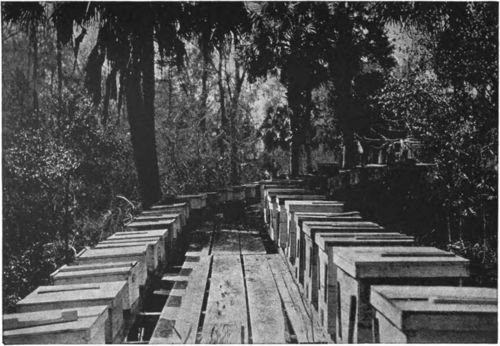
Apiary on Apalachicola River, Florida, where tupelo is main source of honey.
Bee Pasture
Honeydew
There are several sweet substances which the bees store which are not secured from the nectaries of plants and these are usually spoken of as "Honeydew. " Sometimes there are exudations of plants which can hardly be called nectar which may be designated as plant honeydew. Usually this differs but little from honey when the bees have finished with it and the quality may be good.
The main source of honeydew, however, is from insects rather than plants and the quality is usually very poor and sometimes extremely bad. Aphids, scale insects and leaf hoppers have exudations which yield this sugar in quantity. These sucking insects are often found on various kinds of trees in great numbers, feeding on the sap and at such times bees and ants gather the secretions for stores.
During dry weather the author noticed on several occasions when passing under forest trees that the bees were fairly swarming among the branches. Stopping to investigate he found them gathering the sweet liquid which the aphids had fairly sprayed over the leaves until they were dripping wet with a sticky sweet substance. At times the aphids are so abundant that the exudations drip from the leaves on the lower portions of the tree as though there had been a shower of rain. Under such conditions if there be no nectar in the fields the bees carry home the honeydew and seal it in their combs.
Most honeydew is a very inferior product and brings a low price in the market. It can only be used for some manufacturing purposes since it is not suited for table use.
There is a honeydew gathered by the bees in the vicinity of the pine forests of Central Europe that is of good quality and much in demand for table use. This honey is said to be nearly black in color and to bring a fancy price. In fact the honeydew from the pine and spruce trees is far better than that which is gathered from such deciduous trees as elms, box elders and hickories.
Storing Fruit Juices
Wherever overripe fruits are exposed after the honeyflows are over, the bees are likely to be busy seeking the juices. The honeybee because her soft mouth parts is unable to puncture the skins of sound fruit and she has often been unfairly charged with injury to grapes. The fact is that she only comes to such fruit as has already been damaged and from that she gathers the exposed juice. Grapes that have been cracked by adverse weather or whose skins have been broken by wasps or birds are freely visited.
Raisin grapes in Southern California are sometimes sucked dry by visiting bees after an unexpected rain has broken the skins of the fruit. Such incidents have led to much friction between beekeepers and fruit growers but of late there is a better understanding of the facts and most fruit men realize that the bees do not injure good fruit but only seek the moisture from those already broken open by some other agency.
In warm countries fruit juices are stored to a considerable extent by the bees and in many cases the product is regarded as very palatable. In Egypt the bees thus store the juices of damaged dates and in Arizona the juice from the fruit of the Giant Cactus is likewise gathered. Bees gathering the juice from fallen apples or pears in the orchards in late autumn after the flowers have faded is a common sight. Broken watermelons seem especially attractive to the bees since they have sweet juice in such abundant quantity.
It sometimes happens that the weather is dry and little nectar is available at the time the grain is cut in midsummer. Sometimes wheat that is cut before it is fully ripe will exude some sap. The bees gather this sap as it flows from the open stems and carry it to their hives.
Such a harvest is the result of the stress of circumstances and is only gathered because there is nothing better to be had. When there is plenty of nectar to be had in the fields the bees will pay no attention to such sources of food nor will they bother where sweets are exposed in the making of candy or molasses. If they are otherwise idle they are likely to be very annoying to one working with syrups unless he be protected behind a screen.
In warm countries where the bees can fly at any time they suffer no inconvenience from the accumulation of such stores. In the northern portion of the United States where they are confined to the hives for long periods during cold weather the result is often disastrous. Honey contains very little waste matter and bees feeding upon it can go for several weeks without a flight. These insects void their excrement only when on the wing and when they are feeding on honeydew or stored fruit juice or other food containing much waste matter they must seek frequent relief. If the weather is cold and they cannot leave the hives their bodies become swollen from the accumulated waste matter in their intestines and they die as a result.
While bees have gone far in their organized ability to avoid hunger by laying up a supply of food, to withstand cold by clustering together to generate heat and to repel enemies by combined attack, they are still subject to the vicissitudes of unfavorable weather and the failure of the natural food supply in times of dearth.
Continue to:


My Books

